Trade between South Africa and Zimbabwe is one of the most important commercial relationships in Southern Africa. Zimbabwe relies heavily on regional imports, and South Africa remains one of its most important supply partners for manufactured goods, machinery, equipment, chemicals, food products, and transport-related products.
This matters for Zimbabwean businesses importing from China because South Africa is not only a neighbouring country. It is also a practical logistics gateway.
For many Zimbabwean companies, importing from China through South Africa creates a strong advantage: goods can arrive through South African ports, move by road into Zimbabwe, and benefit from an established freight network that already operates regularly between the two countries.
Afrimart has used this route to source and deliver machinery to Zimbabwean businesses across different industries. Because Zimbabwe is close to South Africa, road freight is easier to coordinate, border movement is familiar, and after-sales support is more practical than in countries further away.
This makes Zimbabwe one of the strongest markets for Afrimart’s China sourcing and import support model.
Afrimart helps Zimbabwean businesses source, vet, coordinate, freight, clear, and plan delivery through its trusted supplier, logistics, and clearing partner network. The customer starts with Afrimart first, while Afrimart coordinates the process through the right partners.
For Zimbabwean businesses importing machinery, industrial equipment, production lines, solar products, packaging machines, agricultural equipment, construction machinery, and business goods, this creates a simpler and more reliable import experience.
Why Zimbabwe Is a Strong Market for China Sourcing
Zimbabwe has demand across many productive sectors.
Businesses in Harare, Bulawayo, Mutare, Gweru, Masvingo, Kwekwe, Chitungwiza, Victoria Falls, and other commercial centres need machinery, equipment, spare parts, and industrial products to support daily operations and business growth.
Many of these products are sourced internationally because local availability may be limited, prices may be high, or product options may be narrow.
China remains one of the most important sourcing markets because it offers:
- competitive machinery prices
- wide product variety
- flexible supplier options
- industrial equipment for different sectors
- production lines for small and medium businesses
- solar and power solutions
- agricultural machinery
- packaging and processing machines
- spare parts and accessories
- customisable product options
For Zimbabwean companies, the opportunity is clear: China gives access to products that can help businesses expand production, improve efficiency, reduce procurement costs, and enter new industries.
But the risk is also clear.
If the wrong supplier is chosen, the wrong machine is ordered, the documents are incomplete, or the freight route is poorly planned, the import can become expensive and stressful.
That is why Afrimart’s role is important.
Why the South Africa Route Works Well for Zimbabwe
Zimbabwe’s proximity to South Africa is a major advantage.
Unlike more distant landlocked countries where inland freight can become complicated, Zimbabwe has a well-established road connection with South Africa. Goods can move from South African ports or logistics hubs into Zimbabwe by road, using routes that freight operators already understand.
For many Zimbabwe-bound shipments, the practical route is:
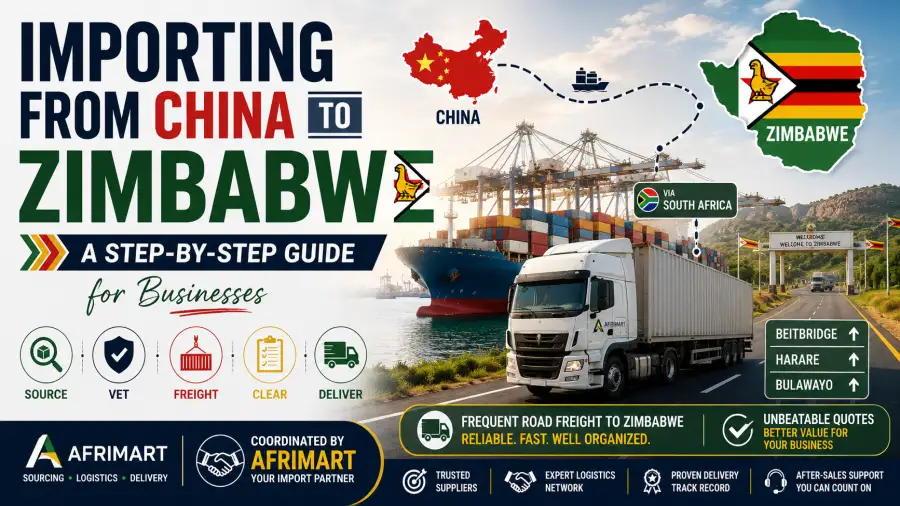
China → South Africa → Zimbabwe
This can involve goods arriving in South Africa through ports such as Durban or other logistics points, then moving by road through South Africa and across the border into Zimbabwe.
This route is especially useful for:
- machinery
- industrial equipment
- containers
- production lines
- construction machinery
- agricultural equipment
- solar systems
- packaging machines
- food processing equipment
- workshop tools
- commercial stock
Afrimart’s freight network moves goods into Zimbabwe often, which makes the route more reliable and better organised for customers.
Because Afrimart works with freight partners that already handle Zimbabwe-bound cargo, buyers can receive competitive freight quotations. In many cases, these partner quotes are more attractive because of Afrimart’s working relationship with the freight network.
This is one of the strongest reasons Zimbabwe should be treated differently from other country guides.
For Zimbabwe, Afrimart is not only helping with China sourcing. Afrimart also has practical experience coordinating deliveries into the country.
Afrimart’s Advantage for Zimbabwean Importers
Afrimart’s advantage in Zimbabwe is built on four things:
1. China-side sourcing and supplier vetting
Afrimart helps buyers find suitable suppliers, check product options, compare quotations, confirm specifications, and reduce the risk of dealing with unreliable suppliers.
2. South Africa-based freight coordination
Because Zimbabwe is close to South Africa, Afrimart can coordinate freight through its trusted logistics partner network. These partners operate the route regularly and can provide quotations for Zimbabwe-bound shipments.
3. Experience delivering machinery into Zimbabwe
Afrimart has sourced and delivered machinery to businesses in Zimbabwe across different industries. This gives Zimbabwean buyers more confidence because the process is not theoretical. Afrimart understands the type of products Zimbabwean businesses need and the practical delivery route.
4. After-sales support is easier because of proximity
After-sales support matters, especially for machinery and industrial equipment.
Because Zimbabwe is close to South Africa, Afrimart can support buyers more practically than in markets that are further away. This is important when customers need spare parts guidance, supplier communication, technical clarification, replacement parts, or follow-up support after delivery.
For machinery buyers, this proximity can make a big difference.
Step 1: Define the Product You Want to Import
The first step is to define the product clearly.
A weak product request creates problems later. A strong product request makes supplier sourcing faster, quotation comparison easier, and delivery planning more accurate.
A good product request should include:
- product name
- model or capacity
- quantity
- voltage
- dimensions
- weight
- production output
- material requirements
- packaging requirements
- spare parts requirements
- warranty expectations
- installation needs
- final delivery city in Zimbabwe
For example, if a business wants a peanut butter production line, the request should not only say “peanut butter machine.” It should mention production capacity, motor power, voltage, grinding level, packaging needs, material grade, spare parts, and whether training or installation guidance is required.
For Zimbabwean importers, this step is especially important because many imported machines are used directly in revenue-generating businesses. A wrong specification can delay production or create unnecessary cost.
Afrimart helps buyers clarify the product requirement before the sourcing process starts.
Step 2: Source and Vet the Supplier in China
Finding suppliers online is easy. Finding the right supplier is harder.
Many Chinese suppliers may offer similar products, but their quality, pricing, communication, packaging, warranty, and export experience can be very different.
Afrimart helps Zimbabwean buyers by reviewing supplier options and checking whether the product and quotation make sense.
Supplier vetting may include:
- reviewing supplier background
- checking product experience
- comparing quotations
- requesting product photos or videos
- confirming machine specifications
- checking warranty terms
- confirming spare parts availability
- checking packaging details
- confirming production time
- checking export documentation readiness
This step helps reduce risk before payment is made.
For machinery and industrial equipment, supplier vetting is not just a small detail. It is one of the most important protections for the buyer.
Step 3: Confirm Specifications Before Payment
Before paying a deposit, the buyer should confirm the product specifications in writing.
This is important for all imports, but it is critical for machinery and equipment.
Specifications to confirm include:
- model number
- capacity
- voltage and frequency
- motor power
- dimensions
- weight
- packaging size
- materials used
- spare parts list
- warranty terms
- consumables
- user manual
- installation requirements
- product certificates where applicable
- final invoice and packing details
Afrimart helps coordinate these checks with the supplier so the buyer does not depend only on a basic product photo or short quotation.
This is especially important for Zimbabwean businesses importing machinery for production, agriculture, food processing, construction, mining support, packaging, or manufacturing.
Step 4: Estimate the Landed Cost Before Shipping
The supplier’s price is not the final import cost.
A Zimbabwean buyer must budget for the full landed cost.
This may include:
- product cost
- China inland charges
- export charges
- sea freight or air freight
- cargo insurance
- South African port or handling costs
- road freight into Zimbabwe
- customs clearance costs
- customs duty
- VAT or applicable import taxes
- border charges
- final delivery costs
- offloading or installation costs where required
Afrimart helps buyers think through the cost before shipment.
This is important because a product that looks affordable at supplier level may become expensive after freight, duty, VAT, border movement, and final delivery are included.
For machinery, the landed cost should also consider after-sales needs such as spare parts, technical support, and replacement components.
Step 5: Choose the Best Route from China to Zimbabwe
For Zimbabwe, the most practical Afrimart-supported route is usually through South Africa.
The route can look like this:
China → South Africa → Zimbabwe
Goods can be shipped from China to South Africa, then moved by road into Zimbabwe through Afrimart’s logistics partner network.
This route works well because:
- South Africa has major ports and logistics infrastructure
- Zimbabwe is close to South Africa
- road freight between the two countries is well established
- Afrimart’s freight partners move goods to Zimbabwe regularly
- machinery and industrial cargo can be handled more practically
- after-sales support is easier due to proximity
For many Zimbabwean buyers, this creates a stronger route than trying to manage the full import journey alone.
Afrimart can help coordinate the shipment, freight quote, customs support, and delivery planning through its partner network.
Step 6: Road Freight from South Africa to Zimbabwe
Road freight is one of the biggest advantages for Zimbabwean importers working with Afrimart.
Because Zimbabwe and South Africa are neighbouring countries, cargo can move by truck from South Africa into Zimbabwe with relatively practical coordination.
This is useful for:
- full container loads
- less-than-container loads
- machinery
- equipment
- pallets
- spare parts
- solar equipment
- packaging machines
- construction tools
- agricultural machines
Afrimart works with freight partners who understand the Zimbabwe route and can quote for delivery.
Because of Afrimart’s partner relationships, Zimbabwean buyers may receive strong freight quotations. This is part of the value Afrimart brings: not only sourcing the goods, but helping the buyer access organised logistics through a trusted network.
For many customers, this makes the import process simpler because they do not have to search separately for suppliers, freight operators, and clearing support.
Step 7: Customs Clearance for Zimbabwe Imports
Imports into Zimbabwe must be cleared through the relevant customs process, with duties and taxes assessed according to the product category, HS code, customs value, and applicable regulations.
Common documents required for import clearance may include:
- commercial invoice
- packing list
- bill of lading or airway bill
- road freight documents
- certificate of origin, where applicable
- import permit, where required
- product certificates, where required
- customs declaration
- proof of payment or value documents
- insurance documents where applicable
Afrimart helps coordinate the documentation with suppliers, freight partners, and clearing support so that the process is prepared before the goods reach the border.
The goal is to reduce avoidable delays caused by missing documents, unclear product descriptions, wrong values, incorrect consignee details, or late permit checks.
Step 8: Check Whether an Import Permit Is Required
Not all goods require an import permit, but some products may be controlled or regulated.
Zimbabwean buyers should check permit requirements before shipping goods from China.
Products that may require special checks include:
- food products
- medicines and medical products
- chemicals
- agricultural inputs
- seeds and plants
- animal products
- electrical products
- telecoms products
- used equipment
- regulated machinery
- products requiring standards approval
- restricted or controlled goods
Afrimart helps buyers identify possible compliance questions early.
This is important because it is much easier to solve permit or document issues before cargo leaves China than after it has arrived at the border.
Step 9: Delivery to Harare, Bulawayo, Mutare, Gweru, and Other Areas
Zimbabwe has several major business centres that receive imported goods.
Common delivery destinations include:
- Harare
- Bulawayo
- Mutare
- Gweru
- Masvingo
- Kwekwe
- Chitungwiza
- Victoria Falls
- Kadoma
- Chinhoyi
- Marondera
- Zvishavane
- Bindura
- Beitbridge
Delivery planning depends on the cargo type, size, weight, route, and final destination.
For machinery and equipment, buyers should also plan for:
- truck access
- offloading equipment
- forklift or crane requirements
- installation space
- power supply
- foundation or floor preparation
- operator training
- spare parts and consumables
- after-sales communication
Afrimart helps buyers think through these issues before delivery. This is especially important for large equipment because a machine should not arrive before the receiving site is ready.
Step 10: After-Sales Support Matters
One of the biggest advantages of importing through Afrimart into Zimbabwe is after-sales support.
When a business imports machinery, the relationship does not end when the cargo arrives.
The buyer may need:
- spare parts
- supplier communication
- warranty follow-up
- technical clarification
- installation guidance
- replacement components
- user manuals
- maintenance advice
- video support from the supplier
- further sourcing for accessories or consumables
Because Zimbabwe is close to South Africa, Afrimart can support buyers more practically than in markets that are much further away.
This proximity matters.
It means that after-sales communication, spare parts coordination, and follow-up support can be handled with better speed and practicality.
For Zimbabwean businesses buying machinery, this is one of Afrimart’s strongest advantages.
Industries Afrimart Can Support in Zimbabwe
Afrimart can help Zimbabwean businesses source machinery and equipment for different industries.
These include:
Agriculture
Zimbabwe has strong agricultural activity, and businesses often need equipment such as irrigation systems, feed machines, grinding machines, oil press machines, tractors, packaging equipment, and processing machines.
Food Processing
Businesses may need peanut butter machines, milling machines, bakery equipment, drying machines, cooking equipment, sealing machines, and packaging systems.
Construction
Construction businesses may need block-making machines, mixers, compactors, scaffolding, lifting equipment, tile machines, and construction tools.
Mining Support
Mining-related businesses may need compressors, pumps, crushers, workshop tools, safety equipment, generators, and spare parts.
Manufacturing
Small and medium manufacturers may need production lines, moulding machines, packaging machines, filling machines, cutting machines, welding equipment, and factory tools.
Energy and Solar
Businesses may need solar panels, inverters, batteries, mounting structures, cables, generators, and backup power systems.
Retail and Wholesale
Retailers and wholesalers may need shelves, display equipment, packaging materials, electronics, furniture, appliances, and commercial stock.
Afrimart’s sourcing network makes it possible to compare different supplier options across these categories before the buyer commits.
Common Mistakes Zimbabwean Importers Should Avoid
Importing from China can create strong business opportunities, but mistakes can be expensive.
Common mistakes include:
1. Buying only based on the cheapest price
The cheapest supplier may not provide the best product, packaging, warranty, or after-sales support. A low price can become expensive if the product arrives damaged, incomplete, or unsuitable.
2. Not verifying the supplier
Supplier verification is important before payment. Buyers should confirm whether the supplier is reliable and whether the product matches the quotation.
3. Not confirming technical specifications
For machinery, specifications must be clear. Voltage, capacity, dimensions, materials, spare parts, and warranty terms should be confirmed before production or shipment.
4. Ignoring freight and border costs
The product cost is only one part of the landed cost. Road freight, clearance, duty, taxes, and final delivery must also be budgeted.
5. Preparing documents too late
Documents should be checked before cargo arrives. Waiting until the last minute can cause border delays and extra costs.
6. Not checking import permit requirements
Some goods may need permits or certificates. These should be checked before shipment.
7. Not planning offloading and installation
Large machinery requires site preparation. Buyers should plan forklift access, crane access, electrical connection, operator training, and installation space.
8. Importing without after-sales planning
A machine is not just a product. It may need parts, support, manuals, training, and maintenance. Buyers should think about after-sales before purchasing.
Afrimart helps reduce these risks by coordinating the sourcing, vetting, freight, clearing support, delivery planning, and after-sales communication process.
Why Use Afrimart for China-to-Zimbabwe Imports?
Afrimart gives Zimbabwean businesses a practical way to import from China with more structure, better route coordination, and stronger support.
Instead of dealing separately with overseas suppliers, freight operators, clearing agents, and transport providers, buyers can start with Afrimart.
Afrimart assists with:
- supplier sourcing
- supplier vetting
- product quotation support
- specification checks
- China-side order coordination
- supplier communication
- export documentation support
- freight coordination through partner networks
- customs clearance support through clearing partners
- road freight planning from South Africa to Zimbabwe
- delivery planning into Zimbabwe
- after-sales communication and support coordination
Afrimart has already sourced and delivered machinery to Zimbabwean businesses in different industries. This experience makes the process more practical for new buyers because Afrimart understands both the China sourcing side and the Zimbabwe delivery route.
The proximity between South Africa and Zimbabwe also makes after-sales support more realistic, especially for machinery buyers who may need spare parts, technical clarification, or supplier follow-up.
Practical Import Checklist for Zimbabwean Businesses
Before importing from China to Zimbabwe, use this checklist:
- Define the product clearly
- Confirm model, capacity, voltage, and specifications
- Check supplier reliability
- Compare quotations properly
- Confirm the Incoterm
- Estimate the full landed cost
- Check the HS code
- Confirm duty and tax expectations
- Check whether an import permit is needed
- Confirm packaging and shipping dimensions
- Choose the South Africa-to-Zimbabwe route where practical
- Get a freight quote through Afrimart’s partner network
- Prepare the commercial invoice and packing list
- Arrange cargo insurance where necessary
- Coordinate customs clearance documents
- Plan delivery into Zimbabwe
- Prepare offloading equipment if needed
- Confirm after-sales support, spare parts, and warranty communication
Afrimart can assist with each stage of this process.
Frequently Asked Questions
Can I import directly from China to Zimbabwe?
Yes. Zimbabwean businesses can import goods from China. Since Zimbabwe is landlocked, goods usually move through a regional port or logistics hub before being transported by road into Zimbabwe.
A practical route is China to South Africa, then road freight into Zimbabwe.
Why is the South Africa route useful for Zimbabwe?
South Africa is close to Zimbabwe, has strong logistics infrastructure, and has established road freight routes into Zimbabwe. Afrimart’s freight partners move goods to Zimbabwe regularly, which makes coordination easier for buyers.
Can Afrimart help with freight to Zimbabwe?
Yes. Afrimart works with freight partners who operate into Zimbabwe. Buyers can receive freight quotations through Afrimart’s partner network, and these quotations may be more competitive because of Afrimart’s existing partner relationships.
Has Afrimart delivered machinery to Zimbabwe before?
Yes. Afrimart has sourced and delivered machinery to Zimbabwean businesses across different industries. This experience supports buyers who want a more practical and coordinated import process.
Can Afrimart help with customs clearance?
Afrimart coordinates customs clearance support through clearing partners. The buyer still needs the correct documents, product details, and import information, but Afrimart helps coordinate the process through the right support network.
What products can I import from China to Zimbabwe?
Zimbabwean businesses can import machinery, construction equipment, agricultural machines, solar products, packaging machines, food processing equipment, workshop tools, spare parts, electronics, furniture, and other commercial goods, depending on import rules and product requirements.
Do I need an import permit?
It depends on the product. Some goods may require permits, certificates, or approvals before importation. Buyers should check this before shipment.
Is sea freight or air freight better?
Sea freight is usually better for machinery, bulky goods, containers, industrial equipment, and non-urgent goods. Air freight is faster but more expensive and is usually best for samples, urgent parts, small electronics, or high-value items.
Can Afrimart help after the machine is delivered?
Yes. Afrimart can help coordinate after-sales communication, supplier follow-up, spare parts sourcing, warranty support, and technical clarification where applicable. Zimbabwe’s proximity to South Africa makes this support more practical.
Final Thoughts
Importing from China to Zimbabwe is one of the most practical regional opportunities for businesses that need machinery, equipment, production lines, solar products, agricultural tools, construction equipment, and industrial supplies.
Zimbabwe’s proximity to South Africa makes the route easier to manage than many other landlocked markets. Road freight is well established, transport partners move between the two countries often, and after-sales support is more practical because of the short regional distance.
Afrimart helps Zimbabwean businesses simplify the process by combining China-side sourcing, supplier vetting, product coordination, freight partner support, customs clearance coordination, delivery planning, and after-sales support.
If your business is planning to import machinery or equipment from China to Zimbabwe, speak to Afrimart first.
Afrimart helps you source the right supplier, verify the product, coordinate the order, arrange freight through its partner network, support customs clearance, plan delivery into Zimbabwe, and stay connected after delivery.