Importing from China to Zambia can give businesses access to competitive machinery, industrial equipment, construction materials, solar products, agricultural machinery, packaging machines, vehicle parts, electronics, production lines, and other commercial goods.
For many Zambian businesses, China is one of the most important sourcing markets because it offers a wide range of products, flexible manufacturing options, and competitive pricing. But importing successfully is not only about finding a supplier online.
The real challenge is managing the full process correctly: choosing the right supplier, confirming product specifications, checking documentation, arranging shipment, estimating duties and taxes, coordinating customs clearance, and planning delivery into Zambia.
This is where Afrimart helps.
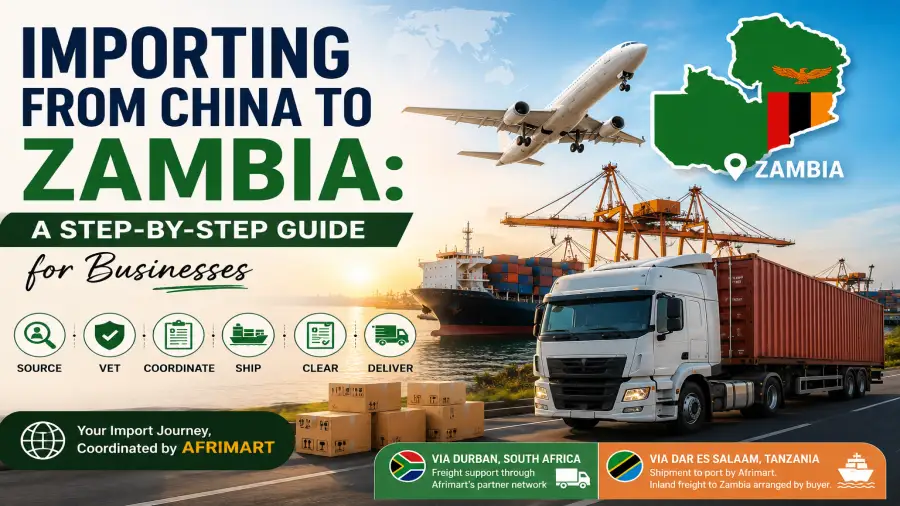
Afrimart supports Zambian businesses by coordinating the China-to-Zambia import journey from the sourcing stage. Through its sourcing team and supplier network in China, Afrimart helps buyers identify products, vet suppliers, confirm specifications, coordinate orders, and prepare shipments.
For buyers who choose to move goods through South Africa, especially via Durban, Afrimart can also coordinate freight support through its logistics partner network. Because Afrimart works with selected freight partners, buyers may receive more competitive partner quotations than they would when approaching freight providers on their own.
For buyers who prefer to use the Dar es Salaam route, Afrimart’s team in China can arrange shipment of the order to Dar es Salaam Port in Tanzania. However, freight movement from Dar es Salaam into Zambia should mainly be organized by the buyer or the buyer’s nominated transport provider. Afrimart may assist with guidance where possible, but the Dar es Salaam-to-Zambia inland freight leg is not Afrimart’s main managed freight route.
In simple terms: Afrimart helps Zambian importers start correctly from China. For the South Africa/Durban route, Afrimart can go further by connecting buyers with its trusted freight partner network.
Why Zambian Businesses Import from China
Zambia has strong demand for imported goods across mining, agriculture, construction, energy, manufacturing, retail, transport, and general trade.
Businesses in Lusaka, Ndola, Kitwe, Solwezi, Chingola, Livingstone, Kabwe, Chipata, Mufulira, and other commercial centres often need products that may not be easily available locally or may be more affordable when sourced directly from China.
Common products imported from China to Zambia include:
- industrial machinery
- mining support equipment
- construction machinery
- agricultural equipment
- irrigation systems
- solar panels, batteries, and inverters
- generators and power equipment
- packaging machines
- food processing machines
- workshop tools
- vehicle parts
- electronics
- furniture
- retail and wholesale stock
- production line equipment
- warehouse and material-handling equipment
However, importing from China requires proper planning. A product may look affordable on the supplier’s quotation, but the final landed cost can change once freight, insurance, customs duty, VAT, clearance costs, transit charges, and inland delivery are added.
That is why Zambian importers should not only ask, “How much is the product?” They should also ask, “What will it cost to bring this product safely and legally into Zambia?”
The Main Challenge Is Not Buying — It Is Coordinating the Whole Process
Many businesses can find Chinese suppliers online. The harder part is knowing whether the supplier is reliable, whether the product is correct, whether the quotation includes the right details, whether the goods can be exported correctly, and whether the shipping route makes commercial sense.
For example, a Zambian buyer importing a machine from China must consider:
- Is the supplier a real factory, trader, or reseller?
- Does the machine match the required production capacity?
- Does the voltage match Zambia’s power requirements?
- Are spare parts available?
- Is installation support needed?
- What is included in the quotation?
- What Incoterm is being used?
- What is the HS code?
- Does the product require an import permit?
- Which route is better: Durban, Dar es Salaam, Beira, Walvis Bay, or another corridor?
- Who handles the inland freight into Zambia?
- What duties, taxes, and clearance costs apply?
- What is the final landed cost?
Afrimart helps structure these questions before the buyer commits. This reduces the risk of paying for the wrong product, choosing the wrong supplier, underestimating logistics costs, or preparing documents too late.
How Afrimart Supports Zambia Importers
Afrimart helps Zambia importers by coordinating the early and most important stages of importing from China.
This includes supplier sourcing, supplier vetting, product comparison, quotation support, specification checks, order coordination, China-side communication, export documentation support, and shipment preparation.
For buyers choosing the South Africa/Durban route, Afrimart can also help connect the buyer with freight partners who can quote for the movement from port or logistics hub into Zambia. Because these are Afrimart partner relationships, buyers may receive discounted or more competitive freight quotations.
For buyers choosing the Dar es Salaam route, Afrimart’s China team can arrange shipment to Dar es Salaam Port. Once the cargo reaches Dar es Salaam, the buyer should arrange the onward freight into Zambia with their own logistics provider. Afrimart may assist with advice or coordination where possible, but buyers should understand that the Dar es Salaam inland freight leg is not Afrimart’s primary managed route.
This distinction is important because different routes require different responsibilities.
Afrimart’s main value is that it helps the buyer start correctly: source the right product, deal with the right supplier, confirm the details, prepare the order, and choose the most suitable route.
Step 1: Define the Product Clearly
The first step is to know exactly what you want to import.
A clear product request should include:
- product name
- model or capacity
- quantity
- voltage
- dimensions
- weight
- material
- intended use
- packaging requirements
- warranty expectations
- spare parts requirements
- installation requirements
- destination in Zambia
For example, if you are importing a block-making machine, it is not enough to say “block machine.” You may need to specify the type of blocks, production capacity per hour, mould sizes, power requirement, mixer requirement, pallet requirement, spare parts, and whether training or installation support is needed.
For industrial products, small specification mistakes can create big problems later. A machine may look correct in pictures, but if the voltage, capacity, dimensions, or spare parts are wrong, the buyer may face delays and extra costs after arrival.
Afrimart helps Zambian buyers clarify the product requirement before approaching suppliers or confirming an order.
Step 2: Source and Vet the Supplier in China
Supplier selection is one of the most important parts of importing.
Not every supplier online is a manufacturer. Some are traders, resellers, or small agents. That is not always bad, but the buyer must understand who they are dealing with.
Afrimart helps buyers review supplier options and compare quotations more carefully.
Supplier vetting may include:
- checking supplier background
- reviewing product experience
- comparing quotation details
- checking product photos and videos
- confirming technical specifications
- checking packaging information
- confirming warranty terms
- confirming spare parts availability
- checking export readiness
- asking for factory or product videos where needed
This stage helps reduce the risk of poor-quality products, wrong specifications, incomplete orders, or suppliers who cannot properly support export documentation.
For Zambian importers buying high-value machinery or industrial equipment, supplier vetting is not optional. It is one of the most important protections before payment is made.
Step 3: Confirm Product Specifications Before Payment
Before a deposit is paid, all important product details should be confirmed in writing.
This is especially important for machinery, solar equipment, electrical goods, processing lines, generators, packaging machines, and production equipment.
Important details to confirm include:
- model number
- machine capacity
- voltage and frequency
- dimensions
- gross and net weight
- packaging size
- spare parts list
- consumables
- installation requirements
- warranty terms
- user manual
- product certificates
- final invoice details
- final packing list details
For Zambia, voltage and technical compatibility should be checked carefully, especially for machinery and electrical products.
Afrimart helps coordinate these checks with suppliers so that the buyer does not rely only on a basic quotation or product photo.
Step 4: Estimate the Landed Cost Before Shipping
A common mistake is to focus only on the supplier’s price.
The supplier’s product price is not the final cost of importing into Zambia.
A proper landed cost estimate may include:
- product cost
- China inland transport
- export charges
- ocean freight or air freight
- cargo insurance
- destination port charges
- customs duty
- import VAT
- customs clearance costs
- transit charges
- border costs
- inland freight into Zambia
- final delivery to Lusaka, Ndola, Kitwe, Solwezi, or another destination
Zambia applies customs duty according to the HS code and product classification. Import VAT also applies to many goods, although some goods may be exempt or zero-rated depending on the category.
This means that two products with the same supplier price can have very different landed costs if their duty rates, weight, shipping method, or clearance requirements are different.
Afrimart helps buyers think through the landed cost before the shipment moves, especially for machinery and high-value goods where cost accuracy matters.
Step 5: Choose the Best Shipping Route to Zambia
Zambia is landlocked, so goods from China usually arrive through a regional port before moving inland by road or rail.
The best route depends on the buyer’s destination, cargo type, shipment size, urgency, and available freight options.
Common routes include:
- China to Durban, then freight into Zambia
- China to Dar es Salaam, then buyer-arranged freight into Zambia
- China to Beira, depending on cargo and destination
- China to Walvis Bay, in some cases
- air freight for urgent or smaller goods
Afrimart’s strongest freight support is through the South Africa/Durban route, where it can connect buyers to freight partners and help them receive a partner quotation.
For the Dar es Salaam route, Afrimart can arrange shipment from China to Dar es Salaam Port, but the inland movement from Dar es Salaam to Zambia should mainly be organized by the buyer.
China to Durban, Then Freight Into Zambia
For many Zambian buyers, the Durban route is a practical and familiar option.
Goods are shipped from China to Durban, then moved inland through South Africa and into Zambia. This route can work well for machinery, containers, industrial products, retail stock, and general commercial cargo.
Afrimart can assist buyers using this route by connecting them to its freight partner network. These partners can provide quotations for the freight movement, and because they work with Afrimart, buyers may benefit from discounted partner rates or better coordination than approaching providers independently.
This route is useful when the buyer wants a more structured process with Afrimart involved beyond sourcing and China-side coordination.
The Durban route may be suitable for:
- full container loads
- less-than-container loads
- machinery
- industrial products
- construction equipment
- packaging machines
- agricultural equipment
- solar equipment
- commercial goods destined for Lusaka, Copperbelt, or other major centres
China to Dar es Salaam, Then Buyer-Arranged Freight Into Zambia
Some Zambian buyers may prefer the Dar es Salaam route.
Afrimart’s team in China can ship the order to Dar es Salaam Port if the buyer chooses that route. This gives the buyer flexibility, especially if they already have a transporter, clearing arrangement, or preferred logistics route from Tanzania into Zambia.
However, buyers must understand that freight from Dar es Salaam to Zambia should mainly be organized by the buyer or the buyer’s nominated logistics provider.
Afrimart may help with guidance or coordination where possible, but this should not be presented as Afrimart’s standard freight-managed route.
This route may be suitable for buyers who:
- already have a logistics provider in Tanzania
- prefer using Dar es Salaam for their own business reasons
- have an established clearing or transport arrangement from Dar es Salaam
- want Afrimart to handle sourcing and China-to-Dar es Salaam shipment only
- are comfortable managing the inland freight leg into Zambia
The key point is simple: Afrimart can help ship to Dar es Salaam, but the buyer must be ready to manage the Dar es Salaam-to-Zambia freight leg.
China to Beira or Walvis Bay
Beira and Walvis Bay may also be considered in some cases, depending on the cargo type, regional freight conditions, and final Zambian destination.
These routes are not always the first option, but they may be useful when there are cost, congestion, or corridor advantages.
For most Zambian buyers, however, Durban and Dar es Salaam tend to be the main routes discussed.
Air Freight to Zambia
Air freight is suitable for urgent, small, high-value, or time-sensitive goods.
It can be used for:
- samples
- spare parts
- electronics
- urgent machine components
- small high-value products
- documents
- medical or technical items
- emergency replacement parts
Air freight is faster than sea freight, but it is usually more expensive. It is not normally the best option for large machinery, bulky goods, or heavy equipment unless urgency justifies the cost.
Afrimart can help buyers decide whether air freight or sea freight makes more sense based on the shipment size, urgency, and budget.
Step 6: Prepare the Import Documents
Correct documentation is critical when importing into Zambia.
Missing or inconsistent documents can delay clearance, increase costs, or create customs queries.
Common import documents include:
- commercial invoice
- packing list
- bill of lading or airway bill
- certificate of origin, where required
- insurance certificate
- supplier export documents
- customs declaration
- import permit, where required
- product certificates, where required
- transport documents
- clearing instructions
The product description, value, quantity, weight, consignee details, and HS code should be consistent across the documents.
Afrimart helps coordinate the document pack with the supplier and relevant parties before the cargo moves. This is important because document problems are easier to fix before the goods leave China than when they are already in transit or waiting for clearance.
Step 7: Check Whether the Product Needs an Import Permit
Not every product requires an import permit, but some goods may be controlled or regulated.
Products that may require special checks include:
- food products
- medicines and medical products
- chemicals
- agricultural inputs
- seeds and plants
- animal products
- electrical and telecoms products
- used machinery or used goods
- products subject to standards requirements
- restricted or controlled goods
Before shipping, the buyer should confirm whether the product requires approval, certification, or an import permit.
Afrimart helps buyers identify possible compliance questions early so they can avoid delays after the cargo arrives.
Step 8: Customs Clearance in Zambia
Imports into Zambia are handled through the Zambia Revenue Authority.
Customs clearance normally involves declaration of the goods, submission of supporting documents, assessment of duties and taxes, payment, possible inspection, and release of the cargo.
The process may include:
- Confirming the HS code
- Preparing the customs declaration
- Submitting the invoice, packing list, and transport documents
- Confirming customs value
- Assessing duty and VAT
- Paying required duties and taxes
- Handling inspections or customs queries if required
- Securing release of the cargo
- Arranging inland delivery
For commercial imports, the buyer should work with a competent clearing arrangement to ensure that documents, classification, and values are handled correctly.
Afrimart can help coordinate clearance support where applicable, especially when the buyer is using Afrimart’s partner-supported route.
Step 9: Understand Customs Duty and VAT
Customs duty in Zambia depends on the HS code and product category.
VAT is also generally applied to imported goods, unless the product falls under a specific exemption or zero-rated category.
This is why the landed cost should be checked before shipping.
The buyer should not assume that all goods have the same duty rate. Machinery, electronics, spare parts, raw materials, vehicles, agricultural equipment, and consumer goods may be treated differently depending on classification.
A proper landed cost estimate helps the buyer understand whether the import still makes commercial sense after freight, duty, VAT, and delivery costs are added.
Afrimart helps buyers plan around these costs before the order is finalized.
Step 10: Plan Delivery Into Zambia
Once the goods are cleared and ready for movement into Zambia, delivery planning becomes important.
Major delivery destinations include:
- Lusaka
- Ndola
- Kitwe
- Solwezi
- Chingola
- Mufulira
- Livingstone
- Kabwe
- Chipata
- Kasama
- Mongu
- Mazabuka
- Kafue
Delivery costs depend on the route, cargo size, weight, truck type, destination, and whether special handling is needed.
For large machinery, buyers should also plan for:
- site access
- offloading equipment
- forklift or crane requirements
- installation space
- power supply
- foundation or floor preparation
- technical support
- spare parts and consumables
For smaller commercial goods, buyers should still plan for warehouse receiving, stock checking, and local distribution.
Afrimart helps buyers think through delivery planning so that cargo does not arrive before the receiving site is ready.
Sea Freight vs Air Freight: Which Is Better?
The best shipping method depends on the goods being imported.
Sea Freight
Sea freight is usually best for:
- machinery
- large equipment
- construction materials
- solar equipment
- furniture
- industrial products
- production lines
- bulk goods
- non-urgent commercial stock
Sea freight can be done as a full container load or less-than-container load.
A full container load is suitable when the buyer has enough goods to fill a container or wants dedicated container space. Less-than-container load is useful when the buyer has a smaller shipment that can be consolidated with other cargo.
Air Freight
Air freight is best for:
- urgent spare parts
- samples
- small electronics
- high-value goods
- technical components
- emergency replacement items
- time-sensitive shipments
Air freight is faster but more expensive. For heavy machinery or bulky cargo, sea freight is usually more cost-effective.
Afrimart helps buyers compare options before choosing the route.
Common Mistakes Zambia Importers Should Avoid
Importing from China can be profitable, but mistakes can quickly reduce margins.
Common mistakes include:
1. Buying only because the price is low
The cheapest supplier may not offer the best product, packaging, warranty, or export support. A low price can become expensive if the product arrives damaged, incomplete, or unsuitable.
2. Not checking the supplier properly
Supplier vetting is important before payment. Buyers should confirm whether the supplier is reliable and whether the product matches the quotation.
3. Not confirming specifications
For machinery and technical products, specifications must be clear. Voltage, capacity, dimensions, spare parts, warranty, and installation requirements should be confirmed before production or shipment.
4. Ignoring the landed cost
The product price is not the final cost. Freight, insurance, customs duty, VAT, clearance costs, transit charges, and delivery must be included.
5. Choosing a route without understanding responsibility
This is especially important for Zambia.
If the buyer chooses the Durban route, Afrimart can help connect the buyer with its freight partner network.
If the buyer chooses the Dar es Salaam route, Afrimart can ship the order to Dar es Salaam Port, but the buyer should arrange the freight from Dar es Salaam to Zambia.
6. Shipping before checking import permits
Some goods may need permits, certificates, or approvals. These should be checked before the shipment leaves China.
7. Preparing documents too late
Documents should be checked before the cargo arrives. Waiting until arrival can cause delays and storage charges.
8. Not planning offloading and installation
Large machinery needs receiving preparation. The buyer may need a forklift, crane, technician, power supply, or foundation before the machine arrives.
Afrimart helps reduce these risks by coordinating the sourcing and shipment preparation process from the beginning.
Why Use Afrimart for China-to-Zambia Imports?
Afrimart gives Zambian businesses a practical way to import from China with more structure and less uncertainty.
Instead of starting alone with overseas suppliers, buyers can start with Afrimart as the sourcing and import coordination partner.
Afrimart assists with:
- supplier sourcing
- supplier vetting
- product quotation support
- specification checks
- order coordination
- China-side supplier communication
- export documentation support
- shipment preparation
- China-to-port shipping coordination
- route guidance
- freight partner quotation support for the Durban/South Africa route
- customs and delivery planning support where applicable
For buyers using the South Africa/Durban route, Afrimart can connect them with its freight partner network for a quotation. Because Afrimart already works with these partners, buyers may benefit from better pricing or more coordinated support.
For buyers using the Dar es Salaam route, Afrimart can arrange shipment from China to Dar es Salaam Port. The buyer should then organize the inland freight from Dar es Salaam to Zambia through their own transporter or nominated logistics provider.
This makes Afrimart’s role clear and practical: Afrimart helps you start correctly, source correctly, ship correctly, and choose the route that makes sense for your business.
Practical Import Checklist for Zambia Businesses
Before importing from China to Zambia, use this checklist:
- Define the product clearly
- Confirm the model, capacity, voltage, and specifications
- Check whether the supplier is reliable
- Compare quotations carefully
- Confirm the Incoterm
- Estimate the landed cost
- Check the HS code
- Confirm duty and VAT expectations
- Check whether an import permit is needed
- Confirm packaging and shipping dimensions
- Choose the best route
- Decide whether to use Durban, Dar es Salaam, Beira, or another corridor
- Confirm who is responsible for inland freight
- Prepare the commercial invoice and packing list
- Arrange cargo insurance where necessary
- Coordinate customs clearance documents
- Plan delivery into Zambia
- Prepare for offloading and installation if needed
Afrimart can assist with the sourcing, supplier vetting, order coordination, China-side shipment preparation, and route planning process.
Frequently Asked Questions
Can I import directly from China to Zambia?
Yes. Zambian businesses can import from China, but because Zambia is landlocked, goods normally arrive through a regional port before moving inland into Zambia.
Common routes include Durban, Dar es Salaam, Beira, and sometimes Walvis Bay, depending on the cargo and destination.
Can Afrimart help me import from China to Zambia?
Yes. Afrimart can help with supplier sourcing, supplier vetting, product quotation support, specification checks, order coordination, China-side communication, export documentation support, shipment preparation, and route guidance.
For the South Africa/Durban route, Afrimart can also connect buyers with its freight partner network for a quotation.
Can Afrimart ship my goods to Dar es Salaam?
Yes. If a Zambian buyer chooses the Dar es Salaam route, Afrimart’s China team can arrange shipment of the order to Dar es Salaam Port.
However, freight from Dar es Salaam to Zambia should mainly be arranged by the buyer or the buyer’s nominated logistics provider. Afrimart may provide guidance where possible, but the Dar es Salaam-to-Zambia inland freight leg is not Afrimart’s main managed freight route.
Is Durban a good route for importing from China to Zambia?
Durban can be a practical route for many Zambia-bound shipments, especially when buyers want to use Afrimart’s freight partner network through South Africa.
This route may be suitable for containers, machinery, industrial goods, solar products, packaging machines, agricultural equipment, and other commercial cargo.
Which route is better: Durban or Dar es Salaam?
It depends on the buyer’s needs.
Durban may be better when the buyer wants Afrimart to help connect them with its freight partner network for the inland movement.
Dar es Salaam may be suitable when the buyer already has their own transporter or prefers that route for business reasons. Afrimart can ship the goods to Dar es Salaam, but the buyer should arrange onward freight into Zambia.
Do I need an import permit to import goods into Zambia?
It depends on the product. Some products may require permits, certificates, or regulatory approval before importation.
Buyers should check requirements before shipment, especially for food, chemicals, medicines, agricultural inputs, used goods, electrical products, and regulated items.
What costs should I budget for?
You should budget for the product cost, China inland charges, freight, insurance, customs duty, VAT, clearance costs, transit charges, border costs, and final delivery into Zambia.
For machinery, you should also budget for offloading, installation, spare parts, and technical support where needed.
Is air freight better than sea freight?
Air freight is faster but more expensive. It is suitable for urgent, small, or high-value goods. Sea freight is usually better for machinery, large equipment, bulk goods, and non-urgent commercial stock.
Can Afrimart deliver to Lusaka, Ndola, Kitwe, or Solwezi?
Afrimart can help with route planning and, where applicable, connect buyers with freight support through its partner network, especially for the South Africa/Durban route.
Delivery options depend on the route, cargo size, cargo weight, final destination, and available logistics arrangements.
Final Thoughts
Importing from China to Zambia can be a strong opportunity for businesses in mining, agriculture, construction, energy, manufacturing, retail, and industrial supply.
But success depends on planning.
The supplier must be checked. The product must be specified correctly. The route must be chosen carefully. The documents must be prepared properly. Duties, VAT, permits, freight, and delivery costs must be understood before the shipment moves.
Afrimart helps Zambia businesses simplify the process by supporting supplier sourcing, supplier vetting, product checks, order coordination, China-side communication, export documentation support, and route planning.
For buyers using the Durban/South Africa route, Afrimart can connect them with its trusted freight partner network for a quotation, with possible partner-rate advantages.
For buyers using the Dar es Salaam route, Afrimart can ship the order to Dar es Salaam Port, while the buyer arranges the freight from Dar es Salaam into Zambia.
If your business is planning to import from China to Zambia, speak to Afrimart first.
Afrimart helps you source the right supplier, verify product details, coordinate the order, prepare shipment from China, and choose a practical route into Zambia.