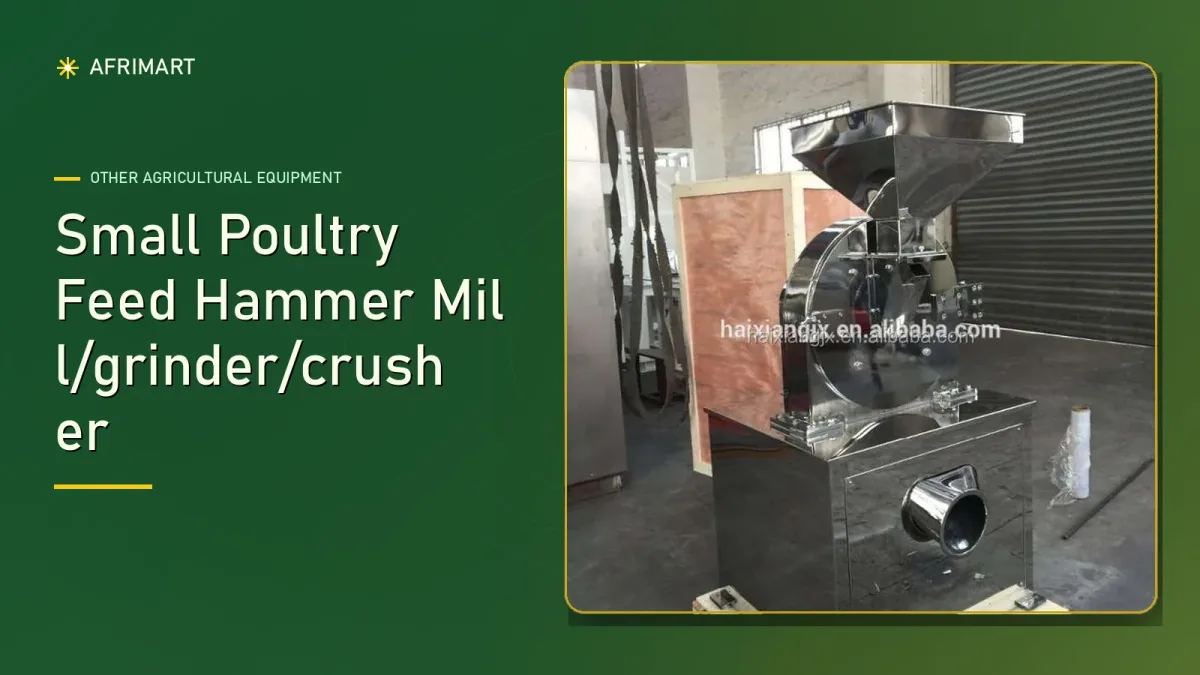
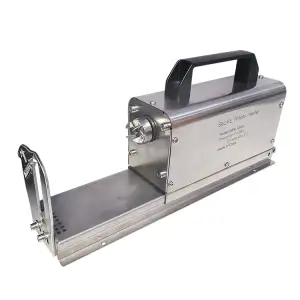







































































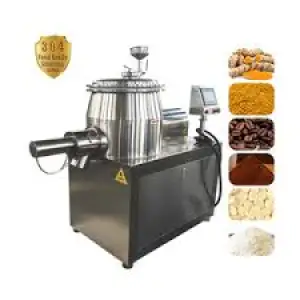

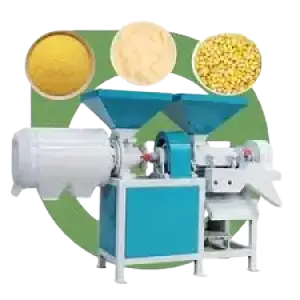
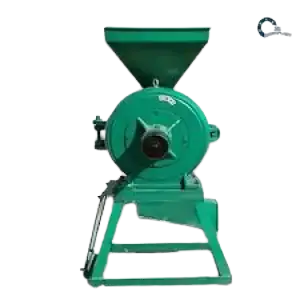












































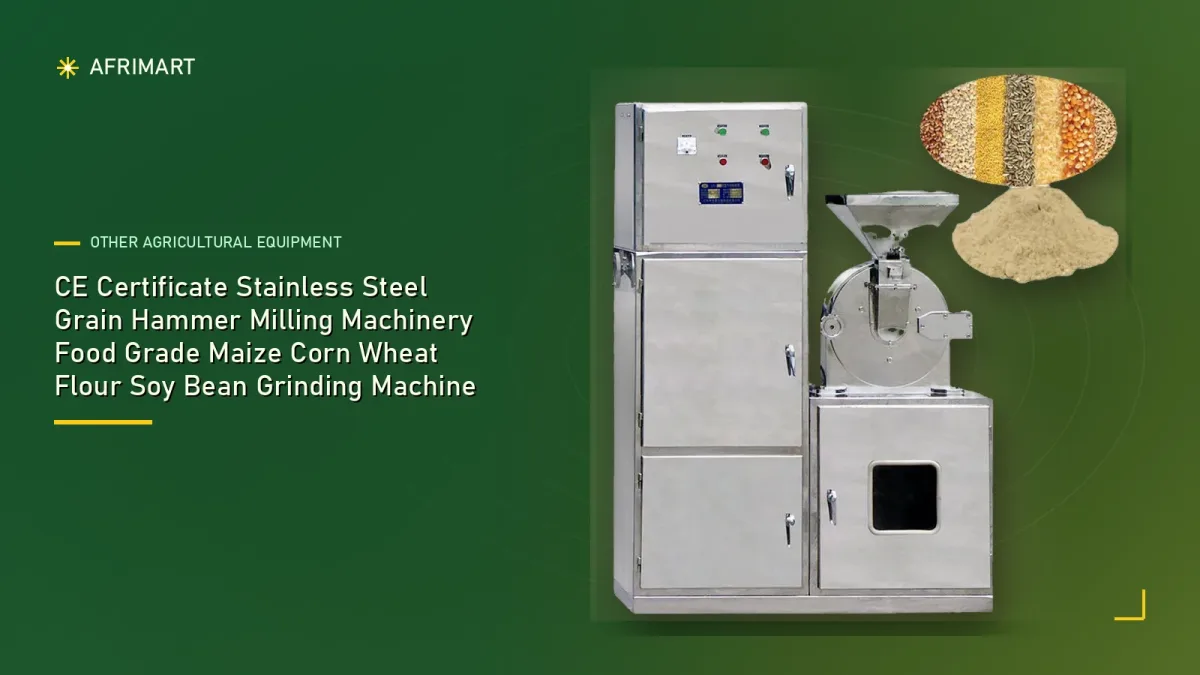
The CE Certificate Stainless Steel Grain Hammer Milling Machinery is a food-grade grinder designed to mill maize, corn, wheat, soy beans and other grains into flour or powder. It is suited to food processors, plant operators and industrial buyers who need stainless steel construction, button-press control and a verified output range of 30 to 300 kg/h.
At a glance
Best suited to: Food processing plants and chemical processing operations requiring fine powder grinding
Input material: Grains including maize, corn, wheat and soy beans, with 1–10 mm feeding size
Final product: Flour or powder at 12–120 mesh (0.125–1.7 mm)
Control system: Button press control
Rated capacity: 30–300 kg/h
Motor power: 5.5 kW
What is CE Certificate Stainless Steel Grain Hammer Milling Machinery Food Grade Maize Corn Wheat Flour Soy Bean Grinding Machine?
This machine is a grinder mill, also described as a miller, built to reduce grain inputs into finer flour or powder for food processing and chemical processing. In practical terms, it takes prepared feed material within a stated particle size range, processes it at high spindle speed, and discharges a finer output in the specified mesh range.
It is important to define what this equipment does not do. It is a grinding machine, not a complete grain cleaning, drying, roasting or packaging line. Buyers should not assume that upstream preparation or downstream handling equipment is included simply because the grinder can produce flour or powder.
The verified construction is one of its strongest purchasing points. The machine is made from SUS304 and SUS316L stainless steel, both widely used stainless steel grades in processing environments. The named core components are the bearing and motor, and the published control method is button press operation. Afrimart also lists CE certification, a machinery test report and an outgoing inspection video as part of the product information.
How does CE Certificate Stainless Steel Grain Hammer Milling Machinery Food Grade Maize Corn Wheat Flour Soy Bean Grinding Machine work?
This grinder works by feeding prepared material into a high-speed milling chamber where mechanical impact reduces the particle size. Based on the published product information, buyers can understand the process in the following stages:
Material preparation: Input material such as maize, corn, wheat or soy beans is prepared to a feeding size of 1–10 mm. This matters because the listed feed range indicates the machine is intended for already sized material rather than large whole bulk inputs.
Feeding into the mill: The prepared material is introduced into the grinder mill for processing. The source names button press control, so the operator starts and manages the machine through a simple push-button control method.
High-speed grinding: The spindle runs at 3600–3800 r.p.m. (revolutions per minute). At this speed, the machine is designed to break down the feed material into smaller particles suitable for flour or powder applications.
Particle size reduction: The machine produces an output size of 12–120 mesh, equivalent to 0.125–1.7 mm. This output range allows buyers to target coarser powder or finer flour depending on the selected operating arrangement.
Product discharge: The finished ground material exits as flour or powder for use in food or chemical processing. The rated output capacity is 30–300 kg/h, though the listing does not state which materials or settings correspond to the lower and upper ends of that range, so buyers should request that clarification for their intended product.
The product page does not specify whether hoppers, cyclones, sieving assemblies, dust collection, feeding systems or discharge conveyors are supplied with the machine. Buyers should confirm the complete equipment scope and accessory list before ordering.
What materials or products can it process?
The verified product information supports grain grinding applications for maize, corn, wheat, soy beans and other grains. It also states that the machine is suitable for chemicals processing and food processing, which indicates it can be used where a fine powder output is required, subject to suitability of the exact material.
| Input requirement | Verified value |
|---|---|
| Material type | Maize, corn, wheat, soy beans and other grains |
| Application | Food processing; chemicals processing |
| Feeding size | 1–10 mm |
The listing does not state acceptable moisture content, oil content, temperature condition of the feed, or which chemical products are appropriate for this configuration. Buyers should confirm these material characteristics with Afrimart because they directly affect throughput, achievable fineness, cleaning requirements and wear on the grinding chamber.
Where is CE Certificate Stainless Steel Grain Hammer Milling Machinery Food Grade Maize Corn Wheat Flour Soy Bean Grinding Machine used?
Maize flour production: This machine is suitable for processors turning maize into flour for food applications. The stated 30–300 kg/h output range makes it relevant to smaller production units as well as operations needing a compact mill for batch or support processing.
Corn milling for food ingredients: Corn grinding is a verified application on the product page. Buyers producing meal or powder for packaged foods can use the 12–120 mesh output range to discuss the required final fineness with Afrimart before purchase.
Wheat grinding for bakery supply: Wheat milling is one of the named uses. For bakery-focused processors, the machine can serve as a flour grinder where stainless steel product-contact construction is important for hygiene-focused processing environments.
Soy bean grinding for food products: Soy beans are specifically listed as compatible input material. That makes the machine relevant to processors making soy-based ingredients, powdered mixes or intermediate products that require reduction to a controlled powder size.
Food processing plants of different sizes: The product description states that it works well in food processing plants of all sizes. In practice, its broad voltage options from 110V to 415V and moderate 5.5 kW power rating can help buyers match the machine to available electrical infrastructure.
Chemical powder preparation: The machine is also listed for chemicals processing. Here, the relevance is the ability to reduce input material into a finer powder range, but buyers should check compatibility carefully because the source does not identify the chemical materials, corrosion conditions or cleaning protocol for those duties.
Pilot production and product development: A grinder with a published 30–300 kg/h capacity can be suitable where processors need production flexibility rather than a very high-capacity line. For pilot-scale or developing product lines, the mesh range offers useful flexibility when testing flour or powder grades.
Local value-addition projects: Across African markets, grain grinding equipment supports local processing closer to the source of agricultural raw material. This matters for businesses aiming to move from raw commodity handling into packaged or intermediate processed products using maize, wheat, corn or soy inputs.
Technical specifications
The following specifications are verified from Afrimart’s published listing for Afrimart SKU 1600353613590.
| Specification | Verified value | Buyer note |
|---|---|---|
| Brand reference | Afrimart SKU 1600353613590 | Quote this SKU in enquiries to help Afrimart identify the exact listing. |
| Product name | CE Certificate Stainless Steel Grain Hammer Milling Machinery Food Grade Maize Corn Wheat Flour Soy Bean Grinding Machine | Use the full product name in technical and commercial correspondence where needed. |
| Product type | Grinder Mill / Miller | Confirms this is a grinding unit, not a complete processing line. |
| Application | Chemicals Processing, Food Processing | Buyers should confirm the exact intended material for either duty before ordering. |
| Voltage | 110V / 220V / 380V / 400V / 415V | Confirm the selected voltage and phase arrangement for the destination site. |
| Power | 5.5 kW | Check compatibility with available power supply, starter arrangement and protection devices. |
| Material | SUS304, SUS316L | SUS means stainless steel; buyers should confirm where each grade is used on the machine. |
| Output capacity | 30–300 kg/h | Request the expected capacity for your actual material and target fineness. |
| Feeding size | 1–10 mm | Input preparation may be needed if raw material arrives outside this range. |
| Output size | 12–120 mesh (0.125–1.7 mm) | Confirm which screens or settings are needed to achieve your target flour grade. |
| Spindle speed | 3600–3800 r.p.m | r.p.m means revolutions per minute; actual operating speed should match the supplied motor and configuration. |
| Core components | Bearing, Motor | Ask for the detailed component list if you need a spares plan before purchase. |
| Control | Button Press | Suitable for straightforward operation; buyers should confirm whether any protection or interlocks are included. |
| Dimensions (L×W×H) | 1300 × 700 × 1700 mm | Use these as equipment dimensions and request a layout drawing for installation planning. |
| Weight | 350 kg | The listing does not state whether this is net or gross weight, so confirm for rigging and transport planning. |
| Package | Wooden Case | Relevant for shipping protection and receiving procedures at site. |
| Warranty | 1 Year | Confirm warranty scope, exclusions and the process for claiming replacement parts. |
| MOQ | 1 Set | MOQ means minimum order quantity; suitable for single-machine procurement. |
Specifications may vary according to configuration and must be confirmed in Afrimart’s current written quotation.
What are the main operational benefits?
Stainless steel construction for hygienic processing: The verified SUS304 and SUS316L construction supports use in food-grade environments and can also suit certain chemical processing duties. For buyers, this means easier alignment with cleanliness requirements than painted mild-steel alternatives.
Wide output range for different production needs: The published 30–300 kg/h capacity range means the machine can support lower-volume processing or higher throughputs within one product family. Buyers still need to confirm where their material will fall within that range, but the published envelope is commercially useful.
Flexible product fineness: The stated output size of 12–120 mesh, or 0.125–1.7 mm, gives a clear indication of the fineness range the machine is designed to achieve. That helps procurement teams compare the machine to the flour or powder specification required by their process.
Adaptable electrical options: The listed voltages of 110V, 220V, 380V, 400V and 415V can make the equipment easier to adapt across different sites. This is particularly useful in African markets where industrial power standards and available infrastructure differ by country and facility type.
Compact industrial footprint: With dimensions of 1300 × 700 × 1700 mm, the unit may be easier to place in existing processing rooms than a larger milling line. Buyers should still request an installation drawing, but the published size supports early layout planning.
Straightforward operation: Button press control is a simple and familiar operating method. For many processing plants, this can reduce operating complexity compared with systems that require advanced automation integration.
Documented inspection support: The listing states that a machinery test report and outgoing inspection video are included. For remote buyers, that can improve pre-shipment confidence and help internal teams review the machine before delivery.
Why does this equipment matter for African industry?
Grain and powder processing equipment matters in Africa because value addition often starts with practical, mid-scale machinery that can turn raw agricultural output into a marketable food ingredient. A stainless steel grain hammer milling machine supports that step by enabling local conversion of maize, corn, wheat and soy beans into flour or powder rather than moving all material as unprocessed bulk commodity.
This is relevant across a wide range of African markets, although not always for the same reason. In some locations, smaller processors need compact, single-machine installations that fit limited factory space and modest power availability. In others, larger processors may use such a machine as part of a wider line for specialised ingredients, secondary grinding or support production.
The machine’s voltage range is particularly relevant in a continent with diverse electrical systems and mixed levels of industrial infrastructure. A buyer in one market may be planning for 415V industrial service, while another may need a different configured voltage for a smaller facility. The published options make that conversation easier at quotation stage.
There is also a broader industrial point. Equipment like this can contribute to local processing capacity, help develop downstream food manufacturing and support regional supply chains built around locally available crops. Where soy, maize, wheat or corn are already produced or traded, adding grinding capacity may help businesses move into flour, powder blends or intermediate ingredients closer to the end market.
That does not remove the need for proper specification. Capacity, feed condition and final particle requirements still need to be matched carefully. But for businesses focused on agricultural processing, light manufacturing and practical import substitution, this category of machine is directly relevant.
What should buyers confirm before ordering?
- Required throughput in kg/h for the actual product
- Target final fineness within 12–120 mesh
- Input material type: maize, corn, wheat, soy bean or other grain
- Actual feed size and any pre-crushing requirement
- Moisture condition of the feed material
- Whether the duty is food processing or chemicals processing
- Selected machine voltage from 110V, 220V, 380V, 400V or 415V
- Site power quality and motor protection requirements
- Full equipment dimensions versus available floor space
- Lifting, unloading and internal handling for a 350 kg machine
- Inlet and outlet arrangement for the planned workflow
- Whether hopper, discharge system or dust control are included
- Cleaning requirements between product changeovers
- Stainless steel grade location for product-contact surfaces
- Required spare parts for bearing and motor support
- Warranty scope for the stated 1-year period
- Packaging and shipping expectations for the wooden case
- Installation support and commissioning scope
- Operator training requirements
- Availability of online technical support after delivery
- Machinery test report and outgoing inspection video in the order file
- Applicable local electrical and workplace safety requirements
The most consequential unstated figure for many buyers is where their actual material will sit within the wide 30–300 kg/h capacity range. To resolve that, request a written quotation that states expected throughput for your named input material and target output mesh.
How to source CE Certificate Stainless Steel Grain Hammer Milling Machinery Food Grade Maize Corn Wheat Flour Soy Bean Grinding Machine through Afrimart
Afrimart can help buyers confirm the correct machine configuration and prepare a quotation matched to the intended process. This matters because throughput, voltage selection and the accessory scope all need to align with the actual product and site.
When requesting a quotation, provide:
- Required capacity
- Intended application
- Input materials
- Project location and country
- Available utilities
- Required accessories
- Installation and training requirements
- Target project date
If your procurement process requires direct email submission, you can also send the same project details to [email protected].
Frequently asked questions
What is this stainless steel grain hammer milling machinery used for?
It is used for grinding grains such as maize, corn, wheat and soy beans into flour or powder. The published applications are food processing and chemicals processing, so the machine is intended for operations that need controlled size reduction rather than whole-line cleaning, drying or packaging.
What capacity does this grain grinding machine offer?
The verified output capacity is 30–300 kg/h. That is a broad range, so buyers should not assume they will automatically achieve the upper figure. Actual throughput will depend on the input material and the required output size, which is why a written quotation should match capacity to the intended duty.
What input size and output size does the machine support?
The machine is listed with a feeding size of 1–10 mm and an output size of 12–120 mesh, equivalent to 0.125–1.7 mm. This means the feed should already be prepared within that size range, and the final product can be selected within a fine flour or powder range.
Is this machine suitable for food-grade processing?
Yes, it is presented as a food-grade grinding machine and is made from SUS304 and SUS316L stainless steel. Those are stainless steel construction grades commonly used in processing equipment. Buyers should still confirm where each grade is used, especially on product-contact surfaces, before final approval.
What power supply does the machine require?
The listed voltages are 110V, 220V, 380V, 400V and 415V, with a power rating of 5.5 kW. Buyers should confirm the exact voltage configuration required for their site, along with local electrical standards, phase arrangement and any protection equipment needed for safe installation.
Does Afrimart’s listing include all accessories needed for operation?
The listing confirms the grinder itself, core components such as the bearing and motor, and button press control, but it does not fully define all auxiliary equipment. Buyers should ask Afrimart to confirm whether items such as feeding assemblies, discharge arrangements or dust-handling accessories are included in the quoted scope.
What should I check before installing this hammer milling machine?
Start with space, power and handling. The published dimensions are 1300 × 700 × 1700 mm and the listed weight is 350 kg, so buyers should plan floor space, access routes and unloading equipment. It is also wise to request a layout or dimensional drawing before preparing the installation area.
How do I request a quotation for this grain grinding machine?
Use the Afrimart product page and submit the main project details: required capacity, input material, application, site country, available voltage, accessories needed and your target delivery or installation date. Giving these details early helps Afrimart prepare a more accurate written quotation for the correct configuration.
Sources and technical review
- Afrimart product page: https://afrimart.co.za/product/ce-certificate-stainless-steel-grain-hammer-milling-machinery-food-grade-maize-corn-wheat-flour-soy-bean-grinding-machine
- European Commission, CE marking overview: https://single-market-economy.ec.europa.eu/single-market/ce-marking_en