













































































































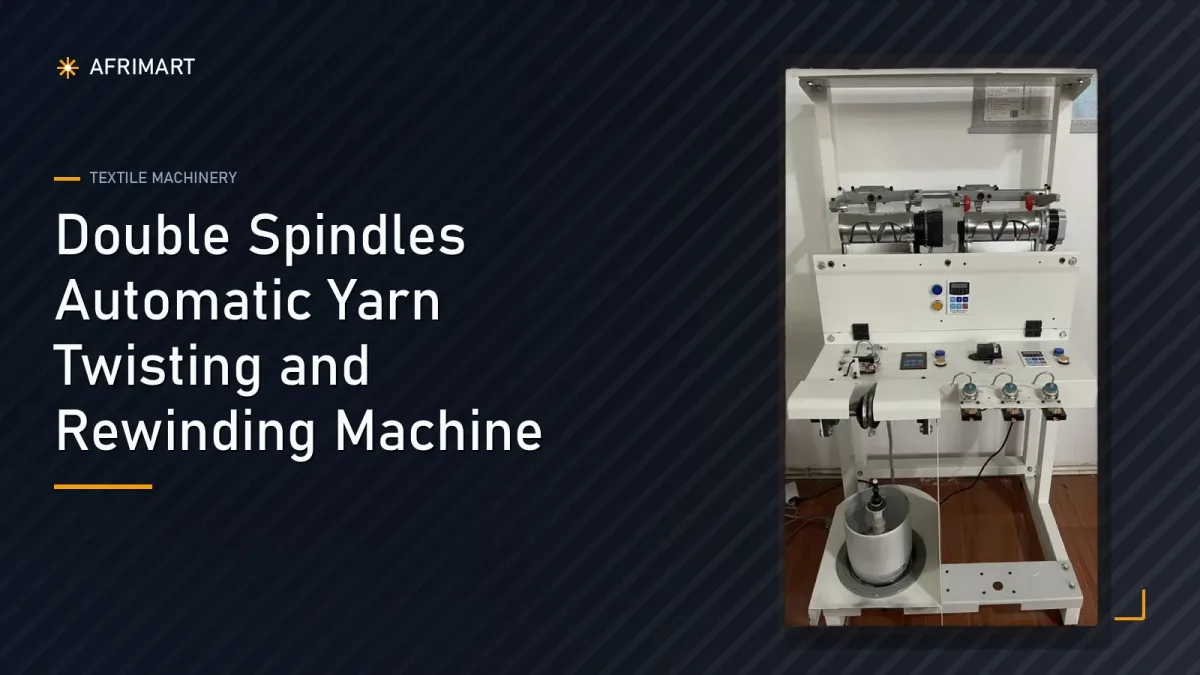
The Double Spindles Automatic Yarn Twisting and Rewinding Machine is an automatic textile machine designed to twist and rewind yarn using two spindles at the same time. It is intended for small and medium yarn-processing operations that need repeatable winding performance, with a verified production capacity of 100~1200 meters/minutes on 220V power and 60W consumption.
At a glance
Best suited to: Small and medium yarn twisting and rewinding jobs
Final product: Twisted and rewound yarn on 5" (170mm) cone bobbins
Operating mode: Automatic
Rated capacity: 100~1200 meters/minutes
Motor power: 60W
Bobbin type: 5" (170mm) Cone
What is Double Spindles Automatic Yarn Twisting and Rewinding Machine?
The Double Spindles Automatic Yarn Twisting and Rewinding Machine is a dual-head yarn-processing unit that twists yarn and rewinds it onto cone bobbins. In practical terms, it helps operators convert yarn from an incoming package into a twisted, rewound output package suitable for further handling, storage or downstream textile processing.
This machine is for yarn handling and package preparation. It does not manufacture yarn fibre, spin raw fibre into yarn, or carry out unrelated textile operations such as weaving, knitting or dyeing. Buyers assessing line fit should view it as a dedicated twisting and rewinding machine rather than a complete yarn-production system.
The verified construction and component information published by Afrimart is concise. The machine’s core components are listed as an engine and motor, and its operating mode is automatic. The product page does not state the frame material, enclosure material or a named electronic controller, so buyers who need those details for maintenance planning or plant standardisation should request the current machine layout and component list from Afrimart before ordering.
How does Double Spindles Automatic Yarn Twisting and Rewinding Machine work?
It works by feeding yarn through an automatic dual-spindle twisting and rewinding process, then building the output onto cone bobbins. Based on the verified product information, the operating sequence can be understood as follows:
Yarn is loaded for processing.
The operator prepares the yarn for winding and twisting on the machine’s two working spindles. Because the machine is described as a double head yarn twisting and rewinding machine, two yarn positions can be processed in parallel.
Automatic twisting and rewinding begins.
Once the cycle is started, the machine automatically performs the twisting and rewinding function. Its automatic grade indicates that the core winding process is designed for automated operation rather than manual hand-twisting.
Dual spindles process yarn simultaneously.
The two-spindle arrangement allows two winding heads to run at the same time. For buyers, this matters because dual-head processing can support smoother workflow in small and medium operations where one operator may need to manage more than one package position at once.
Speed is set within the published production range.
The machine’s verified production capacity is 100~1200 meters/minutes. This published range indicates that the equipment supports both lower-speed and higher-speed winding conditions, depending on the yarn and the selected operating setting.
Output is formed on 5" (170mm) cone bobbins.
The verified bobbin type is a 5" (170mm) cone. The rewound yarn is therefore built onto that cone format, which is an important packaging and downstream handling point for buyers integrating the machine into an existing yarn room.
Saved settings can support repeat runs.
The machine is listed with memory capacity of 1-500. This indicates that the equipment can retain multiple settings or programmes, which may help operators repeat similar jobs more consistently across batches.
The published listing does not specify the supplied yarn creel, tensioning arrangement, yarn guide system, cutter, package doffing method or any optional accessories. Buyers should confirm the complete machine configuration, supplied attachments and standard accessories in Afrimart’s written quotation before purchase.
Where is Double Spindles Automatic Yarn Twisting and Rewinding Machine used?
This machine is used wherever yarn must be twisted and rewound into manageable cone packages for the next production or commercial step. Its published capacity range and dual-spindle arrangement make it especially relevant to operations that need flexible, compact yarn handling rather than a large integrated mill line.
Small textile workshops: Small production units often need a machine that can improve consistency without requiring large installed power. This machine’s 220V supply and 60W power figure may suit smaller premises that want automated yarn handling with modest electrical demand.
Medium yarn-processing businesses: Medium-scale operators handling regular but varied orders may benefit from the two-head configuration and the 1-500 memory capacity. That combination can support recurring jobs where similar winding parameters are used repeatedly.
Yarn preparation for knitting and weaving support operations: Businesses that supply prepared yarn packages to knitting, weaving or other downstream textile processes can use a twisting and rewinding machine to standardise package presentation. The 5" (170mm) cone format is a key consideration where a downstream process expects that package style.
Contract yarn service providers: Some businesses process yarn on behalf of other manufacturers, brands or garment units. For this type of contractor, a dual-spindle automatic machine can help handle mixed short runs and repeated customer specifications more smoothly than manual methods.
Sample development and short-run production: Product developers and textile SMEs often need to prepare limited batches for testing, sampling or pilot production. A machine with a wide stated production range of 100~1200 meters/minutes can be relevant where both slower trial work and faster routine runs are needed.
Educational and training environments: Textile training centres, technical institutes and practical skills programmes may require compact machines that demonstrate industrial yarn handling principles. Automatic operation and video technical support can be useful where operators are still building practical experience.
Value-added yarn packaging businesses: Some enterprises focus on preparing yarn for resale, redistribution or conversion into branded textile inputs. Rewinding onto a defined cone bobbin helps create more uniform packages for handling, stock control and dispatch.
Multi-product textile rooms with limited floor space: The published machine dimensions are 404050 cm, while the single package size is 78X78X160 cm. Because those figures are both relevant but serve different purposes, buyers planning compact installations should confirm the operating footprint and clearance needs before layout approval.
Technical specifications
The following verified specifications relate to the Double Spindles Automatic Yarn Twisting and Rewinding Machine available through Afrimart under the published listing.
| Specification | Verified value | Buyer note |
|---|---|---|
| Brand | Arrow Star | Useful reference when comparing spare parts, manuals and support documents. |
| Afrimart SKU | 1600458996908 | Quote this SKU in enquiries to reduce specification ambiguity. |
| Product name | Double Spindles Automatic Yarn Twisting and Rewinding Machine | Use the exact product name in tender or RFQ documentation. |
| Product type | Double Head Yarn Twisting and Rewinding Machine | Confirms dual-head configuration rather than a single-spindle unit. |
| Function | Winding Yarn | The listing names winding yarn as the machine function; buyers should confirm the exact twist control method required for their yarn. |
| Automatic grade | Automatic | Indicates automated operation, but the listing does not define which adjustments remain manual. |
| Voltage | 220V | Confirm local power compatibility, plug type, frequency and any transformer requirement for the destination country. |
| Power | 60W | Useful for electrical load planning; confirm whether this figure covers the complete machine under working load. |
| Core components | Engine, Motor | Ask for the full component list if your maintenance team needs bearings, drives, controls or consumable references. |
| Production capacity | 100~1200 meters/minutes | This is the key performance figure; buyers should confirm the actual working speed for their yarn type and package requirement. |
| Memory capacity | 1-500 | Confirm what is stored in memory, such as job settings, length data or other run parameters. |
| Bobbin type | 5" (170mm) Cone | Verify compatibility with your current yarn package standards and downstream handling equipment. |
| Weight | 170 kg | The listing does not state whether this is net machine weight or shipping weight, so request confirmation for lifting and floor planning. |
| Dimensions (LWH) | 404050 cm | Because this figure is compact relative to the package size, buyers should request dimensional drawings to confirm the true installed footprint. |
| Single package size | 78X78X160 cm | This is packaging size, not operating size; use it for freight and access planning only. |
| Machinery test report | Provided | Request the current test report as part of technical due diligence before order placement. |
| Video outgoing-inspection | Provided | Useful for remote approval; ask whether the inspection video will cover the exact machine supplied. |
| After service | Video Technical Support, Online Support | Clarify support hours, language, response times and scope of troubleshooting. |
| Warranty | 1 Year | Ask for the written warranty terms, start date and exclusions. |
| After warranty service | Free Replacement Parts & Online Technical Support | Buyers should confirm duration, which parts are covered and whether freight for replacement parts is included. |
| Selling units | Single Item | Relevant for procurement and shipping documentation. |
Specifications may vary according to configuration and must be confirmed in Afrimart’s current written quotation before order placement.
What are the main operational benefits?
Parallel processing from two spindles: The verified double-spindle, double-head arrangement means two yarn positions can run at the same time. For small and medium operations, that can support better operator utilisation than a single-head machine.
Flexible running speed: The published production capacity of 100~1200 meters/minutes gives buyers a wide stated operating range. This can help plants that need one machine to cover slower handling of certain yarn jobs and faster routine rewinding where appropriate.
Low published power figure: The machine is listed at 60W on 220V power. For workshops and smaller factories watching electrical loading, that modest published power requirement may simplify utility planning compared with larger textile equipment.
Automatic operation for repeat work: The automatic grade indicates that the machine is designed to reduce manual intervention in the core process. In practice, this can help make routine yarn twisting and rewinding more controlled than purely manual handling methods.
Stored settings support: A memory capacity of 1-500 is a practical feature for businesses that repeat the same yarn jobs. Saved settings can help reduce setup inconsistency between production runs, particularly where multiple operators share the equipment.
Defined output package format: The verified 5" (170mm) cone bobbin type gives buyers a clear output package reference. This matters because downstream storage, dispatch and textile processing often depend on package format consistency as much as on winding speed.
Documented inspection and support: The listing states that a machinery test report and video outgoing-inspection are provided, together with video technical support and online support. For cross-border African procurement, documented pre-shipment checks and remote technical support can be valuable where the machine will operate far from the point of supply.
Why does this equipment matter for African industry?
Yarn preparation equipment matters because many African textile businesses operate between two pressures at once: they need better process consistency, but they also need machinery that is practical for the scale and infrastructure of their specific plant. A compact automatic yarn twisting and rewinding machine fits that middle ground.
Across Africa, textile activity ranges from small apparel-linked workshops to medium industrial processors serving domestic and regional markets. In these settings, value addition often happens step by step rather than through one fully integrated mill. A machine that twists and rewinds yarn can support that incremental model by improving the presentation and handling of yarn before it enters the next stage of use.
This is especially relevant where businesses are building local capability in garment supply, textile conversion, contract processing or yarn packaging. Better-prepared yarn packages can support cleaner internal logistics, more organised workstations and more repeatable downstream feeding conditions.
The machine’s published 220V supply and 60W power figure may also matter in facilities that do not have heavy industrial electrical infrastructure available at every work area. That does not remove the need to check frequency, protection and site wiring, but it does suggest a machine aimed at accessible operation rather than high-power plant requirements.
Finally, remote technical support matters in African procurement because many buyers operate across long transport corridors and in markets where on-site specialist service may not always be immediately available. The published after-sales support, test report and outgoing-inspection documents can therefore be commercially significant, not merely administrative.
What should buyers confirm before ordering?
Before placing an order, buyers should work through a practical checklist that covers the machine, the site and the commercial terms:
- Required yarn twisting and rewinding duty
- Expected daily or shift output
- Actual working speed needed within 100~1200 meters/minutes
- Yarn type and construction to be processed
- Required twist outcome for the application
- Compatibility with 5" (170mm) cone bobbins
- Need for one machine or multiple units
- Use of saved recipes within the 1-500 memory range
- Local electrical supply compatibility with 220V
- Power protection, earthing and cable requirements
- Installed footprint versus the published 404050 cm dimension
- Delivery access based on 78X78X160 cm package size
- Lifting and handling plan for the 170 kg machine
- Operator working clearance around the machine
- Supplied accessories and standard scope of delivery
- Any required auxiliary yarn handling equipment
- Safety guards, emergency stop and workplace safety procedures
- Operator training and start-up support scope
- Spare parts package for the first year
- Warranty start date and exclusions
- After-warranty replacement parts terms
- Destination country delivery and import documentation
- Installation, commissioning and remote support arrangements
The most consequential unstated figure for many buyers is the exact working configuration around the yarn path and accessories. To resolve that properly, request a current written quotation together with dimensional drawings, the scope of supply and the machinery test report for the exact unit under consideration.
How to source Double Spindles Automatic Yarn Twisting and Rewinding Machine through Afrimart
Afrimart can help buyers confirm whether this dual-head yarn twisting and rewinding machine fits the intended production task and can prepare a project-specific quotation based on the required configuration.
To speed up the quotation process, buyers should provide:
- Required capacity
- Intended application
- Input materials
- Project location and country
- Available utilities
- Required accessories
- Installation and training requirements
- Target project date
For procurement teams, the most useful enquiry includes the planned yarn type, required output package format, power supply details and whether remote support is sufficient or installation assistance is needed.
Request a quotation for Double Spindles Automatic Yarn Twisting and Rewinding Machine through Afrimart. Buyers who prefer direct email can also contact [email protected].
Frequently asked questions
What does a Double Spindles Automatic Yarn Twisting and Rewinding Machine do?
It twists and rewinds yarn onto cone bobbins using two spindle positions. The machine is listed as an automatic double head yarn twisting and rewinding machine, so its core purpose is to prepare yarn packages more quickly and consistently than manual handling methods.
What is the production capacity of this yarn twisting and rewinding machine?
The verified production capacity is 100~1200 meters/minutes. Buyers should treat that as the published operating range and ask Afrimart to confirm the expected working speed for their specific yarn type, twist requirement and package build, because actual running conditions depend on the application.
What bobbin type does this machine use?
The published bobbin type is a 5" (170mm) cone. That matters because cone size affects package compatibility with downstream handling, storage and later textile processes, so buyers should check that this cone format matches their existing production workflow.
What power supply does the machine require?
The machine is listed for 220V operation and 60W power. Before ordering, buyers should confirm local frequency, socket or terminal arrangement, protection requirements and whether any adaptation is needed for the destination site’s electrical system.
Is this machine suitable for small and medium textile operations?
Yes. The published product description states that it is suitable for small and medium yarn jobs. Its dual-spindle layout, automatic operation and relatively modest published power figure make it relevant to businesses that need practical yarn twisting and rewinding without moving to a much larger textile line.
What support documents are provided with the machine?
The listing states that a machinery test report is provided and that video outgoing-inspection is provided. These documents can help buyers verify the machine before shipment, and they are especially useful for cross-border procurement where remote review forms part of the approval process.
What after-sales support is available?
The verified after-service offering includes video technical support and online support. The listing also states a 1-year warranty and after-warranty service of free replacement parts and online technical support, but buyers should request the written terms so that coverage, response scope and any freight responsibilities are clear.
How do I request a quotation for this machine?
The best route is to send Afrimart a project-specific enquiry with your required capacity, yarn application, input material details, project country, available utilities, accessories needed and target installation date. Using the exact product name and Afrimart SKU 1600458996908 will help ensure the quotation matches the correct machine.
Sources and technical review
- Afrimart product page: Double Spindles Automatic Yarn Twisting and Rewinding Machine
https://afrimart.co.za/product/double-spindles-automatic-yarn-twisting-and-rewinding-machine