Metal components in Africa support machinery manufacturing, construction, mining, transport, energy, agriculture and general fabrication. Buyers can source standard materials or customised parts produced through cutting, machining, stamping, bending, casting and welding. Correct selection depends on material grade, dimensions, tolerances, surface finish, operating environment and inspection requirements.
Metal Components in Africa at a Glance
Metal components range from basic sheets, plates, bars and tubes to finished brackets, shafts, gears, enclosures, structural connections and precision-machined parts. Some products are ready for fabrication, while others are manufactured to drawings for a particular machine or assembly.
The Afrimart metal-components category provides access to materials and manufactured components intended for different industrial requirements.
Selecting a metal component is not simply a matter of matching its general shape. Two parts that look identical may perform very differently because of variations in alloy, temper, heat treatment, wall thickness, dimensional tolerance, surface condition or manufacturing method.
Before requesting a quotation, buyers should define:
- Component name and intended function
- Material and grade
- Overall dimensions
- Critical dimensions and tolerances
- Quantity
- Manufacturing process
- Mechanical-property requirements
- Surface finish or coating
- Welding requirements
- Inspection and testing requirements
- Operating temperature
- Exposure to water, chemicals or abrasion
- Applicable drawing revision
- Packaging and identification requirements
A detailed specification helps prevent substitutions that could cause poor fit, premature wear, corrosion or mechanical failure.
What Are Industrial Metal Components?
An industrial metal component is a metallic part or material used in a larger machine, structure, vehicle, processing system or manufactured product.
Components may be supplied in three general forms.
Raw or semi-finished materials
These include:
- Sheet
- Plate
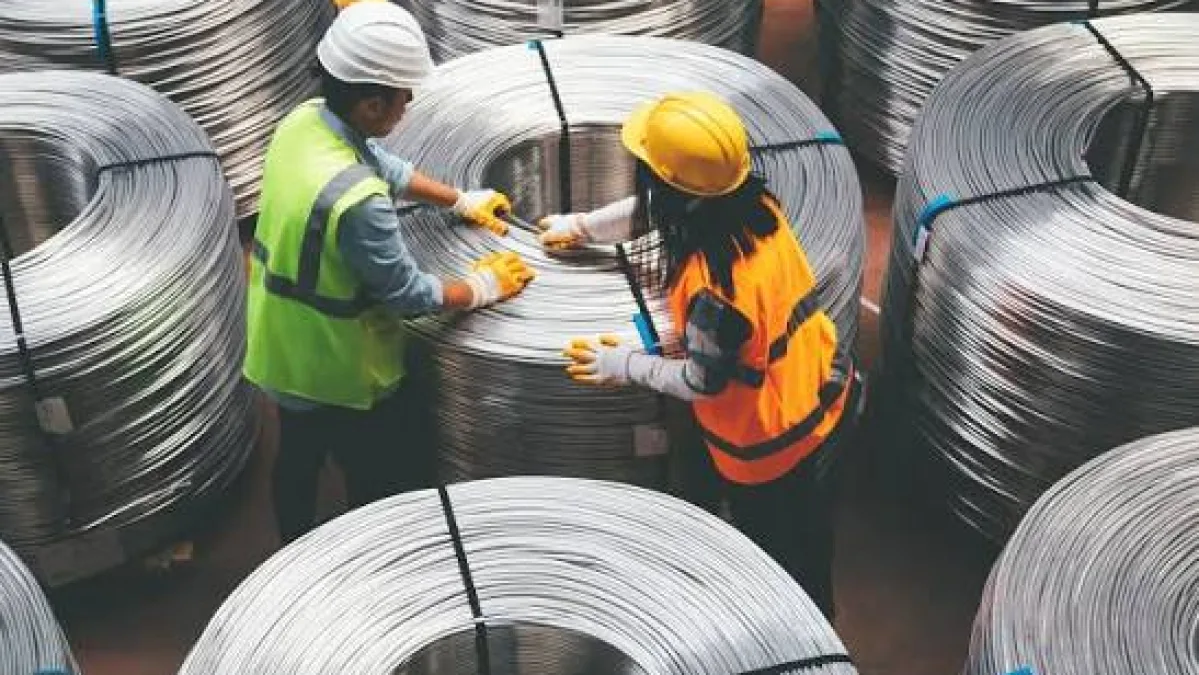
- Coil
- Bar
- Rod
- Tube
- Pipe
- Beam
- Channel
- Angle
- Wire
The purchaser performs additional cutting, forming, machining, welding or assembly after receiving the material.
Standard finished components
Standardised parts include fasteners, bearings, couplings, sprockets, pulleys, flanges and selected structural fittings. Their dimensions may correspond with recognised industry standards.
Custom-manufactured components
Custom components are produced according to drawings, samples or three-dimensional models. They can include machine frames, brackets, shafts, covers, guards, enclosures, hoppers, tanks and replacement parts for industrial machinery.
Customisation increases the importance of drawing control, dimensional inspection and sample approval. A minor misunderstanding about units, tolerances or hole positions can make an entire batch unusable.
Which Metals Are Used for Industrial Components?
Carbon steel
Carbon steel is widely used for frames, brackets, shafts, construction members and general machinery. It offers useful strength and can normally be cut, formed, machined and welded using established processes.
Its corrosion resistance is limited unless it is painted, galvanised, plated or otherwise protected. The required carbon-steel grade should always be specified because strength, weldability and machinability vary.
Stainless steel
Stainless steel is selected where corrosion resistance, cleanability or appearance is important. Applications include food-processing equipment, tanks, enclosures, piping components and outdoor installations.
The term “stainless steel” does not identify a complete specification. Different grades perform differently in acidic, marine, high-temperature and chloride-containing environments. Surface contamination during fabrication can also reduce corrosion performance.
Aluminium
Aluminium has a favourable strength-to-weight ratio and naturally forms a protective oxide layer. It is commonly used for machine covers, transport equipment, marine parts, heat-transfer components, electrical enclosures and architectural applications.
Different aluminium alloy series provide different properties. Some are selected for formability, others for corrosion resistance, machining or higher strength.
Cast iron
Cast iron is commonly used for machine bases, pump bodies, housings, pulleys and components requiring good vibration damping. It can provide excellent compressive strength but may be more brittle than many steels.
The casting grade and expected loading must be confirmed before the material is used in a structural or impact-sensitive application.
Copper and copper alloys
Copper offers high electrical and thermal conductivity. Brass and bronze provide different combinations of strength, corrosion resistance, machinability and wear performance.
Typical products include electrical connectors, busbars, heat-exchanger components, bushings, valves and plumbing fittings.
Tool and wear-resistant steels
Tool steels and abrasion-resistant grades are used for dies, blades, moulds, crusher components, liners and other heavily loaded parts. Their performance may depend on controlled heat treatment.
Ordering a wear-resistant component by hardness alone can be inadequate. Toughness, weldability, thickness and the type of wear should also be considered.
Understanding Aluminium Grades and Tempers
The Afrimart category includes custom-sized aluminium sheet and plate in several listed alloy options. Each alloy family is intended for different performance requirements.
| Aluminium grade | General characteristics | Typical applications | Important buying consideration |
|---|---|---|---|
| 1100 | High aluminium content, good formability and corrosion resistance | General sheet work, reflectors and chemical equipment | Relatively low mechanical strength |
| 2024 | High-strength heat-treatable alloy with useful fatigue performance | Aerospace structures and precision parts | Requires careful corrosion protection |
| 3003 | Good formability, weldability and general corrosion resistance | Tanks, ducting, roofing and formed products | Not intended for the highest-strength duties |
| 5052 | Good corrosion resistance and formability | Enclosures, transport parts and marine-related fabrication | Temper affects forming behaviour |
| 5083 | Strong aluminium-magnesium alloy with good marine corrosion resistance | Marine structures, tanks and welded assemblies | Welding procedure and temper must be confirmed |
| 5086 | Corrosion-resistant alloy used in marine and transport fabrication | Boat structures, pressure-related fabrications and vehicles | Mechanical properties vary with temper |
| 6061 | Versatile heat-treatable alloy with useful strength and machinability | Frames, machinery and structural components | Strength can be affected by welding |
| 6082 | Medium-strength structural alloy with good machining characteristics | Structural frames, transport and machinery | Confirm availability in the required temper |
| 7021 | High-strength alloy used for specialised structural applications | Transport, industrial structures and fabricated assemblies | Verify forming and welding requirements |
| 7075 | Very high-strength aluminium alloy | Aerospace, tooling and highly loaded components | Lower general corrosion resistance than some marine alloys |
The temper designation is as important as the alloy number. An annealed sheet behaves differently from a heat-treated plate of the same alloy. Buyers should specify both alloy and temper rather than requesting “6061 aluminium” without further qualification.
Common Metal-Component Manufacturing Methods
Laser and plasma cutting
Laser cutting can produce accurate profiles, holes and slots in sheet or plate. It is often selected for clean edges and detailed shapes. Plasma cutting is frequently used for thicker conductive materials where productivity is prioritised over the finest cut quality.
The drawing should identify dimensions that will be finished by machining rather than relying on the thermal-cut edge.
Waterjet cutting
Waterjet equipment uses high-pressure water, often with an abrasive, to cut material without a significant heat-affected zone. It can process metals, composites and other materials but may leave taper or striation that must be considered.
CNC machining
Computer numerical control machines produce features through turning, milling, drilling, boring and related operations. CNC machining can provide repeatable dimensions, but the drawing must still contain achievable tolerances and suitable datum references.
Stamping and punching
Stamping uses presses and tools to cut or form sheet metal. It is commonly economical for repeat quantities after tooling has been developed.
Punching can rapidly produce holes, vents and profiles. Designers should account for edge condition, minimum spacing, burr direction and potential distortion.
Bending and roll forming
Press brakes create individual bends, while roll-forming systems progressively shape continuous material. Bend radius, grain direction, material thickness and springback affect the finished dimensions.
A flat cutting pattern should be developed from the finished geometry rather than assumed from external dimensions.
Casting
Casting pours molten metal into a mould to create complex shapes. Processes include sand casting, investment casting and die casting.
Casting specifications should define material, dimensional allowances, surface quality, heat treatment, defect limits and any machining required after casting.
Forging
Forging shapes metal through compressive force. It can produce favourable grain flow and strong components for demanding applications such as shafts, connecting parts and heavy equipment.
Welding and fabrication
Fabrication combines cut and formed pieces using welding, fasteners or other joining methods. Drawings should identify joint type, weld size, weld length, distortion limits and inspection requirements.
A component that fits before welding may distort as it cools. Fixtures, welding sequence and post-weld machining may therefore be required.
Technical Specification Table
The following fields can be used to prepare a complete metal-component specification.
| Specification field | Information to provide | Why it matters |
|---|---|---|
| Component description | Functional name and application | Establishes the intended use |
| Material | Metal family and exact grade | Determines strength, corrosion and processing behaviour |
| Temper or heat treatment | Required material condition | Influences hardness, strength and formability |
| Dimensions | Length, width, height, thickness and diameter | Defines the finished geometry |
| General tolerance | Permitted variation for non-critical dimensions | Prevents unnecessary manufacturing cost |
| Critical tolerance | Specific tolerance for mating or functional features | Controls fit and performance |
| Surface roughness | Required roughness value and measurement area | Affects sealing, friction and appearance |
| Coating or finish | Paint, galvanising, plating, anodising or passivation | Provides corrosion protection or appearance |
| Manufacturing method | Cutting, machining, stamping, casting or fabrication | Influences cost, finish and dimensional capability |
| Welding requirement | Process, joint details and inspection level | Controls structural integrity |
| Quantity | Prototype, batch and forecast annual volume | Influences process and tooling selection |
| Inspection | Dimensions, material tests and reports required | Provides acceptance evidence |
| Marking | Part number, batch number and revision | Supports identification and traceability |
| Packaging | Surface protection, separation and crate requirements | Reduces transport and storage damage |
| Drawing revision | Current controlled drawing identifier | Prevents manufacture from outdated information |
No dimension should be left open to interpretation. Drawings should use one measurement system and state whether dimensions apply before or after coating.
Dimensions, Tolerances and Fits
Tolerance is the permitted variation from a specified dimension. A shaft designed as exactly 25 millimetres cannot be manufactured with literally zero variation. The drawing must define an acceptable range.
Tolerance affects:
- Assembly
- Alignment
- Interchangeability
- Bearing life
- Sealing
- Vibration
- Manufacturing cost
- Inspection time
Tight tolerances should only be applied where function requires them. Applying precision tolerances to every surface increases machining and inspection costs without necessarily improving the component.
A fit describes the relationship between mating features, such as a shaft and a hole. Depending on the tolerance zones, the assembly may have clearance, transition or interference.
ISO 286-1 establishes an internationally recognised code system for tolerances on linear sizes and explains concepts used for fits between mating features. The applicable standard, tolerance class and drawing convention should be agreed for the project.
Datum references are also important. They tell the manufacturer and inspector which surface or feature establishes the measurement origin. Without suitable datums, a part may meet individual dimensions while failing to align correctly in the final assembly.
Surface Finishes and Corrosion Protection
The correct surface treatment depends on the metal, operating environment, expected life and appearance requirements.
Painting and powder coating
Paint and powder coating create a barrier between metal and the environment. Performance depends on surface preparation, coating type, thickness, curing and edge coverage.
The colour reference alone is not a complete coating specification. Buyers should also state substrate preparation, primer requirements, thickness and exposure conditions.
Galvanising
Galvanising applies a protective zinc layer to steel. It is often selected for structural and outdoor applications. Component design should allow drainage and venting during hot-dip galvanising.
The process can affect dimensions, threaded features and the appearance of welded fabrications. These considerations should be addressed before manufacture.
Plating
Zinc, nickel, chrome and other plated coatings can provide corrosion protection, wear performance or decorative appearance. The required coating composition and thickness should be stated.
Anodising
Anodising creates a controlled oxide layer on aluminium. It can improve corrosion resistance, surface hardness and appearance. Alloy selection and surface preparation affect the final colour and consistency.
Passivation and pickling
Stainless-steel fabrication can introduce heat tint or surface contamination. Appropriate cleaning, pickling or passivation may be specified to restore a suitable corrosion-resistant surface.
Mechanical finishing
Grinding, polishing, brushing, blasting and tumbling alter texture, appearance and edge condition. A phrase such as “smooth finish” may be interpreted differently, so a reference sample or measurable roughness requirement is preferable.
Quality Control and Inspection
Inspection should focus on features that affect safety, assembly and performance. Checking every feature to the tightest possible standard can be costly, while checking too little increases the risk of defective parts.
A suitable quality plan may include:
- Material certificate review
- Chemical-composition verification
- Hardness testing
- Tensile testing
- Dimensional inspection
- Surface-roughness measurement
- Coating-thickness testing
- Weld visual inspection
- Dye-penetrant testing
- Magnetic-particle testing
- Ultrasonic testing
- Pressure or leak testing
- Trial assembly
- First-article inspection
The required method depends on the component’s risk and function. A decorative cover does not normally require the same inspection programme as a pressure-retaining part, lifting attachment or highly loaded structural connection.
Measuring equipment must be suitable for the required tolerance. Basic tape measurements cannot verify precision bores, shaft diameters or flatness. Calibration status and measurement conditions may also need to be controlled.
For repeated custom parts, approving a first article before manufacturing the entire batch can reduce risk. The first article should be inspected against the controlled drawing and any agreed reference sample.
Benefits of Correctly Specified Metal Components
Improved fit and assembly
Accurate dimensions and suitable tolerances reduce forced assembly, rework and alignment problems.
Longer service life
Correct material, heat treatment and surface protection help components resist fatigue, wear, impact and corrosion.
Reduced production disruption
Reliable replacement parts can restore machinery without repeated modification or premature failure.
Better product quality
Consistent metal components support repeatability in the final machine, vehicle, structure or manufactured product.
More efficient fabrication
Selecting an appropriate alloy and manufacturing process can reduce unnecessary machining, welding or finishing.
Greater traceability
Controlled drawings, batch markings and inspection records help businesses identify materials and manage future replacements.
Improved maintainability
Interchangeable parts allow worn components to be replaced without redesigning or modifying the surrounding assembly.
Better use of engineering resources
A complete specification reduces the time engineers and purchasing teams spend resolving avoidable technical questions.
Applications Across African Industries
Metal components are used throughout African industrial and infrastructure sectors.
In mining, they support crushers, screens, conveyors, pumps, processing plants and underground equipment. Wear resistance and repairability may be especially important.
Agricultural applications include implement frames, shafts, hoppers, processing-machine parts and irrigation components. Equipment may operate in dusty, humid or chemically aggressive environments.
Food and beverage factories use stainless-steel tanks, enclosures, guards, tables, frames and pipe fittings. Hygienic design, cleanability and food-contact compatibility must be considered.
Construction applications range from structural connections and brackets to roofing, doors and prefabricated systems. Designs must satisfy the relevant structural codes and project specifications.
Renewable-energy and electrical projects require mounting systems, equipment cabinets, busbars and precision supports. Outdoor components may need strong corrosion protection.
Transport equipment uses aluminium, carbon steel, stainless steel and specialist alloys in frames, bodies, brackets and mechanical systems. Weight, fatigue and vibration become important selection factors.
Packaging, Transport and Storage
Metal parts can be damaged even when they are mechanically strong. Scratches, dents, corrosion, bent edges and contaminated surfaces may make a component unsuitable for its intended purpose.
Packaging should reflect the component’s:
- Mass
- Shape
- Surface finish
- Corrosion sensitivity
- Sharp edges
- Centre of gravity
- Lifting points
- Storage period
- Transport route
Finished aluminium or stainless-steel sheets may require protective film and separation between surfaces. Machined parts may require corrosion inhibitor, capped openings and individual wrapping. Heavy fabrications need secure supports and clearly marked lifting points.
Outdoor storage should only be used when the material and packaging permit it. Water trapped between stacked metal sheets can produce staining or corrosion. Components should be stored securely, separated by material type and protected from chemical contamination.
Safety When Handling and Processing Metal Components
Metalworking and component handling introduce risks from sharp edges, heavy loads, rotating machinery, heat, fumes, noise and stored energy.
The International Labour Organization’s machinery-safety code addresses machinery selection, control systems, guarding and protection against mechanical hazards. Equipment must be suitable for its purpose and working environment.
A workplace risk assessment should cover:
- Sharp sheet and cut edges
- Lifting and suspended loads
- Safe stacking
- Guillotines and press brakes
- Rotating machine tools
- Welding fumes and radiation
- Grinding sparks
- Hot metal and surfaces
- Compressed gases
- Flammable coatings and solvents
- Noise and vibration
- Lockout and energy isolation
- Eye, hand and respiratory protection
Gloves can protect workers when handling sharp stationary material, but loose gloves may create an entanglement hazard near rotating equipment. Personal protective equipment must therefore match the task and machinery.
Guards, interlocks and extraction systems should remain operational. Maintenance and jam clearing should only begin after the equipment has been isolated and stored energy controlled.
Buyer Checklist for Metal Components
Use this checklist before submitting an enquiry:
- Define the component’s function.
- Supply a dimensioned technical drawing.
- State the measurement units.
- Identify the exact material grade.
- Specify temper or heat treatment.
- Identify critical dimensions.
- Apply tolerances only where required.
- Define datum references.
- Specify holes, threads and thread standards.
- Identify required surface roughness.
- Define coating or surface treatment.
- State operating temperature.
- Describe corrosion and chemical exposure.
- Identify impact, fatigue or wear conditions.
- Define welding requirements.
- State the required manufacturing process.
- Provide prototype and production quantities.
- Request a first-article inspection when appropriate.
- Specify required material certificates.
- Define dimensional and functional tests.
- Establish acceptable defect criteria.
- Provide the current drawing revision.
- Define part marking and traceability.
- Specify protective packaging.
- Confirm lifting and transport requirements.
- Review local engineering and product standards.
- Approve samples before large-volume production.
- Retain the final approved drawings and reports.
How to Request Metal Components Through Afrimart
Buyers can review available materials and parts on the Afrimart metal-components category page.
A useful quotation request should contain more than a photograph. Include the component’s application, material grade, dimensions, tolerance, quantity, surface finish and inspection requirements. For a custom component, attach a controlled two-dimensional drawing or three-dimensional model.
If an existing sample is being reproduced, describe which dimensions are critical and whether the old component is worn. Measuring a worn part without considering its original dimensions can reproduce the wear rather than the intended design.
For aluminium sheet or plate, state the alloy, temper, thickness, width, length, surface condition and quantity. The Afrimart aluminium listing includes multiple grade options, coated surfaces, customised width and cutting as a processing service. Buyers should confirm the precise configuration needed for their application.
Frequently Asked Questions
What information is needed to order a custom metal component?
Provide a drawing, material grade, dimensions, tolerances, quantity, surface finish and intended application. Include inspection, marking and packaging requirements where relevant.
What is the difference between a material grade and temper?
The grade identifies the alloy composition, while temper describes its processing or heat-treatment condition. Both can affect strength, hardness, formability and machining behaviour.
Should every dimension have a tight tolerance?
No. Tight tolerances should be reserved for functional features. Excessive precision increases manufacturing and inspection costs and may limit suitable production methods.
Which aluminium grade is best?
It depends on the application. Grades differ in strength, corrosion resistance, weldability, formability and machinability. The operating environment and fabrication process should guide selection.
Can a physical sample replace a technical drawing?
A sample can support development, but a controlled drawing is safer for repeat manufacturing. It defines nominal dimensions, tolerances, materials and revision status that may not be obvious from the sample.
How can corrosion be reduced?
Select a suitable base material and compatible protective finish. Design, drainage, fabrication quality, coating thickness and maintenance all influence corrosion performance.
What should be inspected before accepting metal components?
Check material identity, dimensions, critical tolerances, surface condition, coating, weld quality, quantity and marking. Safety-critical parts may require additional mechanical or non-destructive testing.
Sources and Technical Review
This guide was prepared using the Afrimart metal-components category, the listed custom-sized aluminium sheet and plate, ISO 286-1 guidance on tolerances and fits, and the International Labour Organization’s machinery-safety code.
Material suitability, tolerances, coatings and inspection requirements must be confirmed against the component’s engineering function. Safety-critical, structural, lifting and pressure-retaining parts should be reviewed by appropriately qualified professionals before manufacture or use.