Commercial ice makers produce controlled quantities of cube, block, tube, flake, nugget or other ice formats for hospitality, retail, food processing, fisheries, healthcare and industrial applications. Selecting the correct machine requires more than comparing kilograms per day: buyers must match ice type, ambient conditions, water quality, storage, electricity and sanitation requirements to the intended operation.
Commercial ice makers at a glance
Available ice formats: Cube, block, tube, flake, nugget and dry ice
Published category capacities: From smaller commercial units to multi-ton industrial systems
Common applications: Restaurants, hotels, bars, retail ice, fisheries, food processing and cold-chain operations
Essential inputs: Water and electricity for conventional ice; carbon dioxide for dry ice equipment
Key selection factors: Required ice type, daily demand, ambient temperature, water temperature and storage capacity
Installation needs: Water treatment, drainage, ventilation, power and hygienic handling facilities
Operating modes: Integrated, modular, countertop, freestanding and industrial configurations
The Afrimart ice makers category includes commercial cube machines, block ice systems, tube ice plants, flake ice makers and separate dry ice equipment. Published product names cover outputs ranging from tens of kilograms per day to multi-ton industrial capacities.
These capacities are not directly interchangeable. A machine producing 500 kg of beverage cubes serves a different purpose from a 500 kg block ice installation, while a dry ice pelletiser uses a different process and input material from a water-based ice maker.
What are commercial ice makers?
Commercial ice makers are refrigeration systems that remove heat from water until it freezes into a controlled shape. Depending on the machine, the ice is formed on an evaporator, inside moulds, around tubes or across a chilled drum.
The resulting ice may be harvested automatically or removed through a separate process. It can then be stored, dispensed, packed or transferred to another operation.
A working ice-production installation normally includes:
A safe and adequate water supply
Water filtration or treatment
Refrigeration equipment
An ice-forming mechanism
A harvesting or removal system
Drainage
Insulated storage
Hygienic handling or packaging
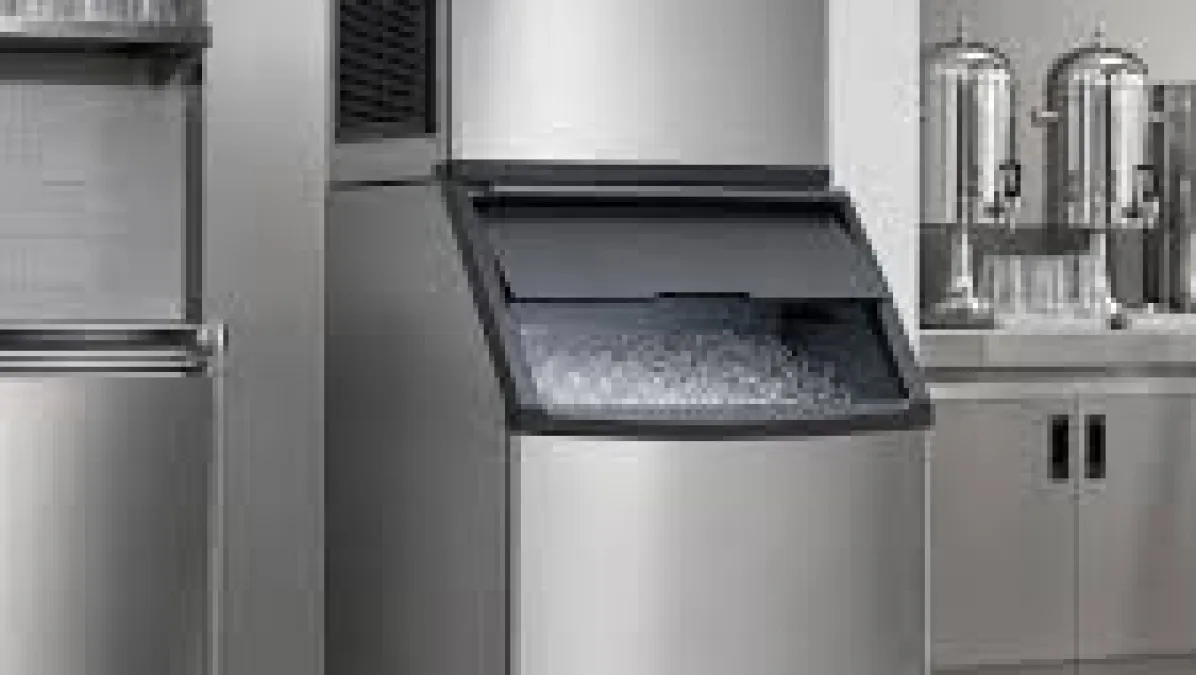
Not every machine includes every component. Some commercial units combine the ice maker and storage bin in one cabinet. Larger modular machines may require a separately selected bin, screw conveyor, packaging system or cold room.
Daily production capacity is usually stated in kilograms or tonnes per 24 hours. That figure should be evaluated under the manufacturer’s test conditions. High ambient temperatures, warm inlet water, poor ventilation, mineral scale and restricted condenser airflow may reduce actual production.
Businesses should therefore size equipment from verified site conditions and peak demand rather than selecting a machine using only its headline rated output.
Which type of ice maker is suitable for each application?
The correct ice format depends on how the ice will be used, handled and stored.
Cube ice machines
Cube ice is commonly used in restaurants, bars, hotels, cafés, catering operations and retail beverage service. Its regular shape supports portioning and a consistent presentation in drinks.
Cube machines may produce full, half, square or other cube profiles. Buyers should confirm:
Cube dimensions
Ice weight
Harvest method
Clarity
Daily production
Storage-bin capacity
Recommended beverage application
The Afrimart category includes commercial cube ice machines with product titles referencing capacities such as 40–60 kg, 65 kg, 136 kg, 200 kg, 500 kg and one tonne per day. These are separate product configurations rather than a capacity range for one machine.
Block ice machines
Block ice is formed as a larger solid mass. Its relatively low surface-area-to-volume ratio can make it useful where slower melting and transport are important.
Applications may include:
Fisheries
Produce cooling
Cold-chain support
Ice resale
Food transport
Events
Remote operations
Block dimensions and freezing time influence handling. Large blocks may require lifting, crushing or cutting equipment before use.
Tube ice machines
Tube ice is cylindrical, generally with a hollow centre. It can be used in beverages, packaged-ice businesses and selected cooling applications.
Afrimart’s category includes tube ice equipment described across industrial capacities. Buyers should confirm the tube diameter, wall thickness, length, ice temperature and whether the finished product is intended for direct consumption.
Flake ice machines
Flake ice is thin and has a broad contact area. It can conform around products, making it relevant to fish displays, seafood processing, meat handling, produce cooling, bakeries and selected healthcare or laboratory applications.
Flake ice can transfer cooling effectively because it covers irregular surfaces. Buyers must verify whether the selected equipment is suitable for food, medical, laboratory or industrial use.
Nugget ice machines
Nugget or chewable ice is made from compacted ice particles. It is often selected for beverage service and applications where a softer texture is preferred.
The storage and dispensing system should be configured for the particular nugget size and production rate.
Shaved ice equipment
A shaved ice machine processes existing ice into fine particles for desserts, beverages or cooling. It is not necessarily an ice-making machine because it may require pre-produced blocks or cubes as its input.
Buyers should distinguish between an ice maker and an ice shaver when planning a complete operation.
Dry ice machines
Dry ice consists of solid carbon dioxide rather than frozen water. Dry ice pelletisers and block-making equipment therefore belong to a separate technical category.
Dry ice systems require:
A suitable carbon dioxide supply
Appropriate pressure-control equipment
Ventilation
Insulated handling equipment
Trained personnel
Carbon-dioxide monitoring where required
Procedures for cold-burn and asphyxiation hazards
A conventional water ice machine cannot produce dry ice, and dry ice must not be handled as ordinary edible ice.
How does a commercial ice machine work?
Although the forming method differs, conventional commercial ice production generally follows six stages.
Water enters the machine
Water passes through the inlet and any installed filtration or treatment system. The water must be suitable for the intended use, particularly where the ice will contact food or beverages.
The refrigeration circuit removes heat
A compressor circulates refrigerant through the refrigeration system. Heat is absorbed at the evaporator and rejected through an air-cooled or water-cooled condenser.
Ice forms on the evaporator
Water freezes in moulds, around tubes, over a plate or across a drum. The freezing method determines whether the machine produces cubes, tubes or flakes.
The ice is harvested
Once the required formation is reached, the machine releases or removes the ice. Cube and tube systems may use a harvest cycle, while flake machines typically scrape ice continuously from a chilled surface.
Ice enters storage or processing
Finished ice falls into a bin, moves along a conveyor or enters a packaging system. Block ice may require demoulding and handling equipment.
Controls repeat the cycle
Sensors monitor operating conditions and may stop production when the storage bin is full. The exact controls depend on the selected model.
An ice machine’s rated production and storage are separate specifications. A machine capable of producing 200 kg per day may have a much smaller storage bin. If the ice is not used or transferred quickly enough, the full-bin control can stop production.
Commercial ice maker specification comparison
The Afrimart category contains several types and capacities. The table below shows the specifications buyers should compare for each equipment class.
| Ice maker category | Main output | Specifications to confirm |
|---|---|---|
| Countertop or dispenser unit | Small beverage ice portions | Daily output, storage, dispensing method, voltage and drainage |
| Commercial cube machine | Individual beverage cubes | Cube size, kg per 24 hours, bin capacity, condenser type and water use |
| High-output cube system | Bulk beverage or packaged ice | Rated output, head modules, bin or silo, conveying and packing requirements |
| Block ice machine | Solid ice blocks | Tonnes per day, block weight, cycle time, mould count and removal method |
| Tube ice machine | Cylindrical ice pieces | Tonnes per day, tube dimensions, ice temperature and packaging interface |
| Flake ice maker | Thin ice flakes | Daily capacity, evaporator design, storage, delivery method and application |
| Nugget ice machine | Compressed, chewable ice | Nugget dimensions, daily output, dispenser compatibility and storage |
| Ice shaver | Shaved ice from cubes or blocks | Input ice size, motor power, hourly processing capacity and blade system |
| Dry ice pelletiser | Solid carbon-dioxide pellets | CO₂ input, kg per hour, pellet diameter, ventilation and operating pressure |
| Integrated ice packing line | Bagged retail ice | Ice format, weighing range, pack speed, sealing, coding and cold storage |
Every machine requires a model-specific technical datasheet. Published capacity, power, dimensions, water use, refrigerant, operating conditions and included accessories must be confirmed in Afrimart’s current written quotation.
How should daily ice capacity be calculated?
Required capacity should be based on the busiest realistic operating period, not only on average consumption.
Begin by identifying every use of ice:
Drinks served
Hotel rooms or hospitality outlets
Fish or meat processed
Produce cooled
Retail bags sold
Deliveries supplied
Seasonal events
Cleaning or process requirements
Emergency reserves
Calculate the quantity required during peak periods and allow for recovery after the storage bin has been depleted. If demand is concentrated into a few hours, adequate storage may be as important as production capacity.
The following factors can reduce real-world output:
High ambient temperature
Warm inlet water
Restricted airflow
Dirty condenser surfaces
Mineral scale
Incorrect water pressure
Voltage instability
Frequent opening of storage
Poor maintenance
Installation outside the approved clearances
Capacity should also be considered alongside operating hours. A machine rated per 24 hours may need most of the day to produce the stated quantity. It cannot necessarily replace the entire daily demand during a short service window.
A practical capacity calculation should include:
Average daily consumption
Peak daily consumption
Peak hourly withdrawal
Storage-bin volume
Seasonal growth
Cleaning downtime
Maintenance downtime
Actual site derating
Backup or reserve strategy
For businesses selling packaged ice, the production line must also include weighing, bagging, sealing, coding, cold storage and distribution. The slowest downstream stage will limit saleable output.
What are the main operational benefits?
A correctly selected commercial ice maker can provide several practical advantages.
Ice production at the point of use
On-site equipment reduces reliance on repeated deliveries for routine operations. This may help restaurants, hotels and processors control production schedules, subject to water and power availability.
Selection of application-specific ice
Cube, block, tube and flake ice perform different functions. Choosing the correct format can improve beverage presentation, cooling contact or transport characteristics.
Repeatable production
Automatic controls can repeat freeze and harvest cycles with limited manual intervention. Consistency still depends on water conditions, cleaning and maintenance.
Scalable capacity options
The Afrimart category spans small commercial units and industrial systems. Businesses can compare equipment against their current demand and planned expansion.
Integration with storage or packing
Larger ice systems can be designed with bins, conveyors, weighing machines and packaging equipment. This supports organised retail ice or industrial cooling operations.
Reduced manual freezing
Commercial equipment replaces the repeated filling and emptying of domestic trays. This can improve workflow where businesses require ice every day.
Potential for dedicated ice enterprises
Block, tube, cube or packaged-ice systems may support businesses supplying hospitality, food retail, events or fisheries. Commercial viability still depends on electricity, water, packaging, distribution and demand.
These benefits should not be interpreted as guarantees of profit, energy savings or a specific payback period. Buyers need a project-level assessment using verified capacity, utility consumption and local operating conditions.
Water quality, sanitation and food safety
Ice intended for consumption or contact with food must be treated as food. Clean-looking ice is not necessarily microbiologically safe.
The US Food and Drug Administration’s packaged ice guidance states that ice is considered food and should be produced, stored and transported under clean and sanitary conditions using safe water and properly maintained equipment.
Although each African country has its own food-safety rules, the principle is directly relevant: the quality of finished ice cannot be better than the water, machine hygiene and handling system used to produce it.
Buyers should test the water source for:
Microbiological quality
Hardness
Iron
Manganese
Chlorides
Turbidity
Taste and odour
Treatment chemicals
Other locally relevant parameters
Water treatment may include sediment filtration, activated carbon, softening, ultraviolet treatment, reverse osmosis or other processes. The correct system depends on the laboratory results and the machine manufacturer’s water specification.
Poor water quality can cause:
Unsafe ice
Scale accumulation
Cloudy appearance
Unwanted taste or odour
Restricted water flow
Longer freeze cycles
Increased maintenance
Damage to components
Ice bins, scoops, chutes, conveyors and packaging equipment are food-contact or post-production handling areas. They require documented cleaning and sanitation, protected storage and hygienic staff practices.
Hands and drinking glasses should not be used to scoop ice. Use clean, suitable utensils stored in a protected position.
Air-cooled or water-cooled condenser?
The condenser removes heat from the refrigeration circuit. Commercial ice makers commonly use air or water to carry that heat away.
Air-cooled systems
An air-cooled condenser draws surrounding air across a heat exchanger.
Potential advantages include:
No continuous condenser-water demand
Simpler water infrastructure
Suitability where water conservation is important
Installation must provide adequate ventilation and clearance. A hot, enclosed or dusty room may reduce heat rejection and ice output.
Water-cooled systems
A water-cooled condenser uses water to remove refrigeration heat.
This configuration may be considered where ambient heat, noise or installation conditions make air cooling difficult. However, it can increase water demand and may require suitable drainage or a recirculating system.
Buyers must confirm:
Water consumption
Water quality requirements
Discharge arrangement
Local water restrictions
Treatment requirements
Whether a cooling tower is needed
Some industrial systems may use remote condensers or other heat-rejection arrangements. The choice should be made through a site-specific refrigeration assessment.
Electricity, water, drainage and installation requirements
Commercial ice makers need stable utilities and an installation area designed for heat rejection, cleaning and maintenance.
Electrical supply
Confirm:
Voltage
Frequency
Number of phases
Rated power
Maximum current
Starting current
Circuit protection
Earthing
Plug or isolator requirements
Larger systems may require three-phase power. Where the electricity supply is unreliable, buyers should assess a suitably sized generator or other backup arrangement.
Backup power must be sized for starting and running loads rather than selected only from nominal kilowatt ratings.
Water supply
The machine requires adequate flow and pressure. The installation may need a break tank, booster pump, filtration and treatment.
Water storage should cover the ice-production requirement as well as cleaning and sanitation.
Drainage
Meltwater, purge water and cleaning water must discharge through suitable drains. Poor drainage can cause standing water, odour, pest activity and unsafe floors.
The quotation should identify drain locations, pipe sizes and any air-gap or backflow-prevention requirements.
Ventilation and heat rejection
Ice machines transfer heat from water into the surrounding environment or condenser system. An air-cooled machine installed in a small room can increase room temperature, which may further reduce production.
The site layout should maintain the manufacturer’s clearances and prevent warm exhaust air from returning directly to the condenser intake.
Storage
An ice machine does not necessarily preserve ice indefinitely. The bin is commonly insulated rather than actively refrigerated.
Businesses storing large quantities may need a dedicated cold room. The storage system should protect ice from contamination, excessive melting and uncontrolled staff access.
Cleaning and preventive maintenance
Cleaning removes soil and biofilm, while descaling addresses mineral deposits. Sanitising is a separate step completed after surfaces have been properly cleaned.
The exact chemicals, concentrations and intervals must follow the selected machine’s manual. Using an unapproved acid or excessive chemical concentration can damage evaporator surfaces, seals or other components.
A maintenance programme should cover:
Water filters
Water distribution components
Evaporator surfaces
Ice chutes
Storage bins
Drain lines
Condensers
Fans
Pumps
Sensors
Electrical connections
Refrigeration performance
Daily checks may include ice appearance, unusual odour, bin cleanliness, scoop storage and visible water leakage.
Scheduled maintenance should record:
Cleaning date
Descaling date
Sanitising date
Chemicals and concentrations
Filter replacement
Water-test results
Production observations
Faults
Repairs
Technician details
Reduced production does not always mean the machine is too small. It may indicate scale, restricted airflow, a dirty condenser, insufficient water pressure, refrigerant-system problems or abnormal ambient conditions.
Refrigeration work should be completed by trained personnel using procedures appropriate to the machine and refrigerant.
What should buyers confirm before ordering?
Use this commercial ice maker buyer checklist:
Define the required ice type.
Explain the final use of the ice.
Calculate average and peak daily demand.
Determine the peak hourly withdrawal.
Confirm the required storage capacity.
Identify whether ice will be packed or used immediately.
Request the machine’s rated output conditions.
Provide the site’s maximum ambient temperature.
Provide the inlet-water temperature.
Obtain a water-quality analysis.
Confirm the recommended water-treatment system.
Select air-cooled, water-cooled or remote condensing.
Verify voltage, frequency and phase.
Request running and starting electrical loads.
Confirm daily water consumption.
Obtain inlet-water pressure requirements.
Confirm drainage specifications.
Check machine and bin dimensions.
Allow space for ventilation, cleaning and servicing.
Confirm the refrigerant type and charge.
Request the ice dimensions and piece weight.
Establish the full production-cycle duration.
Verify whether the storage bin is included.
Confirm whether the bin is insulated or refrigerated.
Identify required conveyors or ice-handling equipment.
Confirm packaging equipment for retail ice.
Request food-contact material specifications.
Obtain cleaning and sanitation instructions.
Confirm approved cleaning chemicals.
Request a spare-parts and consumables list.
Confirm installation and commissioning requirements.
Include operator and maintenance training.
Verify warranty scope and service arrangements.
Provide the project country and installation location.
State the required commissioning date.
For dry ice equipment, also provide the required pellet or block dimensions, carbon-dioxide supply conditions, ventilation plan and occupational-safety controls.
How to source commercial ice makers through Afrimart
Afrimart can help buyers compare ice formats and request equipment appropriate for hospitality, food production, fisheries, retail ice or industrial cooling.
A useful enquiry should include:
Required ice type
Daily and peak demand
Intended application
Ice dimensions
Water analysis
Inlet-water temperature
Maximum ambient temperature
Available electricity
Condenser preference
Required storage
Packaging requirements
Project location
Installation requirements
Target operating date
Ask for a written quotation identifying the exact model, production capacity and test conditions, storage, condenser, refrigerant, water use, electrical load, dimensions, weight, accessories, sanitation requirements, installation and warranty.
Explore commercial ice makers and request a quotation through Afrimart.
Frequently asked questions
How large should a commercial ice maker be?
Size the machine from peak daily demand, peak hourly withdrawal, storage and actual site conditions. Do not rely only on average consumption. High ambient temperature or warm inlet water may reduce output, so request performance data based on conditions comparable to the installation site.
What is the difference between cube, block and flake ice?
Cube ice is commonly used for beverages. Block ice provides a larger mass that can melt more slowly and may suit transport or resale. Flake ice has a large contact area and conforms around products, making it useful for fish, produce and process cooling.
Is the storage bin included with an ice maker?
Not necessarily. Some commercial units integrate a bin, while modular and industrial ice machines may require a separately selected storage system. Confirm bin capacity, compatibility and whether it is insulated or actively refrigerated. Production capacity and storage capacity are different specifications.
Can an ice maker use borehole water?
A borehole may be used only if laboratory testing and suitable treatment establish that the water meets the requirements for the intended ice and machine. Minerals can cause scale, while microbiological contamination can make consumable ice unsafe. Water treatment should be based on analysis.
Does a higher daily capacity guarantee enough ice?
No. A daily rating does not show whether enough ice will be available during peak demand. Storage, recovery time, site conditions and hourly withdrawal must also be considered. Production may stop when the bin is full and may decline when the condenser cannot reject heat effectively.
How often should a commercial ice machine be cleaned?
Follow the cleaning, descaling and sanitising intervals in the model-specific manual and adjust the programme for water quality and operating conditions. Visible slime, scale, unusual taste, odour or declining output requires prompt investigation rather than waiting for the next scheduled service.
Are dry ice and ordinary ice made by the same machine?
No. Ordinary ice machines freeze water through refrigeration. Dry ice equipment processes carbon dioxide into solid pellets or blocks. Dry ice presents severe cold-burn and carbon-dioxide exposure hazards and requires specialised supply, ventilation, handling and storage procedures.