





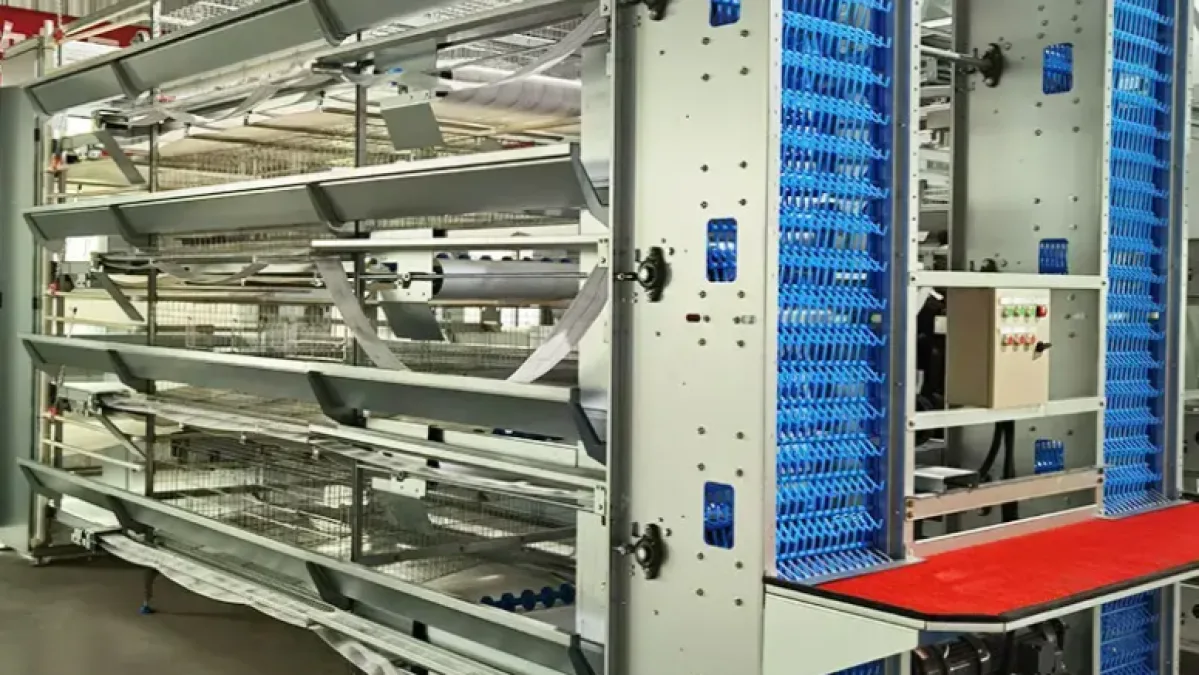
The H-type layer chicken cage system is an automatic poultry-housing solution with a stated capacity of 10,800 laying hens. It organises birds in a vertically tiered battery-cage arrangement designed for structured commercial egg production. Farms must confirm the cage dimensions, automation scope, stocking density, poultry-house requirements and applicable animal-welfare regulations before ordering.
H-type layer chicken cage system at a glance
- Primary application: Commercial layer chicken farming
- Stated capacity: 10,800 chickens
- Cage configuration: H-type
- Housing format: Battery cage system
- Equipment category: Automatic poultry equipment
- Intended users: Commercial poultry farms and automated layer operations
- Afrimart reference: SKU 1600895958992
- Items identified as included: H-type cages, automatic poultry equipment and layer battery-cage setup
The H-type layer chicken cage system for 10,800 chickens is intended for businesses planning a large, organised layer operation.
The stated bird capacity should be treated as a system-design figure rather than a guarantee that any existing poultry house can accommodate 10,800 hens. Final capacity depends on the selected cage layout, compartment dimensions, stocking density, aisle requirements, building dimensions, ventilation and applicable welfare rules.
What is an H-type layer chicken cage system?
An H-type layer cage system houses laying hens in multiple vertically arranged tiers. When viewed from the end, the structural columns and tier arrangement resemble the letter H, which gives the system its name.
Unlike the sloped, outward-facing arrangement commonly associated with A-type cages, an H-type system positions cage tiers more vertically. This can support a higher number of birds within a given building footprint, provided that the poultry house, ventilation and service systems are engineered for the resulting density.
The Afrimart configuration is identified as automatic poultry equipment for layer chickens. Automation in a complete layer house may cover functions such as feeding, drinking, egg collection and manure removal, but the public product information does not define every subsystem or its technical capacity. Buyers must therefore obtain an itemised scope of supply.
The equipment is designed for layers rather than broilers or chicks. Layers are chickens raised primarily for egg production, while broilers are raised for meat. These operations require different housing, feeding, collection and bird-management systems.
An H-type cage system forms only one part of a working egg-production facility. A complete project may also require:
- A suitably designed poultry house
- Feed storage and distribution
- Reliable drinking-water treatment
- Ventilation and cooling
- Lighting and environmental controls
- Egg handling and storage
- Manure management
- Standby power
- Biosecurity infrastructure
- Staff facilities
- Mortality management
- Fire and emergency systems
The cage equipment should therefore be evaluated as part of the total farm design, not as an isolated purchase.
How does the automatic layer cage system work?
The system organises hens into structured cage compartments while associated poultry equipment supports routine feeding, watering, egg handling and waste management.
A typical operating sequence involves the following stages:
Install and align the cage structure
The H-type cage rows are assembled inside a poultry house designed for the system. Alignment is important because feeding, drinking, egg and manure equipment must operate consistently along each row.
Commission the automatic equipment
Motors, control equipment, conveyors and other included systems are connected and tested. The exact automation scope must be confirmed because the listing identifies the equipment as automatic without publishing a full subsystem schedule.
Prepare the house for placement
Operators clean and disinfect the facility, flush water lines, test feeders and drinkers, establish the lighting programme and verify ventilation. All systems should be stable before birds enter the house.
Place the layer flock
Birds are distributed according to the approved stocking plan. Allocation must reflect cage dimensions, bird age, breed, body weight and applicable welfare requirements rather than relying only on the total advertised capacity.
Run daily layer production
Staff monitor feed, water, environmental conditions, egg production, bird health and equipment performance. Automatic systems reduce repetitive material handling but do not remove the need for trained inspection.
Collect eggs and manage manure
Where included, the egg-collection system transports eggs from the cage rows for grading or packing. Manure-removal equipment transfers waste away from the bird area for appropriate handling.
Maintain and record performance
Operators inspect motors, belts, chains, drinkers, feeders, cage fittings and controls. Records should cover feed and water consumption, egg output, mortality, environmental conditions, alarms and maintenance.
Automation can improve consistency, but a fault can affect many birds quickly. Farms therefore need daily inspection routines, alarm response procedures, spare parts and backup arrangements for essential services.
What is included in the 10,800-bird configuration?
The Afrimart page identifies the offered solution as an H-type layer cage system, automatic poultry equipment and a battery-cage setup for layer chickens.
The public listing does not provide an itemised bill of quantities. Buyers should not assume that every component normally associated with an automatic poultry house is included.
A procurement specification should separately identify:
- Cage rows and structural frames
- Number of tiers
- Number of cage compartments
- Birds permitted per compartment
- Feed troughs
- Feed hoppers or distribution carts
- Drinking lines
- Nipples and drip cups
- Water regulators
- Egg belts and collection conveyors
- Cross conveyors
- Manure belts
- Manure-removal drives
- Electrical controls
- Motors and gearboxes
- Sensors and alarms
- Walkways and service platforms
- Installation fasteners
- Spare parts
- Assembly and commissioning services
The building, ventilation, cooling, lighting, feed silos, water-treatment system, generator, egg room and manure-storage infrastructure must also be listed as included, excluded or separately quoted.
This scope clarification is essential because “automatic poultry equipment” can describe very different levels of automation. One configuration may automate only feeding and manure removal, while another may integrate egg collection and environmental controls.
Technical specifications
The following table contains the details published for the Afrimart configuration. Dimensions, tier count, cage density and utility requirements must be established during project design.
| Specification | Verified value | Buyer note |
|---|---|---|
| Product | H-type layer chicken cage automatic poultry equipment | Confirm the final project configuration in the quotation |
| Stated capacity | 10,800 chickens | Capacity remains subject to cage layout and permitted stocking density |
| Cage type | H-type | Request the number of rows, tiers and compartments |
| System format | Battery cage | Confirm whether the cage design meets local welfare requirements |
| Equipment type | Automatic poultry equipment | Obtain a complete automation and control schedule |
| Poultry application | Layer chickens | Not presented as housing for broilers or chicks |
| Intended operational setting | Commercial poultry farms | The building and services must suit high-density layer production |
| Listed supply scope | H-type cage system, automatic poultry equipment and battery-cage setup | Request an itemised bill of quantities |
| Afrimart SKU | 1600895958992 | Include this reference when requesting a quotation |
Specifications may vary according to the selected configuration and must be confirmed in Afrimart’s current written quotation.
The listing does not publish the cage dimensions, number of tiers, birds per compartment, feeding capacity, egg-conveyor capacity, manure-removal capacity, motor power, voltage or building dimensions. These values should not be inferred from unrelated H-type cage installations.
What poultry-house infrastructure is required?
A 10,800-layer project requires a poultry house designed around the final cage layout and the environmental needs of the flock.
Building dimensions and structural loading
The cage rows, service aisles, egg conveyors and manure systems must fit inside the available building. Buyers need a dimensioned layout showing row lengths, tier height, aisle width, end clearances and access for maintenance.
The building structure must accommodate the equipment and operating loads. Floor level, drainage, corrosion resistance and anchor points should be established before installation.
Ventilation
High-density poultry housing produces heat, moisture, dust and gases. Ventilation must provide suitable air exchange across all tiers rather than moving air effectively only at floor level.
The UN Food and Agriculture Organization identifies space, ventilation, light and protection from weather and predators as basic poultry-housing requirements. Its guidance also notes that stocking density influences bird behaviour and health.
Ventilation design should consider:
- Bird numbers and body weight
- Seasonal temperatures
- Relative humidity
- House dimensions
- Cage arrangement
- Fan capacity
- Air-inlet distribution
- Minimum and maximum ventilation
- Heat removal
- Ammonia control
- Emergency ventilation
The required fan capacity cannot be determined from bird count alone. A qualified poultry-house designer should calculate it using the local climate and final equipment layout.
Water supply
Layers require continuous access to suitable drinking water. The project needs adequate storage, filtration, pressure regulation and distribution to every cage tier.
Farms should assess water quality for microbiological contamination, minerals and other characteristics that may affect bird health or block drinking equipment. Backup water storage is especially important where municipal or borehole supply is unreliable.
Electrical supply
Automatic feeders, conveyors, manure belts, ventilation and controls require dependable electricity. Buyers must obtain the connected and running loads for all included equipment.
The electrical design may need:
- Correct voltage and frequency
- Circuit protection
- Earthing
- Motor protection
- Surge protection
- Emergency stops
- Control-panel protection
- Automatic changeover
- Standby generation
Ventilation and drinking water are critical services. The backup-power plan must support essential systems during an outage rather than merely providing lighting.
Lighting
Layer production normally uses a controlled lighting programme. The design should provide appropriate and reasonably uniform light across cage tiers while allowing management to control operating hours.
The lighting schedule must be developed for the selected flock and production programme. The cage supplier’s responsibility for lighting should be defined in the project scope.
What are the main operational benefits?
The H-type layer cage system offers several potential benefits when it is correctly sized, installed and managed.
High stated bird capacity
The configuration is designed around 10,800 chickens. This supports a commercial-scale layer project within a structured housing arrangement, subject to the approved density and house design.
Vertical use of building space
The H-type layout arranges birds across multiple tiers. This can accommodate more cage positions within the building footprint than a single-level system.
Organised flock management
Dividing birds into defined compartments can support systematic observation, stocking records and production management. Staff can identify cage sections when recording faults or health concerns.
Integration with automatic equipment
The system is presented as automatic poultry equipment. Where feeding, watering, egg collection and manure removal are included, automation can reduce repetitive manual handling and provide more consistent service.
Structured egg movement
A correctly configured egg-collection system can move eggs away from cage rows in an organised manner. Actual breakage and cleanliness depend on belt alignment, operating speed, transfer points and staff handling.
Planned manure removal
Where manure belts or related equipment are included, waste can be removed according to a farm schedule. Regular removal may support house hygiene, but storage and final disposal still require a dedicated plan.
Potential labour reallocation
Automation can allow workers to focus more attention on inspection, flock health, egg quality, maintenance and record keeping. It should not be viewed as eliminating the need for skilled staff.
Repeatable production routines
Defined cage rows and automatic systems can support standard procedures for feeding, inspection, egg collection and cleaning. Performance still depends on management discipline and equipment availability.
These benefits are operational possibilities rather than guaranteed results. Egg output, mortality, feed conversion and flock health depend on genetics, nutrition, water, environment, disease control and management.
Stocking density and animal-welfare considerations
The advertised capacity of 10,800 chickens must be checked against the usable cage area and the welfare rules applicable at the project location.
Capacity should not be accepted without confirming:
- Internal cage dimensions
- Usable floor area
- Birds per compartment
- Floor area per bird
- Feeder space per bird
- Drinking points per bird
- Cage height
- Ability to inspect and remove birds
- Applicable enrichment requirements
- Local restrictions on conventional battery cages
The FAO’s poultry-housing guidance explains that space is a fundamental housing consideration and that overcrowding can contribute to stress, disease vulnerability, cannibalism and unequal access to feed.
Regulations differ between countries and markets. Some jurisdictions restrict or prohibit conventional battery cages, while others impose minimum cage-area or welfare requirements. Buyers supplying export-oriented egg markets may also face customer standards that go beyond domestic legislation.
A farm should verify requirements with the appropriate veterinary, agriculture, animal-welfare and environmental authorities before finalising the equipment design. The contract should require the selected cage configuration to meet those confirmed requirements.
Welfare management also extends beyond physical space. The project should address ventilation, temperature, lighting, access to feed and water, bird handling, disease prevention, emergency response and humane depopulation procedures.
Biosecurity and flock-management requirements
A 10,800-bird operation concentrates a large flock in one production system. Biosecurity failures can therefore have serious operational consequences.
The site plan should separate clean and potentially contaminated movements. Relevant controls may include:
- Controlled farm access
- Visitor records
- Dedicated clothing and footwear
- Hand-washing and disinfection
- Vehicle control
- Rodent and wild-bird management
- Feed-storage protection
- Water sanitation
- Dead-bird removal
- Cleaning and disinfection procedures
- Flock health monitoring
- Isolation and response plans
Incoming pullets should be sourced and placed according to the farm’s veterinary programme. Mixing birds of different ages or health status can complicate disease control and production management.
Daily flock checks should cover:
- Feed availability
- Water flow
- Bird distribution
- Egg numbers
- Shell quality
- Mortality
- Unusual behaviour
- Respiratory signs
- Temperature and humidity
- Equipment alarms
- Manure condition
Automatic systems need physical verification. A control panel may show that a motor has run without proving that feed reached every cage section or that water is available at every nipple.
The farm should have clear escalation procedures for interrupted ventilation, water loss, feed-system faults, disease signs and unusual mortality.
Feed, water, egg and manure systems
The commercial value of an automatic cage project depends on the performance of its supporting systems.
Feeding
Feed must be delivered evenly along the cage rows. Poor distribution can create differences in intake, body condition and egg production.
Buyers should confirm:
- Feed-storage capacity
- Delivery method from silo to house
- Trough design
- Distribution equipment
- Motor power
- Feed rate
- Control method
- Anti-spillage features
- Cleaning access
Feed formulation and daily allocation should follow the nutrition programme for the selected layer strain and production stage.
Drinking
The water system should deliver adequate flow at the required pressure across every tier. Request the number and spacing of nipples, regulator arrangement, line-flushing method and recommended water pressure.
A loss of water can affect birds rapidly. Tanks, pumps and alarms should therefore be included in the farm’s critical-service plan.
Egg collection
Confirm whether the quoted configuration includes longitudinal egg belts, cross conveyors, elevators or only cage-level collection components. The transfer route should be designed to limit drops and abrupt changes that could contribute to cracked eggs.
The receiving area must be organised for counting, grading, packing and storage.
Manure removal
The quotation should identify the manure-belt arrangement, operating frequency, drive power and discharge point. The system must transfer manure to infrastructure capable of receiving it without obstructing farm traffic or contaminating clean areas.
The manure-management plan should address storage, odour, flies, rainwater, runoff and final agricultural use or disposal under local environmental requirements.
Maintenance and operational continuity
Automatic poultry systems require planned maintenance because a single failure may interrupt service to many birds.
Daily inspections should include:
- Feed distribution
- Nipple drinkers and water lines
- Egg belts
- Manure belts
- Motors and gearboxes
- Chains, bearings and rollers
- Cage doors and partitions
- Fasteners and support structures
- Electrical controls
- Sensors and alarms
- Ventilation equipment
Operators should remove trapped material safely and investigate unusual noise, heat, vibration or belt tracking. Guards must remain fitted, and electrical or mechanical energy should be isolated before maintenance.
A project-specific spare-parts package may include:
- Drive motors
- Gearbox components
- Bearings
- Chains and sprockets
- Rollers
- Belts
- Sensors
- Switches
- Drinkers
- Regulators
- Cage fasteners
- Electrical protection components
The exact list must match the supplied equipment. Buyers should request part numbers, recommended stock quantities, maintenance intervals and expected replacement procedures.
Operational continuity planning should include backup power, reserve water, manual emergency procedures and trained maintenance personnel. A fault-response chart displayed in the poultry house can help staff act quickly when an alarm occurs.
What should buyers confirm before ordering?
Use this procurement checklist before approving an H-type cage project:
- Confirm the target number of layers and production phases.
- Verify that 10,800 birds complies with the permitted stocking density.
- Request the internal dimensions of every cage compartment.
- Confirm the birds allocated to each compartment.
- Obtain the total usable cage area per bird.
- Confirm the number of rows, tiers and cage sections.
- Request a dimensioned poultry-house layout.
- Check aisle widths, end clearances and maintenance access.
- Confirm the cage material, wire treatment and corrosion protection.
- Obtain an itemised equipment bill of quantities.
- Identify which feeding components are included.
- Confirm the drinking-line, nipple and regulator configuration.
- Verify the egg-collection system and its capacity.
- Confirm the manure-removal system and discharge arrangement.
- Request motor powers, total connected load, voltage and frequency.
- Calculate ventilation for the local climate and final bird density.
- Confirm whether fans, inlets and cooling equipment are included.
- Plan water storage, filtration, treatment and backup pumping.
- Establish standby-power requirements for critical services.
- Confirm lighting equipment and control responsibility.
- Review applicable cage-housing and animal-welfare regulations.
- Confirm biosecurity, fire and emergency requirements.
- Request installation drawings and foundation details.
- Confirm assembly, commissioning and operator training.
- Obtain operating, maintenance and illustrated parts manuals.
- Request recommended spare parts and consumables.
- Confirm warranty scope and technical-support procedures.
- Provide the project country, site location and target operating date.
The technical quotation should distinguish between cage capacity and complete-farm capacity. Housing 10,800 hens also requires sufficient feed storage, water, ventilation, egg handling, manure management, staff and backup systems.
How to source the H-type layer cage system through Afrimart
Afrimart can help buyers define the project configuration and prepare a site-specific quotation.
A useful enquiry should include:
- Target flock size
- Layer breed and expected bird weight
- Required stocking standard
- Poultry-house dimensions
- Number of planned houses
- Local temperature and humidity range
- Available electricity
- Water source and storage
- Required automation
- Egg-handling requirements
- Manure-management plan
- Project country and location
- Installation and training requirements
- Target commissioning date
Ask for a quotation containing the cage layout, compartment dimensions, automation scope, utility loads, building interfaces, spare parts, installation, commissioning, training and warranty.
Request a quotation for the H-type layer chicken cage system for 10,800 chickens through Afrimart.
Frequently asked questions
What is the capacity of the H-type layer cage system?
The stated system capacity is 10,800 layer chickens. Buyers should verify this figure against the cage dimensions, number of compartments, birds per compartment and legally permitted stocking density. The poultry house, ventilation, water, feed and manure systems must also be designed to support the full flock.
What does “automatic poultry equipment” include?
The listing identifies the equipment as automatic but does not publish a complete subsystem schedule. Buyers should request written confirmation of the feeding, drinking, egg-collection, manure-removal, lighting, environmental-control and alarm equipment included. Each motor, conveyor, control panel and accessory should appear in the bill of quantities.
Is the poultry house included?
The public information identifies the H-type cage system and automatic poultry equipment but does not confirm that a complete building is included. Buyers should request separate scope sections for the cage equipment, building, ventilation, cooling, electrical installation, water system, feed storage, egg room and manure infrastructure.
How much space is required for 10,800 birds?
The required space cannot be established from bird capacity alone. It depends on cage dimensions, row length, tier count, aisle width, ventilation arrangement and local stocking rules. Afrimart should provide a dimensioned layout for the selected configuration before the building is constructed or modified.
What electrical supply does the system require?
The product page does not publish voltage, frequency, motor power or total connected load. These must be confirmed in the technical quotation. Buyers should also calculate the power required for ventilation, lighting, water pumping and other farm equipment and provide backup power for critical systems.
Can the system be used in every African country?
The equipment’s legal suitability must be checked in the destination country. Poultry-housing, battery-cage, stocking-density, animal-welfare, environmental and building requirements vary. Export-oriented farms should also review the standards imposed by customers or target markets before selecting a cage format.
What information is needed for a quotation?
Provide the target flock, layer breed, poultry-house dimensions, local climate, required stocking standard, electricity, water supply, automation requirements, egg-handling plan, manure strategy, project location and commissioning date. This allows the cage layout and supporting systems to be evaluated as one complete poultry operation.
Sources and technical review
- Afrimart: H-Type Layer Chicken Cage Automatic Poultry Equipment for 10,800 Chickens
- Food and Agriculture Organization: Poultry housing and general management