B21, China Town Mall, Midrand

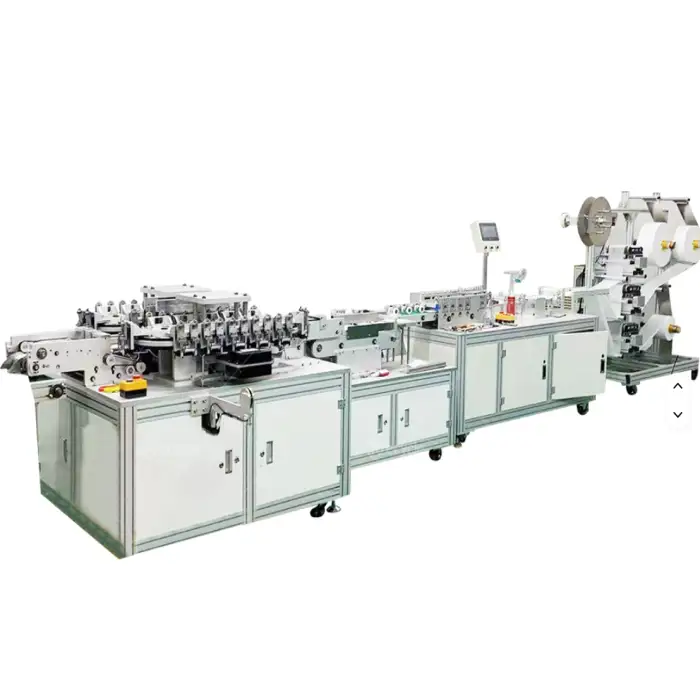
High Speed 300 Pcs/min Surgical Butterfly Face Mask Making Machine 3 Ply Mask Machine
Asset finance available
Do you want funding for this equipment?
Afrimart can connect you with trusted funding partners who specialise in asset finance for businesses like yours. Compare options and apply in minutes — final approval is subject to provider review.
Check funding options
Secure & no obligation

- Section : Machinery
- Category : Apparel Machinery
- SKU : 1600411193172

High Speed 300 Pcs/min Surgical Butterfly Face Mask Making Machine 3 Ply Mask Machine
The High Speed 300 Pcs/min Surgical Butterfly Face Mask Making Machine is a cutting-edge solution for producing high-quality disposable face masks. With a production capacity of 300 masks per minute, this fully automatic machine is designed to meet the high demand for face masks efficiently and effectively. It is easy to operate and features advanced servo control technology for optimal performance.
Specifications
| Attribute | Details |
|---|---|
| Voltage | 110V, 220V |
| Mask Types | Flat Mask |
| Mask Material | Non-woven Fabrics |
| Automatic Grade | Full-automatic |
| Power (W) | 5000 W |
| Production Capacity | 260-300 pcs/min |
| Dimension (L*W*H) | L8600*W1200*H1850 (mm) |
| Lead Time | 5-7 Days |
| After-sales Service | Online Video Technical Support |
| Machine Type | Fully Automatic Production Line |
Key Features
- High production efficiency with 300 masks per minute.
- Easy to operate for quick setup.
- Uses non-woven fabric and meltblown materials.
- Advanced servo control for precise operation.
- Fully automatic production line for seamless workflow.
Applications
- Production of disposable surgical masks.
- Meeting the demand for personal protective equipment.
- Use in hospitals, clinics, and healthcare facilities.
- Manufacturing masks for public health and safety.
- Supporting industries in mask production during health emergencies.
Product Info Gallery
- Shipping Timeframes: All orders are processed within 2-5 business days (excluding weekends and holidays). After your order has been processed, the estimated delivery time is before 30 Nov, 2026, depending on customs, Please note that due to high demand, some items may experience longer shipping times, which will be communicated at order confirmation email.
- Order Processing Time: Please allow 2-5 business days for us to process your order before it is shipped . Orders placed after 16:00 on Fridays, or during weekends and public holidays, will begin processing on the next business day. Processing times may be extended during peak seasons or sales events.
- Manufacturing Time: Some products needs manufacturing time, the manufacturing process will take approximately 10-30 business days depending on the product. This timeframe may vary depending on the complexity of the product and current demand. but this will be communicated with you during order confirmation.
- Returns and Exchanges: We offer a 30-day return policy for most items. If you are not completely satisfied with your purchase, you may return it within 30 days of receipt for a refund or exchange. Items must be unused, in their original packaging, and accompanied by proof of purchase. Return shipping costs are the responsibility of the customer, unless the item was damaged or defective upon arrival.
1. What type of masks does this machine produce?
It produces 3-ply flat surgical/butterfly disposable face masks using non-woven outer/inner layers with a meltblown middle layer (butterfly/flat mask style).
2. What is the production capacity?
Rated at 260–300 pieces per minute. That equals approximately 15,600–18,000 masks per hour and about 124,800–144,000 masks in an 8-hour shift, depending on operating conditions and material changeover time.
3. What raw materials and consumables are required?
Non-woven fabric for outer and inner layers, meltblown fabric for the middle layer, earloop material (elastic), and nose bridge strips. Specific material widths and specifications should be confirmed with the supplier.
4. What are the electrical requirements and power consumption?
Voltage options are 110V or 220V. Total machine power is approximately 5000 W. Confirm site electrical capacity and grounding requirements prior to installation.
5. What are the machine dimensions and footprint?
Overall dimensions are L 8600 mm × W 1200 mm × H 1850 mm. Allow additional space around the machine for material handling, maintenance access, and operator movement.
6. Is the machine fully automatic and how is it controlled?
Yes — it is a fully automatic production line that uses advanced servo control technology for precise feeding, cutting and welding operations.
7. What kind of after-sales support is provided?
The machine comes with online video technical support. For additional services such as on-site installation, training, spare parts or extended warranty, contact the supplier to arrange terms and costs.
8. What is the lead time for delivery?
Typical lead time is 5–7 days. Final delivery time depends on order confirmation, payment, customization, and shipping logistics.
9. Can mask size or design be customized?
The machine is built for flat/butterfly 3-ply masks. Minor adjustments (mask length/width, earloop placement) may be possible via tooling and parameter changes; discuss specific customization requirements with the supplier.
10. Does the machine guarantee that produced masks meet surgical or medical standards?
The machine manufactures the physical masks, but compliance with surgical/medical standards depends on the selected raw materials and subsequent testing. Certification testing (e.g., BFE, PFE, differential pressure) must be performed on finished masks according to local regulatory requirements.
11. What routine maintenance is required?
Regular cleaning of feeding and welding areas, lubrication of moving parts per supplier schedule, checking and replacing wear items (blades, belts, weld heads), and routine electrical/servo inspections. Follow the manufacturer's maintenance manual for detailed intervals.
12. Are spare parts available and what are commonly replaced parts?
Suppliers typically provide spare parts kits and consumables. Common replacement items include cutting blades, welding heads, belts, sensors and filters. Contact the supplier for a recommended spare parts list.
13. What environmental conditions are recommended for operation?
Operate indoors in a clean, dry, stable-temperature environment free of excessive dust or humidity. Avoid extreme temperatures and ensure adequate ventilation and stable power supply.
14. How long does it take to set up and start production?
Setup time depends on operator experience and material changeovers. With trained staff and proper preparation, initial setup and tuning can often be completed within a few hours; supplier video support can speed this process.
15. What quality control or inspection should be performed during production?
Use visual inspections and sample testing for weld quality, earloop strength and dimensional accuracy. For medical/surgical use, perform appropriate lab tests (BFE, PFE, breathability) on finished masks according to regulatory standards.
Latest Order Arrivals
Discover our latest orders

12 Heads Embroidery Machine

Toilet Paper Machine Machine

Order Collection

Cross Border Clients

Order cros border countries Collected

Industrial Machine Cllection

Agriculture Processing Machines

Ready for collection

Water Pump Equipment

Packaging Machine and accessories

Fabrics Manufacturing Equipment

Mining Equipments

Food Processing Machine

Batch of Orders

Batch of Orders

Latest Orders Labelled

wheel alignment machines

new arrivals

Pre Orders Offloading

Latest Arrivals

Latest Arrivals

Latest Arrivals

Loading

Toilet paper making machine

Toilet paper making machine

Toilet paper Rewinding Machine

latest arrivals

offloading

order success

order collection

order offloading