B21, China Town Mall, Midrand

Browse categoriesView all categories
Appliances
View all products →


Beauty & Personal Care
View all products →


Car Parts
View all products →


Computers
View all products →


Construction Material
View all products → Building Boards & Insulation
Coated & Treated Products
Decorative Building Materials
EPDM/PVC/TPO Membrane
Building Boards & Insulation
Coated & Treated Products
Decorative Building Materials
EPDM/PVC/TPO Membrane
 Flat Products (Sheets, Plates & Coils)
Gabion mesh
Geocell
Geogrid
Geomembrane Welding machine
HDPE Geomembrane
HDPE Geomembrane
Hdpe/Pvc Pipe
Industrial Hardware & Fasteners
LDPE LLDPE Geomembrane
Luxury Wall Panels
Nonwoven Geotextile
Other Geosynthetics
Pipe Floater
Pipeline & Fluid Systems
Pipes & Hollow Sections
PVC Ceilings
PVC Cornices
PVC Suspended Ceilings
PVC Wall Panels
Roofing & Cladding
Roofing & Corrugated Sheets
Rubber Hose
SPC Flooring
Strips & Bars
Structural Steel & Profiles
Flat Products (Sheets, Plates & Coils)
Gabion mesh
Geocell
Geogrid
Geomembrane Welding machine
HDPE Geomembrane
HDPE Geomembrane
Hdpe/Pvc Pipe
Industrial Hardware & Fasteners
LDPE LLDPE Geomembrane
Luxury Wall Panels
Nonwoven Geotextile
Other Geosynthetics
Pipe Floater
Pipeline & Fluid Systems
Pipes & Hollow Sections
PVC Ceilings
PVC Cornices
PVC Suspended Ceilings
PVC Wall Panels
Roofing & Cladding
Roofing & Corrugated Sheets
Rubber Hose
SPC Flooring
Strips & Bars
Structural Steel & Profiles


Consumer Electronics
View all products → Camera & Photo
 Chargers, Batteries & Power Supplies
 Commercial Equipment
 Home Audio & Video
 Portable Audio
 Printing Equipment
 Professional Audio
 Security & Protection
 Testing Equipment


Commercial Equipment
 Advertising Boards
 Advertising Inflatables
 Advertising Light Boxes
 Commercial Fryers
 Computer Hardware & Software
 Digital Signage and Displays
 Display Racks
 Food Trucks
 Ice Cream Machines
 Interactive Boards
 Photo Booths
 Projectors & Presentation Equipments
 Refrigeration Equipment
 Supermarket Shelves
 Vending Machines


Electrical & Tools
View all products →


Renewable Energy
 Energy Storage System
 Flexible Solar Panels
 Home Energy Storage
 Lead Acid Batteries
 Lithium Ion Batteries
 Portable Power Stations
 Renewable Energy Accessories
 Solar Charge Controller
 Solar Energy System
 Solar Inverters
 Solar Light
 Solar Mounting System
 Solar Panels
 Solar Production Lines
 Solar Water Pump
 Uninterruptible Power Supplies
 Wind Generators
 Wind Power Generation System


Furniture
View all products → Bedroom Furniture
 Commercial Furniture
 Decorations
 Dining Room Furniture
 Kitchen Furniture
 Living Room Furniture
 Office Furniture


Kids & Toys
View all products →


Machinery
View all products →
Aftersales
 Agriculture Machinery
 Apparel Machinery
 Chemical Machinery
 Cleaning Equipment
 Construction Machinery
 Environmental Machinery
 Food & Beverage Machinery
 Industrial Machinery
 Machine Tool Equipment
 Machinery Accessories
 Material Handling
 Packaging Machines
Agriculture Machinery
Apparel Machinery
Chemical Machinery
Cleaning Equipment
Construction Machinery
Environmental Machinery
Food & Beverage Machinery
Industrial Machinery
Machine Tool Equipment
Machinery Accessories
Material Handling
Packaging Machines


Construction Machinery
 Brick Making Machinery
 Concrete Mixers
 Concrete Pumps
 Crushers
 Drilling Rigs
 Engineering & Construction Machinery
 Excavators
 Gas Generation Equipment
 Loaders
 Mineral Separators
 Mining Machinery
 Mortar Spray Machines
 Other Construction Machinery
 Road Machinery
 Stone Machinery
 Tile Making Machinery
 Truck Cranes


Food & Beverage Machinery
 Baking Equipments
 Beverage & Wine Machines
 Cake machine
 Donut machines
 Fermenting Equipment
 Fish Processing Machines
 Flour & Rice Mills
 Flour Mill
 Food Sterilizers
 Fruit & Vegetable Processing Machines
 Fruit & Vegetable Processing Machines
 Fryers
 Ice Cream Machines
 Juice Extractors
 Meat Processing Machinery
 Meat Slicers
 Other Food Processing Machinery
 Popcorn machine
 Snack Machines
 Vegetable Cutters
 Vegetable Washing Equipments
Industrial Machinery
 Apparel & Textile Machinery
 CNC industrial Machinery
 Industrial Compressors & Parts
 Industrial Robots
 Industry Laser Equipment
 Machine Tool Equipment
 Manufacturing Machinery
 Metal & Metallurgy Machinery
 Paper Production Machinery
 Plastic & Rubber Processing Machinery
 Welding Equipment
 Woodworking Machinery


Medical Supplies
View all products → Animal & Veterinary
 Household Medical Devices
 Medical Consumables
 Professional Medical Devices
 Testing Instrument


Professional Medical Devices
 Bone Surgical Instruments
 Burns Surgery Instruments
 Clinical Analytical Instruments
 Clinics Apparatuses
 Dental Chair
 Dental Consumables
 Dental Equipments
 Dental Handpiece
 Diagnostic Apparatuses
 Emergency & Clinics Apparatuses
 General Assay & Diagnostic Apparatuses
 Hospital Beds
 Hospital Chairs
 Hospital Trolley
 Implants & Interventional Materials
 Medical Cryogenic Equipments
 Medical Imaging Equipment
 Medical Optical Instruments
 Medical Ultrasound Instruments
 Medical X-ray Equipments
 Obstetrics & Gynecology Equipments
 Oral Therapy Equipments
 Physical Therapy Equipment
 Radiology Equipment & Accessories
 Rehabilitation Equipment
 Stethoscope
 Surgical Instruments
 Transfusion, Dialysis & Circulation Machines
 Vacuum Suction Devices
 Visual Acuity Examination Supplies


Pet Supplies
View all products →


Phones & Accessories
View all products → Featured Accessories
 Mobile Phones
 Phone Accessories
 Screen Protector Machines
 Tablets
 Telecommunications


Telecommunications
 Broadcast Intercom Systems
 Camera Modules
 Communication Antennas
 Corded Telephones
 Development Boards, Kits
 Enterprise Firewalls
 Enterprise Switches
 Fiber Optic Equipment
 Fixed Wireless Terminals
 Other Telecommunications Products
 PBX
PBX
 Signal conversion Boards
 Telecom Parts
 Wireless Infrastructure Equipment
Production Lines
View all products →

Metal Components
Custom fabricated metal assemblies
Flanges, couplings, and joints
Machined metal parts and forgings
Metal brackets, connectors, and fasteners
Metal frames and chassis components
Metal plates, sheets, and coils
Metal stampings and pressings
Pipes, tubes, and fittings (steel, copper, aluminum)
Steel beams, angles, channels, and structural sections
Wire mesh and expanded metal
Raw Inputs
Ceramic powders and compounds
Composite material components
Glass sheets and raw glass materials
Plastic resins and polymers (pellets, granules, powder)
Raw minerals and aggregates
Raw rubber and elastomer compounds
Raw steel, aluminum, copper, and other metal stock materials
Textile fibers and fabrics
Wood lumber and timber sheets
Sports & Entertainment
View all products →


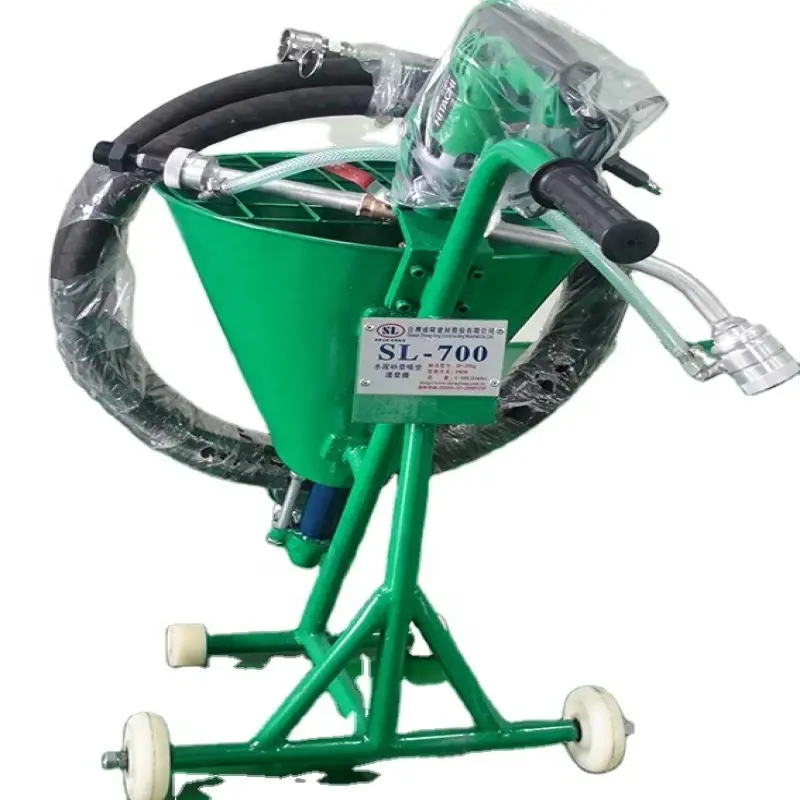
Diesel Wall Cement Plastering Mortar Spraying Machine

- Section : Machinery
- Category : Engineering & Construction Machinery
- SKU : 11000001390211

Product Description

According to market's demand and the development, along with the rapid development of infrastructure, especially the construction industry, architects are more concerned about building structures - joints deformation due to thermal expansion of cold reduced , lifting foundation, shaking of high-rise building at the top, earthquakes, have caused a deformation of the building's expansion joints.
To this end, our company study in-depth of these issues, combined with the actual situation,research and develop a series of new products to meet market demand, and accepted by the majority of user.
New materials, new technology, SL-700 mortar spraying machine is the best choice for construction industry.
Characters
1.Solid and Portable:
The body is made by iron, and the bottom with 4 wheels, easy to take along.
2.Easy to use and repair
Spray gun used for conveying and closed particles coating materials which is less than 2mm.Under the combination of air compressor, atomizing the material, and spraying evenly on the surface of the building.
Grouting Packer do the function of conveying and closing couting material. Slurry the material into building interior, to achieve the effect of waterproof and stop leakage.
Proper Structure can be repaired to avoid stopping working caused by the repair can be avoided.
3.Fast speed and efficient
Speed up to 1200RPM, more efficient.
4.Less waste, less manpower.
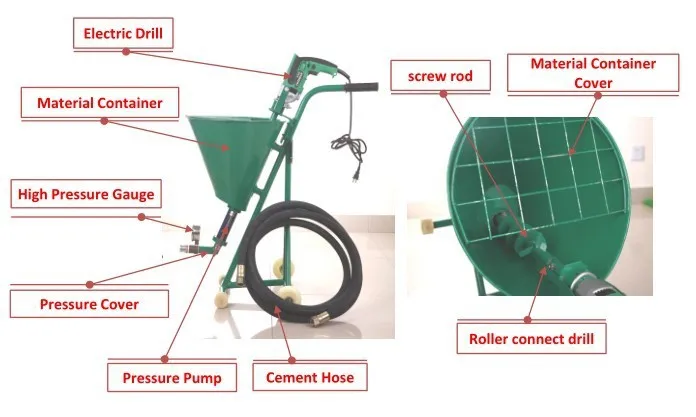
Hopper design material container, original Hitachi D13VG Drill, adjustable and high torque, suitable for one gear when in using,less waste and manpower.
Standard Equipped

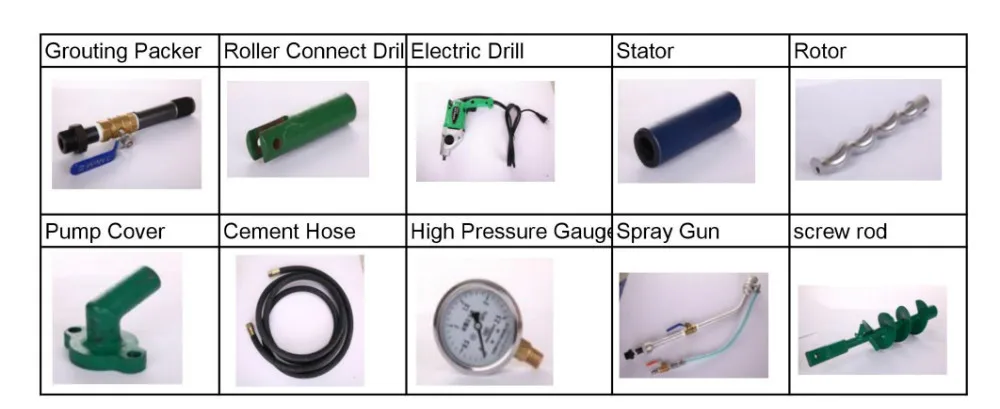
| 1. Machine Body 1 set |
| 2.Electrical Drill 1 unit |
| 3.High Pressure Gauge 1 unit |
| 4.Spray Gun 1unit |
| 5.Grouting Packer 1 Unit |
| 6.Cement Hose 1 Unit |
| 7. Spare Parts 1 set |
| 8. Instruction booklet 1 unit |
Product parameters

| ITEM NO. | SL-700 |
| Net Weight/Gross Weight: | 21.00/27.00kgs |
| Drill Power: | 800W/220v |
| Flow:(L/Minute) | 1-10L |
| Granular material: | Less than 2mm |
| Speed:(RPM) | 0-1200 |
| Pressure:(kgs) | 20.00 |
| Packing Measurement:(CM) | 78x51x96CM |
Application Area

1.Leak resistance and leak stopping projects: suitable for expansion joint/movement joint leaking, settlement joint leaking, metro leaking, tunnel leaking, mine leaking, dam leaking and other leak resistance and leak stopping projects.
2.Structure strengthening projects: suitable for terrace hollow, crack strengthening, bridge strengthening and other strengthening projects.
3.Waterproofing spraying projects: suitable for indoor and outdoor spraying, cement mortar spraying, dry powder mortar spraying, putty powder spraying, waterproofing material and waterproofing surface spraying, ceiling spraying, wall spraying, coating/painting spraying, gardening spraying, relief effect coating, art and craft spraying, emulsion paint, stone-like paint, manmade rock spraying, carving and sculpture spraying, damping material spraying and other spraying projects.
Suitable Material
1.Cement Mortar
2.Putty Powder
3.Emulsion Paint
4.Waterproof Coating Material
Spraying Operation Instructions
1.pore some clean water into the material barrel before starting up, the rotating speed should be adjusted to middle high speed, so that it can make the hose wet. Continuing for a short time, then drain the clean water .
2.put the material(mixed evenly first) into the material barrel, then lock the hose and joint with the spraying grouter tightly.
3.before spraying, the pressure of the air compressor should reach 8kg(the matching air compressor should be 0.26-0.36m), then lock the spraying nozzle.
4.switch on, put the spraying nozzle against the material barrel, then adjust the pressure of air compressor and the rotating speed of the spraying grouter to make the spray pattern better. Then switch off the spraying grouter, leave the air compressor on.
5.after adjusting the spray pattern, move the spraying nozzle to the construction places.
6.the hose is full of material when it is running, so it is not good to let the spraying grouter off for a long time. If power failure happens, the hose should be taken down immediately.
7.if the pressure in the hose is high, cover a piece of cloth on it before take it down to protect your eyes.
8.when you are failed to start up the spraying grouter, please check the electrical driving drill to see if it is burned out. If the electrical driving drill is burned out, replace it with a new one.
9.when cleaning the spraying grouter with water, do not wet the electrical driving drill or electrical controlling box. Otherwise it may be damaged.
10.clean the material barrel, hose, spraying nozzle and joint after work.
11.after using for a long time, the pressure pump may wear out. The one pressure pump need to be replaced with a new one.
12.If it doesn’t work while the electrical driving drill is still on, then the spraying nozzle is blocked. Switch off the spraying grouter and clean the spraying nozzle.
Grouting Operation Instruction
1.Make sure the switch of the electrical driving drill is on off direction, the new injection pump should be lubricated by the lubricant before using. The body and the accessories should be mopped with a lubricant saturated cloth. Pour the cement into the material cup. Turn the switch to open and the injector to the dust bin. Turn of the power switch, Expel the lubricant from the hose until the medicament come out. Turn off the power and then the switch value
2. Confirm the location of expansion joint. Drill a hole about 16mm on the joint, the distance of hole is about 50-100cm
3.Put the grouting packer into the hole, and clamp rigidly.
4. Connect the injection nozzle with the packer, and clamp well. Turn on the switch value and then the power, inject the cement(the granule should be less than 2mm) to the structure until overflow...and then turn to another hole to grout untill the joint is being filled.
5.After construction, clean up the injection pump immediately with special cleanser. Pour the cleanser into the material cup and expel it from the hose. Put the injector into the material cup, turn on and off the switch value for several times to create pressure in the hose. It helps clean. After 3 to 5 minutes, expel the cleanser from the pump to the dust bin. After that, lubricant is necessary for maintain to avoid residue blocking in the hose.
- Shipping Timeframes: All orders are processed within 2-5 business days (excluding weekends and holidays). After your order has been processed, the estimated delivery time is before 14 Dec, 2026, depending on customs, Please note that due to high demand, some items may experience longer shipping times, which will be communicated at order confirmation email.
- Order Processing Time: Please allow 2-5 business days for us to process your order before it is shipped . Orders placed after 16:00 on Fridays, or during weekends and public holidays, will begin processing on the next business day. Processing times may be extended during peak seasons or sales events.
- Manufacturing Time: Some products needs manufacturing time, the manufacturing process will take approximately 10-30 business days depending on the product. This timeframe may vary depending on the complexity of the product and current demand. but this will be communicated with you during order confirmation.
- Returns and Exchanges: We offer a 30-day return policy for most items. If you are not completely satisfied with your purchase, you may return it within 30 days of receipt for a refund or exchange. Items must be unused, in their original packaging, and accompanied by proof of purchase. Return shipping costs are the responsibility of the customer, unless the item was damaged or defective upon arrival.
1. What is the Diesel Wall Cement Plastering Mortar Spraying Machine (SL-700) used for?
The SL-700 is designed for spraying cement mortar, putty, dry powder mortar, waterproof coatings and similar materials (granules <2 mm). Typical uses include leak sealing (expansion joints, tunnels, dams), structure strengthening (bridges, terraces), interior/exterior wall and ceiling spraying, decorative finishes and grouting/injection work.
2. What are the key technical specifications of the SL-700?
Net/Gross weight: 21 / 27 kg; Drill power: 800 W / 220 V; Flow: 1–10 L/min; Granular size: <2 mm; Speed: 0–1200 RPM; Pressure: 20 kg (pump); Packing size: 78 × 51 × 96 cm.
3. Which materials can I spray or inject with this machine?
Suitable materials include cement mortar, putty powder, emulsion paint and waterproof coating materials, as long as particle size is under 2 mm and the material is mixed to a pumpable consistency.
4. What air compressor do I need to operate the sprayer?
Before spraying, the air compressor pressure should reach about 8 kg (as stated in the manual). The recommended air supply range in the manual is 0.26–0.36 (check the unit and local spec). Use an air compressor that can reliably supply this pressure and the necessary flow for consistent atomization.
5. How do I prepare the machine before spraying?
Pour clean water into the material hopper and run at mid-high speed briefly to wet the hose, then drain. Mix materials thoroughly, load into the hopper, securely connect hoses and spray gun, ensure compressor pressure is correct, then adjust rotating speed and air pressure while spraying into the hopper to set the spray pattern before moving to the work surface.
6. What are the steps for grouting/injection with the packer?
Lubricate the new injection pump, load mixed cement into the cup, vent lubricant through the hose until material flows, drill 16 mm holes spaced 50–100 cm along the joint, insert and clamp grouting packers, connect injector, turn on valve and power, inject until overflow, then move to the next hole. Clean immediately after finishing.
7. How do I clean and maintain the machine after use?
Clean the material barrel, hose, spray nozzle and joints after work. For the injector, run a special cleanser through the pump and hose, cycle the valve several times to create pressure, then expel cleanser. Lubricate pumps and moving parts regularly to prevent residue build-up. Replace the pressure pump if worn.
8. How do I unclog the spray nozzle or hose if material stops flowing?
If nozzle blockage occurs, switch off power and clean the spray nozzle thoroughly. If the drill runs but nothing sprays, check the nozzle for blockage. Also ensure hoses are not kinked and material is properly mixed and filtered (granules <2 mm).
9. What troubleshooting steps should I take if the sprayer won't start?
Check the electrical driving drill (motor) and power connections. If the drill is burned out, replace it. Ensure the main switch is in the OFF position before inspecting or replacing components. Verify air compressor is supplying required pressure.
10. Are spare parts and accessories included with the machine?
Standard equipment includes machine body, electrical drill, high pressure gauge, spray gun, grouting packer, cement hose, a set of spare parts and an instruction booklet.
11. Is the machine portable and easy to move on site?
Yes. The SL-700 has an iron body with four wheels for portability. At 21 kg net weight it is relatively easy to transport around the jobsite.
12. What operator safety precautions should I follow?
Do not wet electrical components (drill or control box). When disconnecting a pressurized hose, cover it with cloth to protect eyes from material spray. Avoid letting the machine run idle with hose full of material. Follow standard PPE: goggles, gloves, dust mask/respirator and hearing protection.
13. How should I store the machine between jobs or long-term?
Clean and flush all material from hopper, hoses and pump with appropriate cleanser, lubricate moving parts and pumps, store in a dry place protected from dust and moisture. Remove electrical drill if storing for long periods.
14. What routine parts may need replacement and how often?
Wear parts include the pressure pump, gaskets/seals and spray/nozzle components. Frequency depends on usage and abrasive content of materials; inspect regularly and replace worn parts to maintain performance.
15. Where can I get service, spare parts or warranty information?
Refer to the instruction booklet for supplier contact details. For warranty, service and genuine spare parts contact your vendor or the manufacturer's authorized service center listed in the manual.
Latest Order Arrivals
Discover our latest orders

12 Heads Embroidery Machine

Toilet Paper Machine Machine

Order Collection

Cross Border Clients

Order cros border countries Collected

Industrial Machine Cllection

Agriculture Processing Machines

Ready for collection

Water Pump Equipment

Packaging Machine and accessories

Fabrics Manufacturing Equipment

Mining Equipments

Food Processing Machine

Batch of Orders

Batch of Orders

Latest Orders Labelled

wheel alignment machines

new arrivals

Pre Orders Offloading

Latest Arrivals

Latest Arrivals

Latest Arrivals

Loading

Toilet paper making machine

Toilet paper making machine

Toilet paper Rewinding Machine

latest arrivals

offloading

order success

order collection

order offloading