B21, China Town Mall, Midrand

Browse categoriesView all categories
Appliances
View all products →Beauty & Personal Care
View all products →Car Parts
View all products →Computers
View all products →Construction Material
View all products → Building Boards & Insulation
 Coated & Treated Products
Decorative Building Materials
EPDM/PVC/TPO Membrane
Coated & Treated Products
Decorative Building Materials
EPDM/PVC/TPO Membrane
 Flat Products (Sheets, Plates & Coils)
Gabion mesh
Geocell
Geogrid
Geomembrane Welding machine
HDPE Geomembrane
HDPE Geomembrane
Hdpe/Pvc Pipe
Industrial Hardware & Fasteners
LDPE LLDPE Geomembrane
Luxury Wall Panels
Nonwoven Geotextile
Other Geosynthetics
Pipe Floater
Pipeline & Fluid Systems
Pipes & Hollow Sections
PVC Ceilings
PVC Cornices
PVC Suspended Ceilings
PVC Wall Panels
Roofing & Cladding
Roofing & Corrugated Sheets
Rubber Hose
SPC Flooring
Strips & Bars
Structural Steel & Profiles
Flat Products (Sheets, Plates & Coils)
Gabion mesh
Geocell
Geogrid
Geomembrane Welding machine
HDPE Geomembrane
HDPE Geomembrane
Hdpe/Pvc Pipe
Industrial Hardware & Fasteners
LDPE LLDPE Geomembrane
Luxury Wall Panels
Nonwoven Geotextile
Other Geosynthetics
Pipe Floater
Pipeline & Fluid Systems
Pipes & Hollow Sections
PVC Ceilings
PVC Cornices
PVC Suspended Ceilings
PVC Wall Panels
Roofing & Cladding
Roofing & Corrugated Sheets
Rubber Hose
SPC Flooring
Strips & Bars
Structural Steel & Profiles
Consumer Electronics
View all products → Camera & Photo
 Chargers, Batteries & Power Supplies
 Commercial Equipment
 Home Audio & Video
 Portable Audio
 Printing Equipment
 Professional Audio
 Security & Protection
 Testing Equipment
Commercial Equipment
 Advertising Boards
 Advertising Inflatables
 Advertising Light Boxes
 Commercial Fryers
 Computer Hardware & Software
 Digital Signage and Displays
 Display Racks
 Food Trucks
 Ice Cream Machines
 Interactive Boards
 Photo Booths
 Projectors & Presentation Equipments
 Refrigeration Equipment
 Supermarket Shelves
 Vending Machines
Electrical & Tools
View all products →Furniture
View all products → Bedroom Furniture
 Commercial Furniture
 Decorations
 Dining Room Furniture
 Kitchen Furniture
 Living Room Furniture
 Office Furniture
Kids & Toys
View all products →Machinery
View all products →
Aftersales
 Agriculture Machinery
 Apparel Machinery
 Chemical Machinery
 Cleaning Equipment
 Construction Machinery
 Environmental Machinery
 Food & Beverage Machinery
 Industrial Machinery
 Machine Tool Equipment
 Machinery Accessories
 Material Handling
 Packaging Machines
Agriculture Machinery
Apparel Machinery
Chemical Machinery
Cleaning Equipment
Construction Machinery
Environmental Machinery
Food & Beverage Machinery
Industrial Machinery
Machine Tool Equipment
Machinery Accessories
Material Handling
Packaging Machines
Construction Machinery
 Brick Making Machinery
 Concrete Mixers
 Concrete Pumps
 Crushers
 Drilling Rigs
 Engineering & Construction Machinery
 Excavators
 Gas Generation Equipment
 Loaders
 Mineral Separators
 Mining Machinery
 Mortar Spray Machines
 Other Construction Machinery
 Road Machinery
 Stone Machinery
 Tile Making Machinery
 Truck Cranes
Food & Beverage Machinery
 Baking Equipments
 Beverage & Wine Machines
 Cake machine
 Donut machines
 Fermenting Equipment
 Fish Processing Machines
 Flour & Rice Mills
 Flour Mill
 Food Sterilizers
 Fruit & Vegetable Processing Machines
 Fruit & Vegetable Processing Machines
 Fryers
 Ice Cream Machines
 Juice Extractors
 Meat Processing Machinery
 Meat Slicers
 Other Food Processing Machinery
 Popcorn machine
 Snack Machines
 Vegetable Cutters
 Vegetable Washing Equipments
Industrial Machinery
 Apparel & Textile Machinery
 CNC industrial Machinery
 Industrial Compressors & Parts
 Industrial Robots
 Industry Laser Equipment
 Machine Tool Equipment
 Manufacturing Machinery
 Metal & Metallurgy Machinery
 Paper Production Machinery
 Plastic & Rubber Processing Machinery
 Welding Equipment
 Woodworking Machinery
Medical Supplies
View all products → Animal & Veterinary
 Household Medical Devices
 Medical Consumables
 Professional Medical Devices
 Testing Instrument
Professional Medical Devices
 Bone Surgical Instruments
 Burns Surgery Instruments
 Clinical Analytical Instruments
 Clinics Apparatuses
 Dental Chair
 Dental Consumables
 Dental Equipments
 Dental Handpiece
 Diagnostic Apparatuses
 Emergency & Clinics Apparatuses
 General Assay & Diagnostic Apparatuses
 Hospital Beds
 Hospital Chairs
 Hospital Trolley
 Implants & Interventional Materials
 Medical Cryogenic Equipments
 Medical Imaging Equipment
 Medical Optical Instruments
 Medical Ultrasound Instruments
 Medical X-ray Equipments
 Obstetrics & Gynecology Equipments
 Oral Therapy Equipments
 Physical Therapy Equipment
 Radiology Equipment & Accessories
 Rehabilitation Equipment
 Stethoscope
 Surgical Instruments
 Transfusion, Dialysis & Circulation Machines
 Vacuum Suction Devices
 Visual Acuity Examination Supplies
Pet Supplies
View all products →Phones & Accessories
View all products → Featured Accessories
 Mobile Phones
 Phone Accessories
 Screen Protector Machines
 Tablets
 Telecommunications
Telecommunications
 Broadcast Intercom Systems
 Camera Modules
 Communication Antennas
 Corded Telephones
 Development Boards, Kits
 Enterprise Firewalls
 Enterprise Switches
 Fiber Optic Equipment
 Fixed Wireless Terminals
 Other Telecommunications Products
 PBX
PBX
 Signal conversion Boards
 Telecom Parts
 Wireless Infrastructure Equipment
Prefab & Modular Homes
View all products →Production Lines
View all products →Metal Components
Custom fabricated metal assemblies
Flanges, couplings, and joints
Machined metal parts and forgings
Metal brackets, connectors, and fasteners
Metal frames and chassis components
Metal plates, sheets, and coils
Metal stampings and pressings
Pipes, tubes, and fittings (steel, copper, aluminum)
Steel beams, angles, channels, and structural sections
Wire mesh and expanded metal
Raw Inputs
Ceramic powders and compounds
Composite material components
Glass sheets and raw glass materials
Plastic resins and polymers (pellets, granules, powder)
Raw minerals and aggregates
Raw rubber and elastomer compounds
Raw steel, aluminum, copper, and other metal stock materials
Textile fibers and fabrics
Wood lumber and timber sheets
Renewable Energy
View all products →Sports & Entertainment
View all products →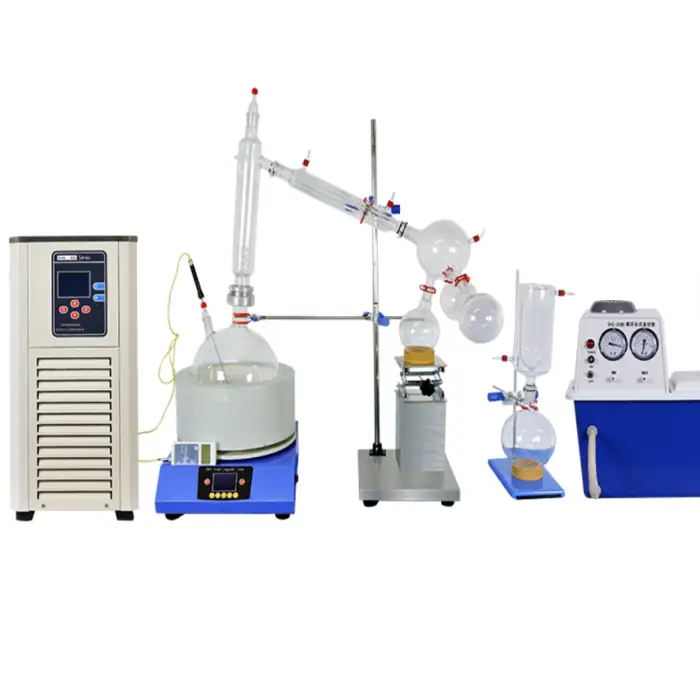
Lab Supplies
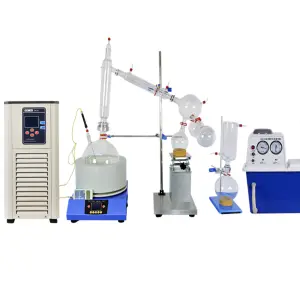
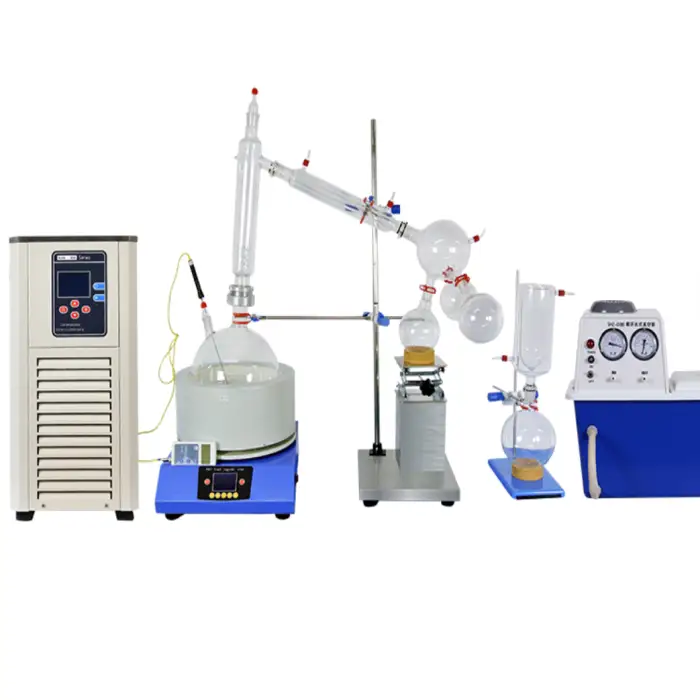
2L Laboratory Short Path Head Distillation Kit Process Complete Equipment
core components

Product Description
core components
motor
key selling points
High Productivity
Processing
Vacuum Distillation
Power Source
Electric
video outgoing-inspection
Provided
machinery test report
Provided
Power(w)
120W
place of origin
Guangdong, China
brand name
FBL
voltage
110V/220V can be customized
dimension(l*w*h)
1200*670*550 mm
After-sales Service Provided
Engineers available to service machinery overseas
Evaporation Speed
>3L/H
Collection flask
Optional
Rotating Speed
0-140rpm
Vacuum Degree:
0.098 Mpa
Price
Negotiable
Sealing
Main PTFE Seal
Application Industries
Chemical Industry
Main uses
Industrial Distillation
Material
High Borosilicate Glass
Frequently Asked Questions
What is a Laboratory Short Path Head Distillation Kit and what is it used for?
A short path head distillation kit is a laboratory glassware assembly designed to perform short path (molecular) distillation under high vacuum. It's used to purify heat‑sensitive or high‑boiling compounds by reducing the distance vapor travels before condensation, minimizing thermal decomposition. Common applications include purification of pharmaceuticals, natural products, fine chemicals, and essential oils.
What components are typically included in a complete short path distillation kit?
A complete kit usually includes a short path distillation head (condenser), boiling flask(s), receiving flask(s), cold traps, adapters, clamps, thermometers or temperature probes, PTFE stopcocks, a heated mantle or oil bath compatible flask support, and necessary tubing and seals (e.g., silicone or Viton). Some kits also include a cold finger or external condenser and basic assembly tools.
What materials are the glassware and seals made from?
High‑quality kits generally use borosilicate glass (e.g., 3.3 glass) for all vacuum and distillation components. Seals and gaskets are commonly PTFE, silicone, or Viton depending on chemical compatibility and temperature requirements. Ask the supplier for exact materials if you need specific chemical resistance.
What vacuum level is required for short path distillation?
Short path distillation typically operates under high vacuum to achieve reduced boiling points and minimize thermal exposure. Typical operating vacuums are in the range of 10^(-2) to 10^(-3) mbar (roughly 0.01 to 0.001 mbar) for sensitive compounds, but required vacuum depends on the material being distilled. A suitable high‑vacuum pump (rotary vane + mechanical booster or oil diffusion/turbomolecular system) and an effective cold trap are recommended.
What temperature ranges are used and what heating equipment is needed?
Operating temperatures depend on the material and target vacuum. Boiling temperatures under vacuum are much lower than atmospheric. Typical oil bath or heating mantle temperatures can range from 50°C to 220°C depending on your sample and flask rating. Use a compatible oil or silicone heat transfer fluid and a precise temperature controller. Verify the maximum temperature rating of seals and glassware before use.
How do I choose the right kit size (flask volume) for my work?
Select the kit size based on your batch volume and desired throughput. Common lab sizes are 50 mL, 250 mL, 500 mL, 1 L, and multi‑liter setups. As a rule of thumb, do not fill the boiling flask more than 40–50% to allow proper vaporization and prevent bumping. If unsure, consult the vendor with your typical batch size and viscosity.
What vacuum pump and cold trap should I use with this equipment?
A robust vacuum system is crucial. For routine short path distillation, a two‑stage rotary vane pump with a cold trap and optionally a vacuum booster or turbomolecular pump is common. Use a cold trap cooled with dry ice/acetone, liquid nitrogen, or a refrigerated trap to protect the pump from condensable vapors. Match the pump's ultimate vacuum and flow rate to your kit size and expected vapor load.
How do I assemble and set up the short path distillation apparatus safely?
Assemble on a stable lab bench or fume hood using proper glassware clamps and lab stands. Ensure all joints are clean and greased (if required), seals are compatible with temperature and chemicals, and the condenser and receiving flasks are positioned correctly. Connect the vacuum pump through a cold trap. Start heating slowly while applying vacuum gradually to avoid bumping. Always wear appropriate PPE and follow institutional safety protocols.
How do I prevent bumping and sample loss during distillation?
To minimize bumping: use an appropriate fractionating surface (e.g., boiling beads, spin bars when compatible), reduce the fill level, apply vacuum slowly, ramp temperature gradually, and maintain smooth vacuum control. For very viscous samples, consider pre‑filtering and degassing. Using an anti‑bumping granule or controlled stirring can help, but ensure compatibility with high vacuum.
How should I clean and maintain the distillation kit?
Clean glassware after cooling by rinsing with appropriate solvents, followed by more polar washes if needed, then dry thoroughly. Avoid harsh mechanical shocks or thermal stresses. Inspect joints, clamps, and seals regularly for wear; replace any cracked glass or degraded gaskets. Keep the cold trap and pump oil clean and change pump oil per manufacturer recommendations. Store glassware assembled with light joint protectors or separated to avoid chipping.
What safety precautions are important when using this equipment?
Key precautions: operate in a well‑ventilated fume hood, use appropriate PPE (gloves, eye protection, lab coat), be cautious with hot baths and high temperatures, ensure vacuum lines have trap protection to prevent chemical exposure to pumps, avoid rapid pressure changes that can shatter glass, and be mindful of flammable or toxic vapors. Have spill cleanup materials and emergency procedures in place.
Can I use this kit for essential oils, cannabinoids, or food‑grade products?
Yes, short path distillation is commonly used for concentrating and purifying essential oils and botanical extracts, including cannabinoid distillation. However, ensure materials of construction (glass and seals) are compatible, and that processing follows any applicable regulatory and safety standards for consumable products. For large‑scale or regulated work, consult process and compliance experts.
What troubleshooting steps help if distillation yield or separation is poor?
Check vacuum level (leaks or insufficient pump), confirm correct bath temperature and stable control, verify condenser cooling efficiency, ensure correct distillation head positioning and joint integrity, reduce sample fill or improve agitation, and confirm that the sample is pre‑filtered and degassed. If problems persist, review boiling point data under your vacuum conditions and consider altering temperature or vacuum setpoints.
Are replacement parts and spare glassware available?
Most suppliers provide replacement glass components, gaskets, thermometers, and fittings. When purchasing, ask about availability of spare parts for common wear items like joints, seals, and receiving flasks. Keep a record of glass part numbers or joint sizes to simplify reordering.
How do I choose between a short path head kit and alternative technologies (e.g., wiped‑film distillation)?
Short path heads are ideal for small‑ to medium‑scale lab purification of heat‑sensitive compounds with relatively low viscosity. Wiped‑film or thin‑film distillation is better for high‑throughput, viscous feeds, or industrial scale because it provides continuous feed and larger surface area for heat transfer. Choose based on batch size, viscosity, required throughput, and budget.
Technical Specifications
No approved technical specifications are available yet. Please refer to the product description or contact our team.
Related Products

Latest Order Arrivals
Discover our latest orders

12 Heads Embroidery Machine

Toilet Paper Machine Machine

Order Collection

Cross Border Clients

Order cros border countries Collected

Industrial Machine Cllection

Agriculture Processing Machines

Ready for collection

Water Pump Equipment

Packaging Machine and accessories

Fabrics Manufacturing Equipment

Mining Equipments

Food Processing Machine

Batch of Orders

Batch of Orders

Latest Orders Labelled

wheel alignment machines

new arrivals

Pre Orders Offloading

Latest Arrivals

Latest Arrivals

Latest Arrivals

Loading

Toilet paper making machine

Toilet paper making machine

Toilet paper Rewinding Machine

latest arrivals

offloading

order success

order collection

order offloading

collected
Recently Viewed Products