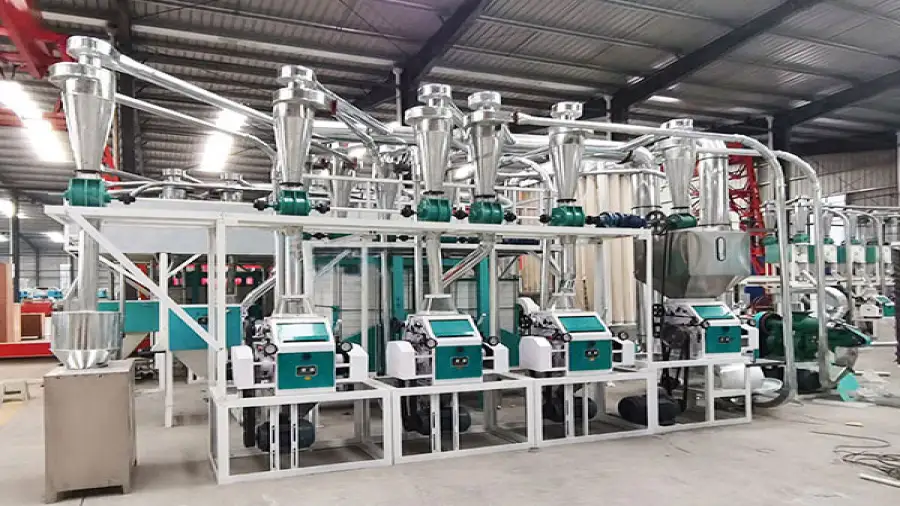
A maize milling plant converts cleaned maize grain into products such as maize meal/flour, samp, and grits. In many African markets, milling is not only a consumer staple—it is also part of national food security and price stability conversations.
For a factory investor, the success of a maize mill is usually decided by four fundamentals:
- Raw maize supply reliability (price, volume, seasonality)
- Extraction rate and product mix (how much saleable meal you get per ton of maize)
- Power and uptime (grid reliability, backup power, maintenance discipline)
- Route-to-market (bulk buyers, wholesalers, retail packaging strategy, and distribution)
Your goal when planning is to design a plant that converts these fundamentals into predictable unit economics (margin per ton) and predictable operational performance (tons per day).
Market Opportunity in Africa
Maize is deeply embedded in food consumption across sub-Saharan Africa. A credible indicator of demand strength is how much household spending and caloric intake is linked to maize: maize accounts for a large share of low-income food expenditure and contributes a substantial portion of dietary calories in many SSA diets.
Demand drivers that make maize milling investable
Population growth and staple demand
Sub-Saharan Africa’s population is large and growing, and staple foods typically remain high-frequency purchases even during economic slowdowns. World Bank regional indicators show SSA population around the 1.29 billion range and continuing growth.
Urbanization and packaged staple consumption
Urban growth tends to shift demand from informal, “bring-your-grain” community milling toward packaged products sold through wholesalers and retailers (in smaller, branded formats). Urban population growth in SSA has been running in the mid-single digits in recent years, supporting the expansion of formal retail and more standardized packaging.
Food safety and product standardization
As markets formalize, buyers increasingly request consistent granulation, reliable weights, and labeling—especially for institutional customers (schools, hospitals, NGOs, and FMCG distributors). Codex standards and national regulations influence product expectations around moisture, safety, contaminants, and labeling.
Fortification policies
Many countries have fortification policies for maize meal/flour (or related staples). For example, South Africa’s regulations specify minimum micronutrient levels and labeling considerations for fortified maize meal at manufacturing/import/sale points.
This matters because fortification changes your equipment needs (e.g., vitamin doser), QC approach, and compliance documentation.
What “winning” looks like in practice
A maize mill often wins by becoming one of the most reliable suppliers in its radius (consistent quality + consistent availability). The brand and distribution strategy matter, but in staple milling, the operational discipline and supply chain are usually the “engine” that customers ultimately trust.
Investment Range and Capacity Planning
This section gives three practical CAPEX scenarios based on publicly listed manufacturer benchmarks for mills of different capacities, plus the cost buckets you should budget beyond the mill itself.
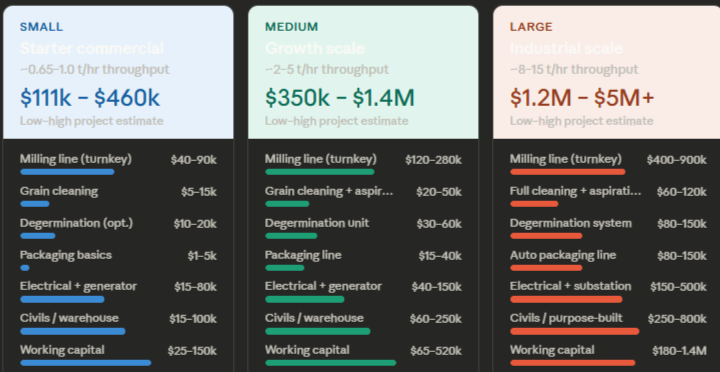
CAPEX scenarios (small, medium, large)
Below are equipment cost anchors from publicly listed price ranges for turnkey mills and key equipment modules (manufacturer list pricing). Your all-in project budget should also include building/civils, power, storage, packaging, and working capital.
Small plant (starter commercial scale)
Typical throughput: ~0.65–1.0 ton/hour milling system (often a “starter mill” category).
Equipment anchor (turnkey mill): A listed starter mill at this size can start around ZAR 679,000 for a base configuration.
Common use case: Start with wholesale/offtake customers or community service milling, then upgrade to better cleaning/degermination and packaging.
Indicative cost buckets (USD planning range)
- Milling line package (starter turnkey): $40k–$90k (depends on configuration, automation, packing)
- Grain cleaning + basic aspiration: $5k–$15k (capacity dependent)
- Small degermination (optional but valuable for shelf life): $10k–$20k
- Packaging basics (stitcher, scale, sealer): $1k–$5k
- Electrical + backup generator (often critical): $15k–$80k (site-specific)
- Civils / warehouse adaptation: $15k–$100k (site-specific)
- Initial working capital (maize stock + packaging + wages): $25k–$150k (depends on volumes)
Planning takeaway: Small mills can be launched lean, but they are sensitive to power reliability and raw maize price swings because you have less scale to absorb shocks.
Medium plant (commercial packaging & distribution scale)
Typical throughput: 2–3 tons/hour (often 48–72 tons/day nameplate).
Equipment anchor (turnkey mill): Public listing shows ~US$223,650 to US$382,500 (approx.) for a 2–3 ton/hour mill range.
Operational note: Some compact mill designs reduce civil requirements; one example specifies standard industrial concrete floors and a roof height requirement (no special structure needed).
Indicative cost buckets (USD planning range)
- Turnkey milling line + controls: $225k–$450k
- Storage + handling (bins, conveyors, elevators): $30k–$200k
- Packaging line (weighing + bagging + stitching; semi-auto if needed): $10k–$120k (automation-dependent)
- Quality lab basics (moisture meter, sampling, records): $2k–$20k
- Fortification equipment (if required): $1k–$5k (plus premix supply)
- Civils / utilities / transformer / generator: $50k–$400k (site-specific, power reliability dependent)
- Working capital: $50k–$300k
Planning takeaway: Medium plants are often the “sweet spot” for entrepreneurs who want branded packaging and meaningful distribution without building a megaproject.
Large plant (high-volume, multi-product, automated)
Typical throughput: ~5 tons/hour class (large footprint, automation, multiple product streams).
Equipment anchor (turnkey mill): One publicly listed 5 ton/hour system starts from ZAR 17,850,000 (base configuration).
Indicative cost buckets (USD planning range)
- Turnkey high-capacity milling line + automation: $900k–$1.6m (configuration-dependent)
- Silos/storage + receiving + bulk handling: $200k–$2.0m
- Advanced packaging (higher speed, multi-SKU): $100k–$800k
- Larger power infrastructure + redundancy: $150k–$1.0m
- Quality + food safety systems (HACCP/ISO-ready): $25k–$250k
- Working capital: $150k–$1.0m
Planning takeaway: At large scale, distribution and raw maize procurement become “the business,” and milling is the conversion engine.
Production capacity and typical output examples
Extraction rate matters because it determines how much sellable maize meal you produce per ton of maize input. A public benchmark for a commercial mill indicates extraction rate ranges roughly ~69–74% for certain maize meal grades and ~80–85% for refined/special meal—dependent on maize quality and market requirements.
Examples (illustrative):
- If you mill 100 tons of maize grain/month at 72% extraction, you may produce ~72 tons of maize meal plus ~28 tons of bran/germ/offal (some of which can be sold into feed markets).
- A 2–3 ton/hour mill can be scaled by operating hours and days; capacity specs are typically stated as nameplate throughput.
Equipment and Process Design
A conventional maize milling process typically links: intake and cleaning → conditioning → degermination → milling and sifting → (optional) fortification → packaging.
Cleaning and degermination are not “nice-to-haves”—they directly affect product quality, shelf-life, and contamination risks.
Detailed equipment list (specs + indicative price ranges)
Below is a practical equipment list with brief specs and indicative price ranges, based on publicly listed manufacturer pricing for individual modules and mills (often in ZAR).
Note: Exact pricing varies by brand, capacity, automation, steel type, and shipping/installation. Use these as budgeting anchors, then request a formal quotation for your exact configuration.
Intake, pre-cleaning, and separation (protects quality and equipment)
- Grain cleaner (example: 4–6 ton/hour class): removes foreign matter before milling.
- Price anchors include maize grain cleaners listed around ZAR 44,000–140,000 depending on model/capacity.
- Aspirator leg / aspiration: removes light impurities (husks, dust).
- Example listing from ZAR 15,000+.
- Magnets (metal removal): often low-cost but critical for equipment safety.
Conditioning / tempering (improves bran separation and milling performance)
- Conditioning conveyor / water dosing: adds controlled moisture for better separation.
- Conditioning conveyor is listed in the tens of thousands of ZAR range.
Degermination (quality and shelf-life enabler)
- Degerminator (small): 800–1200 kg/hour, listed from ZAR 231,000.
- Degerminator (higher capacity): up to 7 ton/hour, listed from ZAR 425,000.
Degermination helps separate bran and germ from endosperm, supporting cleaner, more stable meal.
Milling (size reduction into meal/flour)
- Roller mill / maize milling machine (community/rural scale): ~650–750 kg/hour mills are publicly listed (e.g., a 750 kg/hour maize mill).
- Hammer mill (often for certain applications, feed, or specific meal specs):
- Example listing: 1500 kg/hour hammer mill from ZAR 28,800.
Sifting and grading (controls granulation and product consistency)
- Mono sifter (example listing): 4 ton/hour class, ZAR 200,000.
Handling (keeps the plant moving)
- Bucket elevator: listed from ZAR 68,000 (height and capacity dependent).
- Screw conveyors: listed from ZAR 17,200+ depending on length and configuration.
- Storage bins (buffer inventory for steady packaging): price varies by volume.
Fortification (if required by law or market)
- Vitamin doser (example listing): ZAR 28,000 for a micro doser feeder.
Fortification decisions should follow national legislation and guidance (WHO provides fortification guidance on maize flour/corn meal).
Packaging (monetization happens here)
- Bag stitcher/closer: example listing ZAR 22,000.
- Weighing scale + bagging: automation level defines cost and throughput.
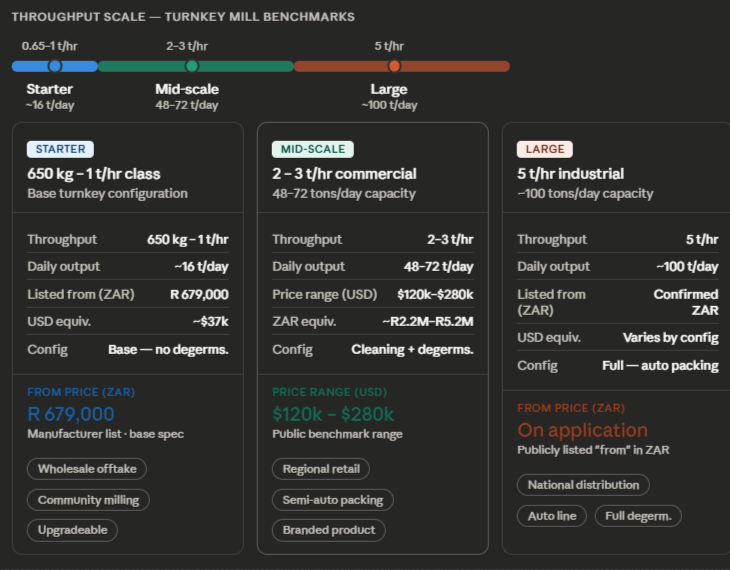
Turnkey mill reference points (public benchmarks)
- Starter mill: 650 kg to 1 ton/hour class; listed “from” pricing and extraction rates are provided publicly for a base configuration.
- Commercial mid-scale mill: 2–3 tons/hour (48–72 tons/day) with an example public price range shown in USD equivalent.
- Large mill: 5 tons/hour, with public “from” pricing shown in ZAR.
Use these as anchors when sizing your project.
Setup, Operations, and Compliance
Factory setup process
Site selection Choose a site based on (1) maize supply routes, (2) distribution access, and (3) power reliability. If you are far from maize-producing areas, transport costs can erase margins quickly.
Utilities and power Power downtime is a major risk. Regional electricity access is uneven, and reliability varies by country and industrial zone.
Some mill systems are designed to restart quickly after outages (helpful where power interruptions are common).
Layout Plan your layout to prevent cross-contamination and reduce handling losses:
- Raw maize receiving and storage (clean separation from finished goods)
- Cleaning and conditioning
- Milling and sifting
- (Optional) fortification dosing point
- Packaging and palletizing
- Finished goods warehouse and dispatch
Compact designs can reduce civil cost requirements; one example states standard concrete floors and a minimum roof height requirement.
Installation and commissioning A turnkey package may include installation, commissioning, training, and delivery (depending on your supplier).
Verify what is included before you finalize your budget.
Staffing Staffing scales by automation and packaging format. A public mill benchmark indicates a staffing example of one operator and multiple packers per shift for a standard packing option.
Plan for maintenance capability (either in-house or contracted) to protect uptime.
Regulatory and quality standards
Codex product standard (global reference) Codex provides a standard for whole maize (corn) meal for direct human consumption (CXS 154-1985), including requirements and key safety considerations such as moisture limits and mycotoxin compliance.
The standard also references hygiene practices aligned to the Codex General Principles of Food Hygiene (CXC 1-1969).
Key highlights you should operationalize:
- Moisture control (Codex indicates maximum moisture for whole maize meal, and notes climate/storage considerations).
- Control of contaminants such as pesticide residues and mycotoxins (important for aflatoxin risk management).
- Packaging and labeling requirements (Codex standard references general labeling standards).
Food safety system expectations Many commercial buyers will expect evidence of good hygiene practices and, increasingly, a HACCP-based approach. The Codex General Principles of Food Hygiene define prerequisite programs (GHP/GMP) as the foundation for HACCP systems.
ISO 22000 is a widely recognized framework for food safety management systems and can be certified to.
Fortification regulations (country-specific) If your market mandates fortification, you must comply with local standards and labeling requirements. For example, South Africa’s government regulations specify minimum micronutrient levels in uncooked maize meal and rules for labeling fortified food vehicles.
Even if fortification is not mandated, some buyers may prefer fortified products.
Profitability Model, Risks, and Next Steps
Operating costs and profitability example (illustrative model)
A useful way to model profitability is “margin per ton of maize processed,” driven by:
- Extraction rate
- Maize grain input price
- Sales price of maize meal
- Sales price of bran/offal
A public milling profit calculator emphasizes these as major profitability drivers.
Assumptions (example only; adjust to your market)
- Plant size: 2 tons/hour throughput
- Operating schedule: 10 hours/day, 26 days/month → 520 tons maize/month (input)
- Extraction rate: 72% maize meal, 28% bran/offal
- Selling price: maize meal $450/ton, bran $120/ton
- Maize grain cost: $280/ton
- Packaging + additives (incl. fortification premix if applicable): $25/ton of meal
- Utilities + labor + maintenance + overhead: $18,000/month (site-dependent)
Monthly revenue
- Meal output: 520 × 72% = 374.4 tons
- 374.4 × $450 = $168,480
- Bran/offal: 520 × 28% = 145.6 tons
- 145.6 × $120 = $17,472
Total revenue ≈ $185,952
- 145.6 × $120 = $17,472
Monthly cost
- Maize grain: 520 × $280 = $145,600
- Packaging/additives: 374.4 × $25 = $9,360
- Utilities + labor + maintenance + overhead: $18,000
Total cost ≈ $172,960
Illustrative monthly operating profit ≈ $12,992
Illustrative annual operating profit ≈ $155,904
Payback period (simple illustration)
If your all-in project CAPEX is $500,000, a $155,904/year operating profit implies a simple payback of ~3.2 years (before tax/financing). Actual payback depends heavily on the maize-to-meal price spread and uptime.
Key risks and mitigations
Raw maize price volatility and supply shocks
Mitigation: diversify procurement (aggregators + direct farmers), maintain minimum stock coverage, and build pricing terms with major buyers.
Energy reliability
Mitigation: size backup power, choose equipment with practical restart characteristics, and design for controlled shutdown (protect product and reduce waste).
Food safety and mycotoxins (aflatoxin risk)
Aflatoxin contamination can begin in the field and worsen during storage and transport.
Mitigation: moisture control, cleaning, supplier QA, good storage practices, and testing protocols aligned to standards and buyer expectations.
Regulatory and labeling non-compliance
Mitigation: build compliance into operations early—follow Codex references, implement GHP/HACCP, and align with national fortification and labeling requirements where applicable.
Case example (realistic hypothetical)
Project: 2–3 tons/hour maize meal plant near a regional trading city
Goal: supply wholesalers with 5 kg and 12.5 kg bags and sell bran to local feed producers
Configuration: compact shift-based operation; target extraction 70–74% for standard meal; later add refined line based on demand
Why it works: proximity to maize supply routes + strong distribution partnerships; basic fortification system added once compliance requirements confirmed
First 90 days focus: stabilize procurement, lock in three wholesale buyers, reduce downtime, and formalize QC checks.