


















































































































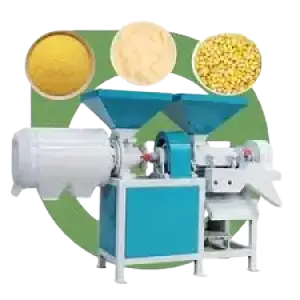
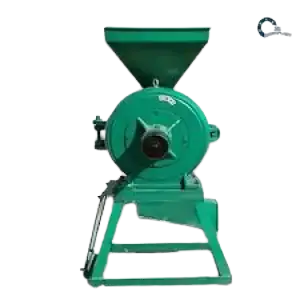

































































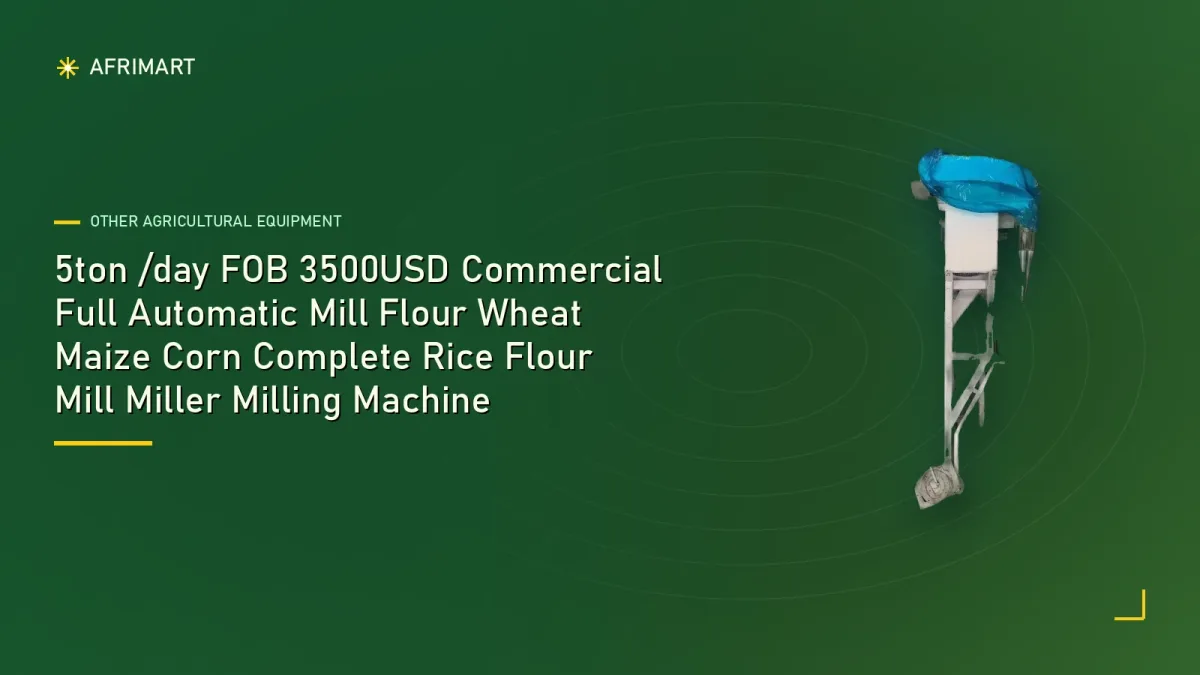
The 5ton /day FOB 3500USD Commercial Full Automatic Mill Flour Wheat Maize Corn Complete Rice Flour Mill Miller Milling Machine is a commercial maize flour mill grinding machine designed to grind wheat, maize, corn, rice and other grain into flour for small and medium processing businesses. A verified differentiator is its selectable production capacity range of 300 kg/h to 2 ton/h, supported by a 7.5 kW motor.
At a glance
Best suited to: Small and medium flour businesses, grain shops, farms and community milling services
Input material: Wheat, maize, corn, rice, grain
Final product: Fine flour
Rated capacity: 300 kg/h, 400 kg/h, 500 kg/h, 1 ton/h, 2 ton/h
Motor power: 7.5 kW
Voltage: 220V–380V–440V
What is 5ton /day FOB 3500USD Commercial Full Automatic Mill Flour Wheat Maize Corn Complete Rice Flour Mill Miller Milling Machine?
It is a multifunction flour grinder for commercial grain milling. Its job is to take raw grain inputs such as wheat, maize, corn and rice and grind them into flour for sale, further processing or local service milling.
For buyers, the key point is that this is a grinding machine, not a full grain handling plant by default. It is designed to mill grain into flour, but the published product information does not state the exact scope of upstream cleaning, feeding, conveying, sifting or packaging equipment supplied with the set. That matters when planning a complete production line.
The verified construction details are limited to its core components, which are listed as a motor and gear. No frame material, body material or named controller is published on the product page, so buyers should request a confirmed machine layout and component list before finalising the order.
How does 5ton /day FOB 3500USD Commercial Full Automatic Mill Flour Wheat Maize Corn Complete Rice Flour Mill Miller Milling Machine work?
The machine works by mechanically grinding grain through a motor-and-gear-driven milling process to produce flour. Based on the verified information, buyers can understand the process in the following stages:
Material loading: Wheat, maize, corn, rice or other grain is fed into the machine for processing. The listing confirms these raw materials, making the unit suitable for multi-grain operations rather than a single-crop use case.
Power transmission: A 7.5 kW motor provides the driving power. The source also names a gear as a core component, indicating that mechanical transmission is part of the grinding system.
Grinding action: The multifunction flour grinder reduces the grain into flour. The product description specifically states that it grinds the inputs into fine flour, which is the intended output form.
Output according to selected capacity: The machine is offered in capacity options of 300 kg/h, 400 kg/h, 500 kg/h, 1 ton/h and 2 ton/h. This means the exact production rate depends on the selected configuration rather than one fixed throughput.
Operator use and support: The listing describes the machine as easy to operate and supported by video technical support, with a machinery test report and video outgoing-inspection provided. That is useful for buyers managing remote installation or first-time operators.
The product page does not specify whether feeders, pre-cleaners, aspirators, sifters, cyclones, dust collection, conveyors, discharge bins or packaging equipment are included. Buyers should confirm the complete machine configuration and supply scope before ordering.
Where is 5ton /day FOB 3500USD Commercial Full Automatic Mill Flour Wheat Maize Corn Complete Rice Flour Mill Miller Milling Machine used?
This machine is used where businesses need daily flour production from commonly available grains. Its flexibility across wheat, maize, corn and rice makes it relevant to several African commercial and community processing settings.
Small commercial flour mills: Small processors often need a machine that can start at a moderate production level without the complexity of a large industrial line. With verified capacity options from 300 kg/h to 2 ton/h, this unit can fit entry-level and growing milling operations.
Grain shops offering value-added services: Grain retailers can use a flour grinder to move beyond raw grain sales and offer processed flour to local customers. That supports higher product variety while using the same core raw materials listed on the product page.
Farm-based processing operations: Farms producing wheat, maize, corn or rice may use the machine to process part of their harvest locally. This can support on-farm value addition, local supply to nearby markets and more control over product handling after harvest.
Community and village milling services: In areas where decentralised food processing is more practical than long-distance transport, a machine designed for easy operation can support shared service models. The stated suitability for community milling services aligns with local grain-to-flour conversion close to end users.
Food processing businesses needing fresh flour: Bakeries, snack makers and other food processors may prefer in-house or nearby milling to control freshness and reduce dependence on externally milled stock. The machine’s multi-grain capability can support businesses that use more than one flour type.
Start-ups entering the grain milling business: New operators often need equipment with a manageable footprint and clear support materials. The published dimensions of 2.77 × 1.1 × 2.2 m and the availability of test and inspection documentation are relevant for first-time project planning.
Multi-grain service processors: Some businesses serve different customer needs across seasons or regions, such as maize meal demand in one market and rice flour or wheat flour demand in another. Because the machine is verified for several grain types, it can support a broader service offering from one milling asset.
Technical specifications for the maize flour mill grinding machine
The table below summarises the verified specifications published for this Afrimart-listed maize flour mill grinding machine.
| Specification | Verified value | Buyer note |
|---|---|---|
| Product name | Maize Flour Mill Grinding Machine | Use this name when matching technical documents to the Afrimart listing. |
| Afrimart SKU | 1601295730947 | Quote the SKU in enquiries to reduce model confusion. |
| Function | Multifunction Flour Grinder | Confirms the machine is for flour grinding rather than grain cleaning or packaging. |
| Raw material | Wheat, Maize, Corn, Rice, Grain | Verify the exact grain varieties and any preparation requirements for your application. |
| Production capacity | 300 kg/h | One of several published capacity options; confirm which output level is quoted. |
| Production capacity | 400 kg/h | Capacity depends on selected configuration and operating conditions. |
| Production capacity | 500 kg/h | Buyers should align this option with daily production targets and shift length. |
| Production capacity | 1 ton/h | Confirm whether this is rated continuous throughput for the exact grain to be milled. |
| Production capacity | 2 ton/h | Request confirmation of the configuration used to achieve this output. |
| Power | 7.5 kW | Check whether the 7.5 kW figure applies to all capacity options or a specific version. |
| Voltage | 220V–380V–440V | Confirm the required phase and frequency for your country’s power supply. |
| Core components | Motor, Gear | Ask for a full bill of major components if comparing maintenance plans. |
| Dimensions (L×W×H) | 2.77 × 1.1 × 2.2 m | Use these dimensions for space planning, but request installation drawings before civil works. |
| Weight | 1300 kg | Confirm whether this is net operating weight or shipping weight before transport planning. |
| Minimum order quantity | 1 Set | Relevant for project buyers ordering a single unit. |
| Warranty | 3 Years | The product page also mentions a 1-year warranty in the features text, so buyers should request written warranty terms in the quotation. |
| Machinery test report | Provided | Useful for technical due diligence and pre-shipment review. |
| Video outgoing-inspection | Provided | Helpful for remote buyers who need evidence before dispatch. |
| After-sales service | Video Technical Support | Confirm whether installation guidance, troubleshooting and operator training are included. |
Specifications may vary according to the chosen configuration and should be confirmed in Afrimart’s current written quotation.
What are the main operational benefits?
Capacity choice for different business sizes: The published output options of 300 kg/h, 400 kg/h, 500 kg/h, 1 ton/h and 2 ton/h allow buyers to match the machine to present demand rather than oversizing from the start. That is useful for phased growth and regional market entry.
Multi-grain processing flexibility: Verified raw materials include wheat, maize, corn, rice and grain. This gives operators the ability to process more than one crop type on the same machine, subject to confirming the exact grain condition and required final flour standard.
Commercial power package: A 7.5 kW motor indicates a power-driven milling unit suited to business use rather than small domestic grinding. For buyers, that supports planning around generator sizing, electrical installation and expected energy demand.
Manageable installation footprint: The stated dimensions of 2.77 × 1.1 × 2.2 m give procurement and engineering teams a starting point for layout planning. This can simplify placement in existing workshops, service milling rooms or small processing buildings.
Documented pre-delivery review: The machine comes with a machinery test report and video outgoing-inspection. That supports technical review before shipment, especially for cross-border purchases where physical inspection may not be practical.
After-sales support for distributed projects: Video technical support is a verified after-sales service feature. In African projects where the site may be far from major service centres, remote support can help operators with set-up, basic troubleshooting and familiarisation.
Ease of operation for developing teams: The product is described as easy to operate, which is relevant for start-up mills, community operations and businesses training new staff. Buyers should still confirm the level of operating instruction supplied, but the published positioning supports relatively straightforward adoption.
Why does this equipment matter for African industry?
This kind of flour mill matters because it supports local grain processing close to where grain is grown, traded or consumed. Across Africa, many businesses are working to move from raw commodity handling into higher-value processing, and grain milling is one of the most practical first steps in that transition.
For agricultural economies, the ability to mill wheat, maize, corn and rice on one machine can support local value addition using crops already present in many regional markets. That matters differently in different countries: some areas prioritise maize meal and staple flour supply, while others may need wheat or rice flour for local food processing.
For small and medium enterprises, a machine with published capacities from 300 kg/h to 2 ton/h can fit decentralised production models. Not every market needs a very large milling plant. In many districts, district towns or farming clusters, a medium-output grinder can be more practical than transporting grain long distances for processing.
This also relates to supply resilience. Local or regional milling can reduce dependence on externally milled product where logistics are weak, roads are seasonal or delivery lead times are unpredictable. It does not eliminate wider supply challenges, but it can help create a more distributed processing base.
There is also a skills dimension. Equipment that is presented as easy to operate and backed by video technical support can help businesses build operator capability locally. In practice, that can support enterprise development, job creation in processing activities and better use of nearby grain supply chains.
What should buyers confirm before ordering?
- Required hourly output from the listed 300 kg/h to 2 ton/h options
- Target daily production and planned shift pattern
- Main grain type: wheat, maize, corn, rice or mixed grain use
- Required flour fineness and finished product standard
- Grain condition before milling
- Whether pre-cleaning equipment is included
- Whether feeding equipment is included
- Whether discharge, collection or bagging equipment is included
- Confirmed power supply voltage: 220V, 380V or 440V
- Required electrical phase and frequency
- Generator compatibility if grid power is unstable
- Available installation space for 2.77 × 1.1 × 2.2 m machine dimensions
- Floor loading suitability for 1300 kg equipment weight
- Access route for unloading and positioning the machine
- Ventilation and dust management requirements in the milling room
- Safety guarding and emergency stop arrangement
- Scope of machinery test report supplied
- Scope of video outgoing-inspection supplied
- After-sales support content under video technical support
- Spare parts supplied with the machine
- Wear parts replacement plan for motor-and-gear-driven operation
- Written warranty terms and duration
- Delivery destination and import documentation required
- Installation, commissioning and operator training responsibilities
The most consequential unstated figure is the exact configuration behind each published capacity option, including what auxiliary equipment is supplied. Buyers should request a formal equipment list and layout drawing with the written quotation to resolve this before purchase.
How to source 5ton /day FOB 3500USD Commercial Full Automatic Mill Flour Wheat Maize Corn Complete Rice Flour Mill Miller Milling Machine through Afrimart
Afrimart can help buyers confirm the correct configuration for their grain type, production target and site utilities, then prepare a project-specific written quotation.
To get an accurate offer, provide:
- Required capacity
- Intended application
- Input materials
- Project location and country
- Available utilities
- Required accessories
- Installation and training requirements
- Target project date
If your procurement process requires direct document exchange, you may also contact Afrimart at [email protected].
Frequently asked questions
What does this maize flour mill grinding machine do?
It is a commercial grinding machine for producing flour from wheat, maize, corn, rice and other grain. The verified function is a multifunction flour grinder, meaning it is intended for flour-making rather than grain storage, cleaning or packaging on its own.
What capacity is available for this flour milling machine?
The published production capacity options are 300 kg/h, 400 kg/h, 500 kg/h, 1 ton/h and 2 ton/h. Buyers should confirm which option is being quoted, because the listing presents these as selectable capacity levels rather than one single standard output.
Can this machine process maize, wheat, rice and corn on the same unit?
Yes, the verified raw materials are wheat, maize, corn, rice and grain. However, buyers should still confirm the exact grain varieties, moisture condition, pre-cleaning needs and any changeover requirements if the machine will be used for multiple grains in one operation.
What power supply does the machine require?
The published voltage range is 220V–380V–440V, and the listed motor power is 7.5 kW. Before ordering, buyers should confirm the required electrical phase and frequency for their country and check whether the 7.5 kW power figure applies to the exact capacity configuration selected.
Is the machine suitable for small and medium milling businesses?
Yes. The product description states that it works well in small and medium flour businesses, and the capacity range from 300 kg/h to 2 ton/h supports that positioning. It may also fit farms, grain shops, start-ups and community milling services, depending on required throughput and site set-up.
What support documents are provided with the machine?
The listing states that a machinery test report is provided and video outgoing-inspection is provided. These documents can help buyers review the equipment before shipment and support internal approval processes, especially where procurement teams cannot inspect the machine in person.
What after-sales support is available?
The verified after-sales service is video technical support. That means remote assistance is available, but buyers should confirm exactly what this includes, such as installation guidance, operator familiarisation, troubleshooting response and any spare-parts support included in the order.
How do I request a quotation for this flour mill through Afrimart?
Use the Afrimart product page to send an enquiry and include your required capacity, grain type, project country, available voltage, required accessories and target delivery schedule. Clear project information helps Afrimart match the machine configuration to your site and prepare an accurate written quotation.