
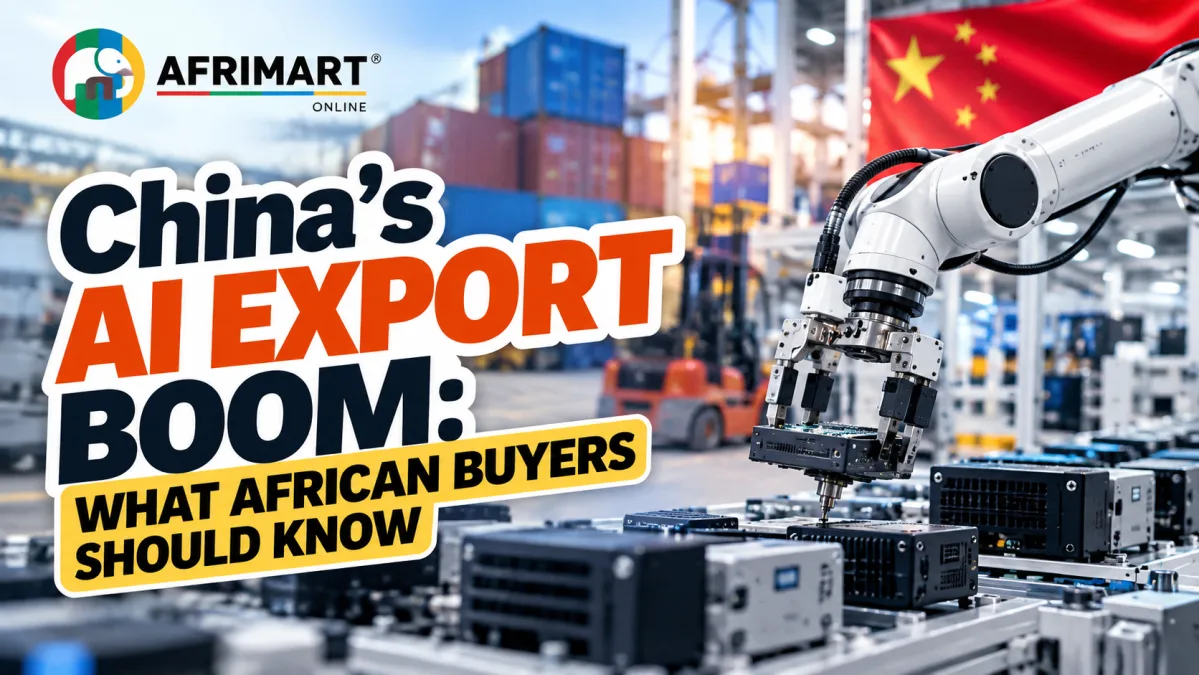
China’s AI export boom is changing more than the global technology market. It is accelerating demand for semiconductors, servers, electronic components, power systems, industrial automation and advanced manufacturing equipment. For African procurement teams, the shift creates access to a wider range of technology—but also introduces new questions about specifications, compatibility, compliance, supplier capacity and long-term support.
Official trade figures confirm that China’s export growth accelerated sharply in August 2026. However, the more important procurement story is not the headline percentage. It is the growing concentration of trade growth in technology-intensive products and the industrial supply chains supporting them.
China is increasingly exporting the physical infrastructure behind artificial intelligence: integrated circuits, computing hardware, electrical equipment, communications systems, automation components and the machinery required to manufacture them. African companies sourcing from China therefore need to understand where genuine industrial capability is expanding, where demand is putting pressure on suppliers and how the AI investment cycle may affect equipment procurement.
What is driving China’s AI export boom?
China’s AI export boom is being driven by worldwide investment in data centres, cloud computing, industrial automation and high-performance computing infrastructure.
According to China’s official customs figures, total goods trade reached RMB34.78 trillion during the first eight months of 2026, representing year-on-year growth of 17.6%. Exports increased by 14.6% to RMB20.17 trillion, while imports rose by 22% to RMB14.61 trillion.
The August figures were especially strong. Measured in Chinese yuan, exports increased by 18.6% year on year and imports rose by 21.7%. When measured in US dollars, exports increased by 25%.
This distinction matters. The percentage used in a headline can differ depending on the reporting currency and exchange-rate movements. Procurement teams should therefore check whether trade growth is being presented in yuan, US dollars, volume or value before using the figure in a sourcing decision.
The underlying product data provides a clearer picture of what is happening. During the first eight months of 2026, China’s exports of mechanical and electrical products rose by 21.9% to RMB12.91 trillion. Integrated-circuit exports increased by 95.4% to RMB1.77 trillion, while exports of labour-intensive products declined slightly.
These figures point to a structural change in China’s export mix. The country is not simply increasing the volume of conventional consumer goods it sells overseas. A growing share of its export momentum is coming from the components, production systems and digital infrastructure required by a more automated global economy.
AI exports are much broader than computers and chips
Artificial intelligence is often discussed as if it were primarily a software industry. In practice, every AI system depends on a large physical supply chain.
A data centre requires servers, processors, networking equipment, cooling systems, backup power, switchgear, cables, racks, fire-protection systems and monitoring equipment. The facilities manufacturing those products require machine tools, testing instruments, clean-room systems, robotic handling equipment and specialist production lines.
AI adoption in a factory has its own equipment requirements. Machine-vision cameras may need to be integrated with conveyors, programmable logic controllers, sensors, robotics and production-management software. An automated warehouse may require barcode systems, autonomous mobile robots, charging equipment and industrial wireless networks.
This means the AI trade category extends well beyond the most advanced processor. The World Trade Organization classifies a broad range of products as AI-enabling goods, reflecting the extensive hardware foundation required to build, operate and connect AI systems.
For African industrial buyers, the practical opportunity may not be importing cutting-edge AI processors directly. It may lie in acquiring more capable production equipment, intelligent inspection systems, energy-management controls, telecommunications hardware or industrial automation at a commercially viable scale.
China’s role is shifting from factory of the world to factory infrastructure provider
China’s manufacturing position has traditionally been associated with high-volume finished products. That model remains important, but the 2026 trade data shows a deeper role emerging.
China is becoming an increasingly important provider of the infrastructure used by other countries to manufacture, automate and digitise their economies. It supplies components, machinery and production technology to factories across Southeast Asia, Latin America, the Middle East and Africa.
This can be described as the “factory behind the factories” model. A product may be assembled in another country, but its production machinery, electronic controls, motors, tooling, intermediate components or packaging systems may still come from China.
AI-related investment strengthens this model because it raises demand across several connected industrial categories. Semiconductor plants require precision equipment. Data centres require power and cooling infrastructure. Automated factories require sensors and control systems. E-commerce growth requires warehouse machinery, packaging lines and logistics technology.
China’s manufacturing ecosystem can respond across several of these categories at the same time. That concentration of suppliers, component manufacturers, engineers, testing facilities and logistics networks remains difficult to reproduce elsewhere at comparable speed.
The result is not that every Chinese product is automatically the correct procurement choice. It means buyers need to evaluate China as an integrated industrial sourcing environment, rather than as a collection of factories offering isolated products.
What the latest Chinese trade figures actually show
The following figures provide a more accurate picture than the figures circulating in social-media graphics.
| Trade indicator | Verified 2026 result | Procurement significance |
|---|---|---|
| Total goods trade, January–August | RMB34.78 trillion, up 17.6% | China’s industrial trade base continues to expand |
| Exports, January–August | RMB20.17 trillion, up 14.6% | Overseas demand for Chinese products remains strong |
| Imports, January–August | RMB14.61 trillion, up 22% | Chinese factories are also purchasing more components and inputs |
| August exports in yuan terms | Up 18.6% year on year | Export activity accelerated during the month |
| August exports in US-dollar terms | Up 25% year on year | Currency denomination materially changes the headline rate |
| Mechanical and electrical exports | RMB12.91 trillion, up 21.9% | Technology and industrial products are gaining importance |
| Integrated-circuit exports | RMB1.77 trillion, up 95.4% | Semiconductor trade is a major source of growth |
| Labour-intensive exports | Down 0.6% | Growth is not evenly distributed across manufacturing categories |
The data does not show that every Chinese export industry is booming. It shows that growth is becoming more concentrated in higher-technology and capital-intensive categories.
UN Trade and Development has similarly warned that the current global trade expansion is not completely broad-based. AI-related products are generating a disproportionate share of growth while many conventional product categories remain under pressure.
This distinction matters for buyers. A factory manufacturing basic household products may be facing weak demand and excess capacity, while a producer of server components, transformers or industrial cooling systems may be managing a full order book. Supplier conditions cannot be inferred from China’s national export growth alone.
How AI investment is reshaping Chinese industrial suppliers
The AI investment cycle is influencing factories that may never market themselves as AI companies.
Equipment manufacturers are adding digital controls, remote monitoring, fault detection and automated quality inspection to conventional machinery. Component suppliers are improving power efficiency and thermal management. Electrical-equipment companies are adapting products for data centres and high-density computing environments.
Factories are also using AI and automation internally. Machine vision can detect production defects. Automated material-handling systems can reduce movement between workstations. Production software can monitor utilisation, maintenance and energy consumption. Robotics can perform repetitive assembly, welding, sorting and packaging tasks.
For buyers, these developments can improve product consistency and expand the range of equipment available. They can also make equipment more complicated to evaluate.
An intelligent control panel may offer useful operational visibility, but it may also depend on proprietary software. A remote monitoring function may require a stable internet connection or an overseas cloud platform. A machine-vision system may need local calibration and technical support. An automated production line may only perform correctly when the input material remains within a narrow specification.
Procurement teams should therefore avoid treating “AI-enabled” as an independent measure of quality. The correct question is whether the technology solves a defined operational problem and whether the buyer can maintain it over the expected life of the equipment.
What China’s AI export boom means for African procurement
African businesses are not entering the AI equipment market from a single starting point. A major telecommunications operator, a university laboratory, a food-processing company and a small manufacturer will have very different requirements.
For large industrial buyers, the immediate opportunity is access to increasingly sophisticated systems. Chinese manufacturers can supply production lines with integrated automation, electronic inspection and data collection that were previously available mainly from higher-cost markets.
For growing manufacturers, the opportunity may be gradual automation. A company does not necessarily need a fully autonomous factory. It may achieve a stronger operational result by automating a specific bottleneck, such as filling, labelling, sorting, cutting, quality inspection or packaging.
For data-centre and digital-infrastructure projects, China’s export expansion creates broader equipment choice. Yet these projects demand especially careful coordination across power, cooling, networking, cybersecurity, fire suppression and physical security.
For public institutions and educational facilities, growing production of scientific and computing equipment may improve access. However, procurement must still account for software licensing, training, maintenance and replacement components.
The common issue across these applications is system fit. An advanced machine that cannot operate reliably with the buyer’s available electricity, materials, workforce or maintenance capacity is not an upgrade. It is a stranded asset.
The opportunity extends beyond buying finished AI systems
The AI trade boom presents an industrial-development question for Africa: should the continent remain mainly a buyer of finished systems, or can African businesses participate in more stages of the value chain?
Building the most advanced semiconductor fabrication facilities requires enormous capital, specialised expertise and substantial infrastructure. That does not mean African participation is limited to final consumption.
Opportunities may exist in data-centre construction, electrical infrastructure, equipment installation, cable production, cooling, maintenance, metal fabrication, enclosure manufacturing, software integration and technical services. There may also be opportunities to assemble selected products regionally where volume, skills and market demand support the investment.
The World Bank describes connectivity, computing capacity, data and skills as the four foundations of AI readiness. This framework is useful because it prevents companies and governments from reducing AI strategy to equipment purchases.
A server installation without reliable power is not a computing strategy. A production machine without trained operators is not an automation strategy. A digital inspection system without usable production data is not a quality-management system.
African investment decisions should connect imported technology to local capability. Equipment should support measurable productive activity, skills development and stronger operational systems—not merely demonstrate that an organisation has acquired the latest technology.
Where procurement risks are increasing
Strong demand can improve manufacturing capability, but it can also create pressure within the supply chain.
High-growth suppliers may extend their stated lead times, prioritise larger orders or substitute components when preferred parts become difficult to obtain. A product quotation may remain valid while the internal component configuration changes. Buyers can receive equipment that performs the same nominal function but contains a different controller, motor, sensor or software version from the one originally reviewed.
Technology products also create lifecycle risks. Some systems depend on updates, licences, online activation or manufacturer-controlled cloud services. The machine may remain physically operational for many years while its digital functions become unsupported much sooner.
Export controls are another factor. Advanced processors, semiconductor equipment and dual-use technologies may be subject to licensing restrictions based on their technical performance, destination, customer or intended application. Buyers should never assume that a product appearing in a catalogue can be exported without further review.
Cybersecurity and data governance also require attention. Connected industrial equipment may transmit operating data outside the buyer’s network. Remote-access functions can support troubleshooting, but poorly controlled access can create security vulnerabilities.
These risks do not make Chinese technology unsuitable. They make technical and commercial due diligence more important.
Why the lowest quotation is an incomplete comparison
China’s expanding industrial ecosystem creates intense price competition, but the lowest quoted amount still does not identify the lowest-cost solution.
Two machines described with the same capacity may have different duty cycles, component brands, safety systems, control architecture and material requirements. One quotation may include installation and commissioning, while another covers only the machine. One supplier may provide a complete spare-parts package, while another expects replacement parts to be ordered after failure.
The comparison should include the equipment configuration, freight, insurance, customs treatment, inland delivery, foundations, utilities, installation, commissioning, operator training, consumables, spare parts and expected maintenance.
For connected or automated equipment, buyers must add software, licences, network requirements, data storage and specialist technical support. They should also consider the cost of downtime if the system cannot be repaired locally.
This is why total landed cost and lifecycle cost are more useful than the ex-works quotation. A cheaper machine can become the more expensive procurement decision when the costs excluded from the supplier’s offer are finally added.
How to evaluate AI-enabled industrial equipment
The evaluation should begin with the operational requirement, not the technology label.
A buyer should define the required output, product specification, operating hours and acceptable level of automation. The supplier should then explain how the proposed system meets those requirements, which functions are automated and which activities still require operators.
The technical review should establish the origin and model of important components. This is especially relevant for controllers, drives, sensors, cameras, industrial computers and safety systems. The buyer should understand whether equivalent replacement components are available and whether substitutions require approval.
Software functionality should be demonstrated rather than described only in a brochure. Buyers should ask to see the interface, user-permission controls, reporting functions, alarm history and data-export process. If the machine supports remote access, the supplier should explain how access is authorised and secured.
The acceptance criteria should be written into the order. These may include output, accuracy, cycle time, energy consumption or defect-detection performance. The conditions under which the criteria will be tested must also be stated.
A system that performs well with the supplier’s ideal material may produce a different result with the buyer’s local raw materials. Sample testing or factory acceptance testing should therefore use representative inputs wherever practical.
A procurement checklist for African industrial buyers
Before ordering AI-related or digitally controlled equipment, the buyer should confirm the exact model and configuration; required output and duty cycle; local power conditions; communication and network requirements; software ownership and licence terms; cybersecurity controls; compatibility with existing systems; replacement-component availability; spare-parts recommendations; training requirements; warranty scope; installation responsibilities; remote-support arrangements; and written performance-acceptance criteria.
The review should also establish which functions remain available if the machine loses its internet connection. Core production should not unexpectedly depend on a cloud service unless that dependency is understood and accepted.
Finally, buyers should confirm whether the product is subject to export licensing and whether the supplier requires end-user or end-use documentation. Discovering these requirements after payment can delay or prevent shipment.
How Afrimart supports project-based industrial sourcing
Afrimart helps African businesses source industrial machinery, production systems and supporting equipment from China through a project-based procurement process.
The process begins with the buyer’s operational brief. This should describe the intended product, required capacity, raw materials, available utilities, installation location and preferred level of automation. Afrimart can then coordinate the quotation process around the project rather than presenting an isolated machine as a complete solution.
Depending on the project, the sourcing process may include supplier verification, technical clarification, OEM or ODM configuration, quality-control coordination, freight and customs planning, local delivery, installation oversight and after-sales support.
This structure is particularly important for AI-enabled equipment because the correct controller, software, electrical configuration and integration scope must be established before production begins.
African buyers planning an automation, data-infrastructure or manufacturing project can submit a sourcing request through Afrimart. A useful request should include the required capacity, application, destination country, available utilities, preferred delivery schedule and any installation or training requirements.
Frequently asked questions
Is China’s export growth in 2026 mainly caused by AI?
AI-related hardware is an important contributor, but it is not the only cause. China’s export growth also reflects demand for mechanical and electrical equipment, green-energy products, machinery and other manufactured goods. Official data nevertheless shows that integrated circuits and other high-technology categories are growing substantially faster than many labour-intensive product groups.
Did Chinese exports increase by 25% in August 2026?
Yes, when measured in US dollars, China’s exports increased by 25% year on year in August. The increase was 18.6% when measured in Chinese yuan. Both figures can be correct because exchange-rate movements affect the comparison. Any article or procurement report using the statistic should state the currency basis.
Did Chinese imports increase by 28% in August?
Not according to the official headline customs data reviewed for this article. China’s imports increased by 21.7% year on year in yuan terms during August 2026. The 28% figure used in the original social-media graphic should not be published without identifying and verifying its calculation method.
Which Chinese export categories are benefiting from AI demand?
Integrated circuits, computing components, servers, networking products and other mechanical and electrical goods are among the clearest beneficiaries. The effect also extends into power equipment, cooling systems, automation controls, sensors, industrial robotics, machine vision and the manufacturing equipment used to produce technology hardware.
Should African manufacturers invest in fully automated equipment?
Not automatically. The correct level of automation depends on production volume, labour requirements, product consistency, technical skills, maintenance capacity and available capital. Selective automation of a production bottleneck may generate a better result than purchasing a fully automated line that the business cannot operate or maintain effectively.
What should buyers check before ordering AI-enabled machinery?
Buyers should verify the machine’s core performance, electrical requirements, component brands, software terms, network dependencies, data controls, spare-parts availability and local support. They should also establish written acceptance criteria and confirm that the system can process the buyer’s actual raw materials.
Can Afrimart source customised automation equipment?
Afrimart can coordinate project-based sourcing, including OEM and ODM requirements where suitable manufacturers offer them. Buyers should provide a detailed operational brief so that the supplier can assess the required capacity, product specifications, automation scope, utilities, installation conditions and technical-support requirements.