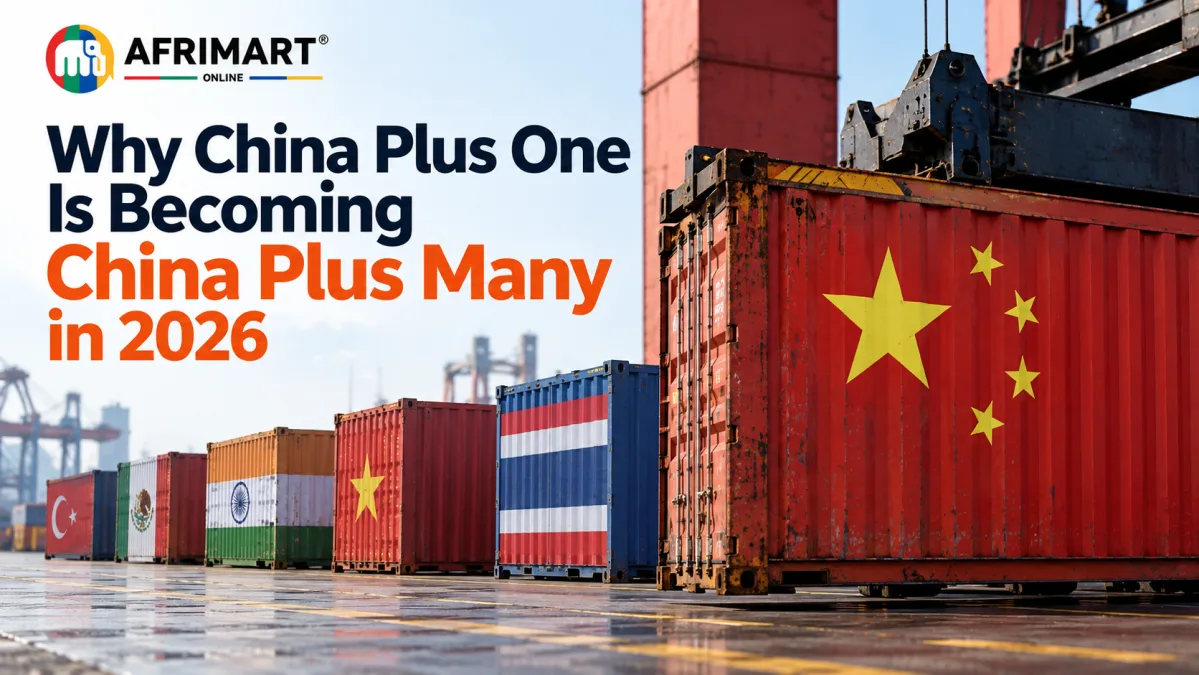
The global sourcing debate has moved beyond whether companies should remain in China or leave. In 2026, procurement teams are building distributed supply networks that retain China for machinery, components and technical capability while placing selected production activities in several alternative markets. This emerging “China Plus Many” model is diversification without assuming that complete decoupling is commercially practical.
At a glance
China Plus One means retaining Chinese suppliers while adding one alternative sourcing country.
China Plus Many distributes production, components, assembly and logistics across several countries.
China remains particularly competitive in industrial machinery, tooling, electronics and engineered components.
Some labour-intensive production continues moving to lower-cost manufacturing locations.
A product assembled outside China may still depend on Chinese machinery and components.
More suppliers do not automatically create greater resilience.
African buyers must evaluate delivery, customs, installation, spare parts and technical support alongside factory location.
The objective is not maximum diversification, but the right level of diversification for each product and project.
What does China Plus Many mean?
China Plus Many is a sourcing strategy in which a company continues using China for selected products, components or manufacturing processes while developing qualified suppliers in several other countries.
The approach represents an evolution from China Plus One, which encouraged businesses to supplement Chinese production with a single alternative location.
Under China Plus Many, the supply chain may include:
Machinery and tooling manufactured in China
Components sourced from several Asian countries
Final assembly conducted in Vietnam, India, Mexico or another market
Raw materials obtained regionally
Warehousing positioned close to major customer markets
Installation and maintenance delivered by local African partners
Multiple shipping routes serving the same destination
The strategy recognises that different countries offer different advantages. No single alternative manufacturing centre can reproduce every part of China’s industrial ecosystem at the same scale.
A business may therefore move basic assembly without moving component production. It may relocate a product line while continuing to purchase the production equipment from China. It may also divide orders between suppliers in different countries rather than closing one source and replacing it with another.
Why is China Plus One no longer sufficient?
China Plus One was designed to reduce dependence on a single country. It worked well as a strategic principle, but it often underestimated the complexity of modern industrial supply chains.
Adding one alternative country can still leave a business exposed to:
A single manufacturing region
One major shipping corridor
The same upstream component manufacturers
Common raw-material suppliers
Similar energy or infrastructure constraints
One customs or regulatory regime
A limited group of ports
The same geopolitical or climate-related risks
If a Vietnamese factory relies on Chinese electronic controls, motors, tooling and raw materials, moving final assembly to Vietnam changes the visible production location without eliminating upstream dependence.
Similarly, moving assembly closer to the destination market does not guarantee that the alternative factory has equivalent engineering capability, production capacity or access to specialised suppliers.
China Plus Many responds to this problem by separating the supply chain into categories and functions. The objective is to determine which parts can be diversified, which should remain concentrated and which require qualified alternatives.
Why does China remain central to global manufacturing?
China remains difficult to replace because its competitive advantage is not based on labour cost alone.
Its manufacturing position combines:
Large-scale industrial capacity
Dense supplier networks
Specialist component manufacturers
Engineering and production experience
Established export infrastructure
Access to tooling and mould production
Automation and equipment integration
Rapid prototype development
Flexible production scaling
Broad availability of industrial machinery
These capabilities are particularly important for complicated products. A manufacturer producing machinery, commercial electronics or automated equipment may depend on hundreds of components supplied by businesses located within the same industrial region.
Moving final assembly is considerably easier than recreating the complete network that supports it.
China’s trade figures reinforce this industrial position. During the first eight months of 2026, the country’s total goods trade increased by 17.6% year on year to RMB34.78 trillion. Exports grew by 14.6%, while exports of mechanical and electrical products increased by 21.9%.
At the same time, exports of labour-intensive products declined by 0.6%. This contrast points towards an important structural shift: China’s advantage is becoming more concentrated in industrial, technological and capital-intensive categories rather than basic low-cost manufacturing alone.
Which sourcing categories are moving away from China?
Production is most likely to relocate when labour accounts for a high proportion of total cost and the manufacturing process can be transferred without rebuilding an extensive supplier network.
Categories experiencing greater geographic diversification can include:
Basic apparel
Footwear
Selected textile products
Simple household goods
Low-complexity assembly
Labour-intensive accessories
Entry-level consumer products
Products benefiting from destination-market trade preferences
Countries with lower labour costs may offer a commercial advantage in these categories, particularly when manufacturing requires limited tooling, fewer specialised components and relatively straightforward quality control.
However, lower wages do not automatically create a lower delivered cost.
Buyers must also evaluate:
Worker productivity
Factory capacity
Defect and rejection rates
Material availability
Import dependence
Port efficiency
Shipping frequency
Energy reliability
Production lead times
Management overhead
Customs treatment
Minimum-order requirements
A country may offer lower labour costs while requiring most materials and machinery to be imported. Once those dependencies are included, the cost advantage can narrow considerably.
Which sourcing categories are likely to remain in China?
China remains particularly competitive in categories that depend on engineering depth, component availability, production scale and rapid coordination between suppliers.
These include:
Industrial machinery
Automated production lines
Electrical and electronic systems
Commercial equipment
Motors, pumps and drive systems
Battery and energy-storage components
Solar and renewable-energy equipment
Automotive subsystems
Precision tooling
Moulds and dies
Packaging machinery
Food-processing equipment
Construction machinery
Mining and mineral-processing equipment
Complex plastic products
Smart devices and control systems
The ability to source components, modify designs, manufacture tooling and scale production within one industrial ecosystem remains a major advantage.
This does not mean that every Chinese supplier is suitable. Factory capabilities, quality systems, export experience and technical support vary widely. China’s manufacturing scale increases the number of options, but it also makes supplier qualification more important.
How is automation changing China’s sourcing position?
Automation is helping Chinese manufacturers move away from a business model based mainly on low-cost labour.
According to the International Federation of Robotics, China installed 295,000 industrial robots in 2024. That represented 54% of worldwide installations, while the country’s operational stock exceeded two million industrial robots.
Automation can support:
Greater production consistency
Higher throughput
Repeatable tolerances
Better process monitoring
Reduced dependence on repetitive manual work
Faster scaling of established products
More efficient use of materials
Integration between production stages
Its effect varies by factory and product. Buying from an automated facility does not automatically guarantee quality, just as buying from a labour-intensive factory does not automatically indicate poor performance.
What automation changes is China’s ability to remain competitive in manufacturing categories where accuracy, repeatability and production scale matter more than the lowest available wage.
For industrial buyers, the relevant question is therefore not simply how many workers a factory employs. It is whether the supplier has the equipment, processes, engineering capability and quality controls required for the product.
Is manufacturing diversification away from China genuine?
Some diversification is substantial. New factories, industrial parks and supply bases have been established in India, Vietnam, Indonesia, Mexico and other markets. These investments can create genuine alternative production capacity.
But diversification should be measured at several levels:
| Supply-chain level | Question to investigate |
|---|---|
| Raw materials | Where do the principal materials originate? |
| Components | Who manufactures the essential parts? |
| Tooling | Where are the moulds, dies and production tools made? |
| Machinery | Which country supplied the production equipment? |
| Engineering | Who owns the product design and process knowledge? |
| Assembly | Where is the finished product assembled? |
| Testing | Where and by whom is performance verified? |
| Spare parts | From which country will replacements be supplied? |
| Logistics | Which ports and shipping routes are used? |
| Technical support | Who assists the buyer after delivery? |
A product may qualify as originating from one country under customs rules while remaining operationally dependent on Chinese industrial inputs.
This does not make the alternative location invalid. It means that country of origin and supply-chain independence are not the same thing.
Procurement teams need both perspectives. Customs origin determines tariffs and market access, while operational origin determines where production could be disrupted.
Does using more suppliers automatically reduce risk?
No. A larger supplier base can reduce concentration, but it can also introduce new risks.
Every additional supplier may create:
Another quality-management relationship
Different technical tolerances
Additional minimum-order quantities
More contracts and payment arrangements
Longer approval processes
Separate regulatory requirements
Increased inspection costs
More complicated inventory planning
Greater communication demands
New intellectual-property exposure
Diversification is valuable only when the alternative suppliers are capable, qualified and commercially sustainable.
A backup factory that has never produced the item is not a functioning backup. A supplier without access to the correct tooling or components may be unable to respond when disruption occurs.
Effective diversification therefore requires maintaining “warm” alternatives. This may involve sample production, small recurring orders, updated technical files, periodic audits and verified access to required materials.
The objective is not to divide every order among as many factories as possible. It is to prevent a commercially important product or component from becoming unnecessarily dependent on one fragile point.
What should remain concentrated?
Not every part of a supply chain should be diversified.
Maintaining one primary source may be more effective when:
Tooling is expensive to duplicate
Production volumes are limited
The supplier owns specialised process knowledge
Regulatory approval is tied to a specific facility
Quality depends on long-term process control
Switching costs exceed the likely risk reduction
A component requires highly specialised equipment
Intellectual-property protection is easier with fewer suppliers
In these cases, resilience may come from holding strategic inventory, securing tooling ownership, preparing emergency logistics options or negotiating access to production data rather than appointing several manufacturers.
A mature sourcing strategy distinguishes between components that require alternative sources and those that require stronger protection within a concentrated arrangement.
What should African procurement teams take from China Plus Many?
African industrial buyers should not copy diversification strategies designed primarily for North American or European retailers.
The commercial priorities are different.
An African manufacturer importing a production line may be less concerned with shifting final assembly between several countries and more concerned with:
Whether the equipment matches local power conditions
Whether it can process locally available raw materials
How it will reach the project site
Who will install and commission it
Whether operators will receive training
How replacement parts will be obtained
Whether remote support is available
How warranty claims will be managed
Whether customs documentation is complete
Whether the supplier can support expansion later
For many African projects, China Plus Many should combine international sourcing with regional execution.
The equipment may be manufactured in China, while civil works, electrical installation, fabrication, operator recruitment, maintenance and consumables are sourced closer to the project.
A practical structure may look like this:
| Project requirement | Potential sourcing approach |
|---|---|
| Main production machinery | Qualified Chinese manufacturer |
| Standard electrical components | Internationally recognised brands with regional availability |
| Foundations and civil works | Local contractor |
| Supporting steelwork | Local or regional fabricator |
| Installation supervision | Equipment manufacturer or technical partner |
| Operator training | Manufacturer-supported on-site programme |
| Consumables | Local or regional supplier where technically suitable |
| Critical spare parts | Purchased with the original equipment |
| Routine maintenance items | Locally available equivalents where approved |
| Expansion equipment | Original supplier or prequalified alternative |
This approach creates resilience without introducing unnecessary complexity into the core equipment package.
How should buyers decide what to diversify?
Each category should be assessed according to its commercial and operational importance.
Supply criticality
Would the absence of this product or component stop production?
Critical parts require stronger continuity planning than easily replaceable consumables.
Availability of alternatives
Can another supplier manufacture the same item to the required specification?
The presence of multiple suppliers does not help if none has been technically qualified.
Switching time
How long would it take to move production, duplicate tooling, approve samples and complete testing?
A theoretical alternative may be commercially useless if qualification takes a year.
Inventory requirements
Can additional stock provide sufficient protection at a lower cost than appointing another supplier?
For certain components, strategic inventory may be the more efficient option.
Technical complexity
Does the product depend on proprietary software, customised controls, specialised materials or supplier-owned tooling?
Complexity increases the cost and time required to diversify.
Destination-market requirements
Would moving production change the tariff, certification or rules-of-origin position?
A new manufacturing location must be evaluated against the requirements of the destination country.
Total delivered cost
Would the alternative remain competitive after freight, customs, inspection, management and quality costs are included?
The factory quotation should never be the only comparison.
A practical China Plus Many framework
Procurement teams can build the strategy in seven stages.
1. Map the existing supply chain
Identify direct suppliers, critical component manufacturers, raw-material origins, tooling locations and major shipping routes.
2. Rank points of dependency
Separate ordinary suppliers from dependencies that could stop production, delay a project or prevent regulatory compliance.
3. Identify realistic alternatives
Focus on suppliers and countries that can meet the technical requirement—not simply those offering a lower indicative price.
4. Compare complete costs
Evaluate manufacturing, quality assurance, freight, customs, inventory, management and transition costs.
5. Qualify before disruption
Complete factory assessment, sampling, testing and commercial approval while the existing supply chain is still operating.
6. Decide how to keep alternatives active
Use periodic orders, framework agreements or scheduled technical reviews to prevent backup arrangements from becoming outdated.
7. Review the structure regularly
Supplier capability, trade rules, logistics conditions and project requirements change. A diversification plan should be reviewed rather than treated as permanent.
What China Plus Many does not mean
China Plus Many is not:
A requirement to leave China
A guarantee of lower costs
A reason to appoint unqualified suppliers
A strategy for splitting every purchase equally
Proof that production outside China is independent of Chinese inputs
A substitute for quality control
A way to avoid proper customs classification
A one-time project completed after adding another country
It is a disciplined method for deciding where concentration remains commercially justified and where additional options are necessary.
How Afrimart supports project-based sourcing
Afrimart helps African businesses source industrial machinery and project equipment through a quotation-led process based on the buyer’s operational requirements.
Instead of evaluating equipment only by its listed factory price, buyers can submit information covering:
Intended industry and application
Required production capacity
Input materials
Finished-product requirements
Preferred level of automation
Destination country and project location
Available electricity and utilities
Installation requirements
Operator-training needs
Required spare parts
OEM or ODM requirements
Target production date
This makes it possible to consider equipment configuration, supplier capability, delivery and project support together.
Submit an industrial equipment request to Afrimart, or email [email protected] with your project requirements.
Frequently asked questions
What is a China Plus Many sourcing strategy?
China Plus Many is a sourcing model that retains China for selected manufacturing activities while using qualified suppliers, assembly locations or service partners in several additional countries. It aims to reduce unnecessary concentration without assuming that China can or should be removed from every supply chain.
How is China Plus Many different from China Plus One?
China Plus One normally adds one alternative manufacturing country to an existing Chinese supply base. China Plus Many distributes different products, components, production stages or logistics functions across several locations based on their individual capabilities and risks.
Does China Plus Many mean moving manufacturing out of China?
Not necessarily. A company may keep complex manufacturing, machinery and component sourcing in China while moving basic assembly or selected product categories elsewhere. The appropriate structure depends on technical capability, cost, market access and supply risk.
Why do factories outside China still use Chinese components?
China has extensive supplier networks for motors, electronics, tooling, machinery, chemicals and intermediate products. A factory in another country may find Chinese components more available, technically suitable or cost-effective than locally produced alternatives.
Is sourcing from several countries more expensive?
It can be. Multiple suppliers may increase inspection, management, inventory, tooling and logistics costs. Diversification creates value when the reduction in disruption or concentration risk justifies the additional commercial complexity.
Which products are most difficult to move away from China?
Products that require specialised components, tooling, automation, engineering knowledge and rapid coordination between suppliers are generally more difficult to relocate. These can include industrial machinery, electronics, automated production systems, battery components and complex automotive subsystems.
What is a warm backup supplier?
A warm backup is an alternative supplier that has already been assessed, sampled and approved and may receive limited recurring orders. This allows the buyer to increase production more quickly if the primary supplier becomes unavailable.
Is China Plus Many relevant to African industrial buyers?
Yes, but it should be adapted to African project requirements. The strategy may combine Chinese machinery with local construction, regional components, on-site installation, operator training and locally available maintenance items rather than duplicating the complete equipment supply chain across several countries.
Sources
General Administration of Customs of China: January–August 2026 trade figures
General Administration of Customs of China: First eight months of 2026 trade overview
International Federation of Robotics: China’s industrial robot installations