Sourcing from China in 2026 is no longer a simple decision between remaining in China and relocating elsewhere. Procurement teams are combining Chinese manufacturing with alternative supply bases while evaluating tariffs, compliance, logistics, supplier capability and after-sales support as part of the total landed cost.
The strategic question has changed.
For most industrial buyers, it is no longer:
“Should we continue sourcing from China?”
It is:
“Which parts of our supply chain should remain in China, which should be diversified, and how do we manage the complete cost and risk of every purchase?”
This distinction matters particularly for African companies sourcing machinery, production lines, industrial components and project equipment. China remains deeply embedded in global manufacturing, but the cheapest factory quotation does not necessarily produce the lowest-cost or lowest-risk outcome once freight, customs, installation, quality control and operational support are considered.
At a glance
China’s goods trade increased by 17.6% year on year during the first eight months of 2026.
Chinese exports grew by 14.6%, while imports increased by 22% over the same period.
Exports of mechanical and electrical products rose by 21.9%, reinforcing China’s role in industrial supply chains.
China installed 295,000 industrial robots in 2024, representing 54% of worldwide installations.
European and North American buyers face tighter carbon, tariff and supply-chain-tracing requirements.
African buyers must place greater emphasis on logistics, customs, installation, spare parts and after-sales support.
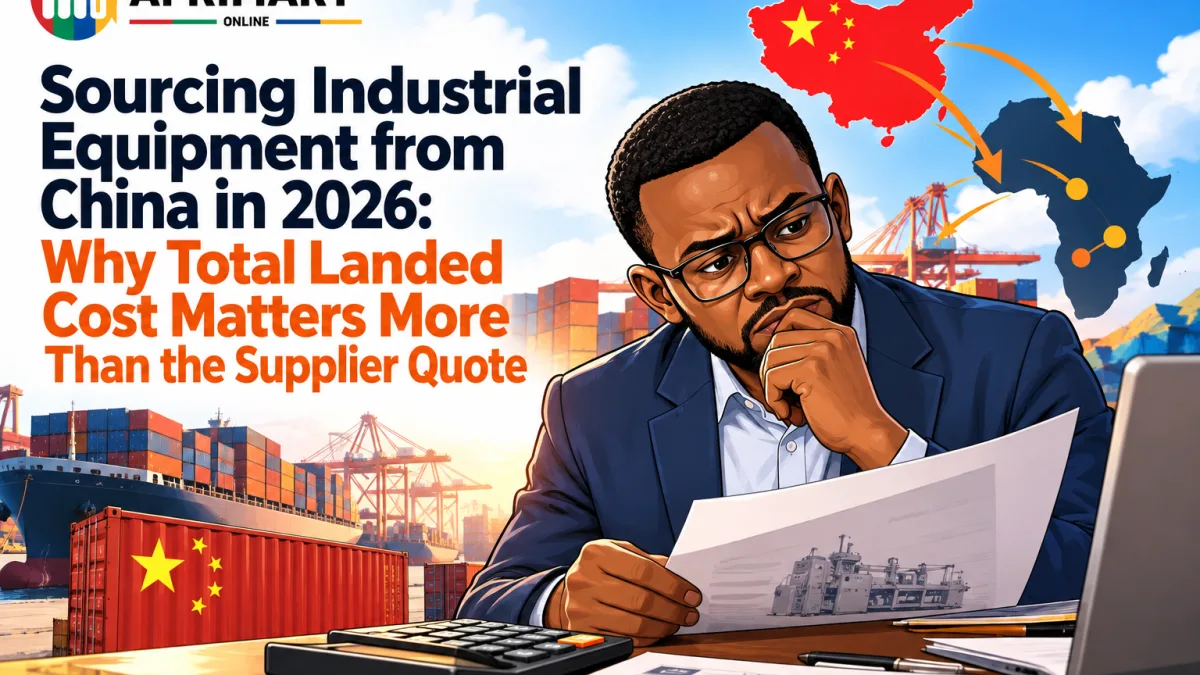
The most effective procurement strategy is increasingly based on total landed cost rather than the ex-works price.
Is China still the world’s factory in 2026?
China remains the world’s most important manufacturing centre, although its role is changing.
Lower-complexity industries such as apparel, footwear and basic consumer goods have continued shifting towards lower-cost production locations. However, China remains highly competitive in industrial machinery, electrical equipment, automotive components, electronics, tooling, production systems and engineered products.
According to China’s General Administration of Customs, the country’s total goods trade reached RMB34.78 trillion during the first eight months of 2026, an increase of 17.6% from the same period a year earlier. Exports rose by 14.6% to RMB20.17 trillion, while imports increased by 22% to RMB14.61 trillion.
The composition of that growth is significant for industrial buyers. Chinese exports of mechanical and electrical products increased by 21.9% during the period, while exports of labour-intensive products declined by 0.6%.
This suggests that China is not simply defending its position as a producer of inexpensive finished goods. It is strengthening its role as a supplier of machinery, components, production technology and capital equipment.
China is becoming the factory behind other factories
The expansion of manufacturing in Vietnam, Thailand, Indonesia, India, Mexico and other alternative locations is often presented as evidence of supply chains leaving China.
The reality is more complicated.
A factory may relocate final assembly to another country while continuing to obtain motors, electronic controls, tooling, moulds, fabricated parts, chemicals, battery materials or production machinery from China. The country of final assembly may change without removing China from the underlying supply chain.
This creates a multilayered sourcing model:
Raw materials may come from one country.
Components may be manufactured in China.
Final assembly may take place in another production hub.
The finished equipment may be delivered to an African project.
Installation, training and after-sales support may involve additional companies.
Country-of-origin labels therefore reveal only part of the procurement structure. Buyers need to understand where the critical components originate, who controls the technical design and where replacement parts will come from.
What does “China Plus Many” mean?
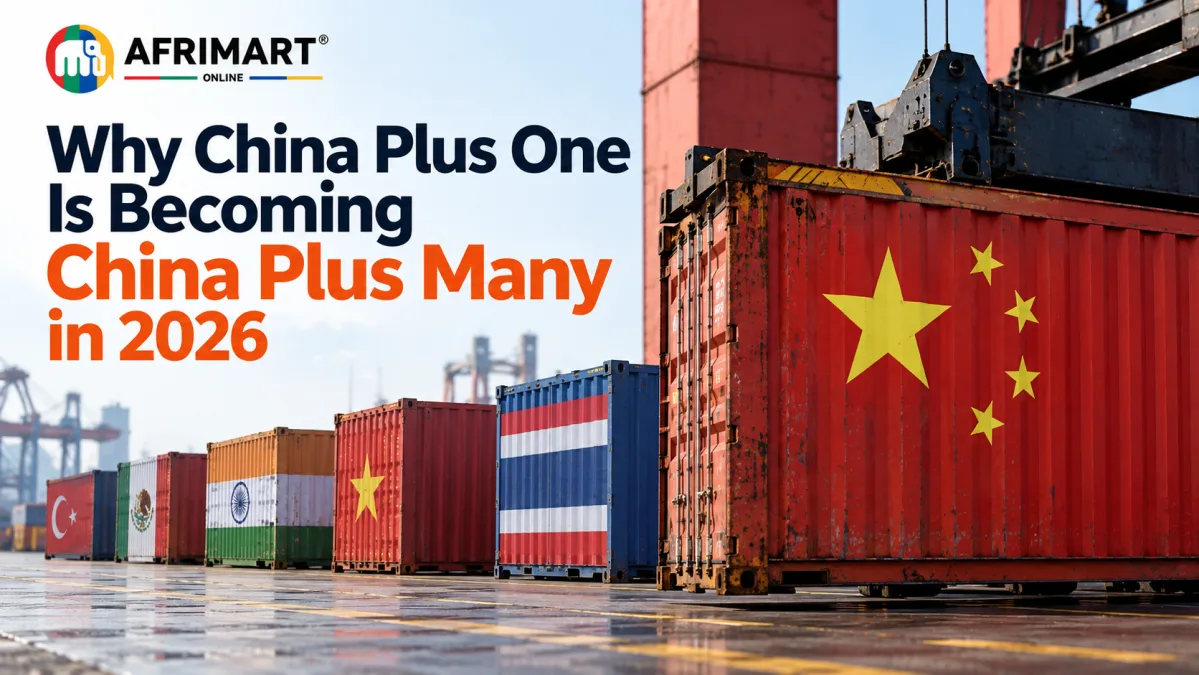
“China Plus One” originally described a strategy of retaining Chinese production while adding one alternative manufacturing country.
By 2026, that model is becoming more diversified. Procurement teams may use several manufacturing locations, logistics routes and approved suppliers instead of relying on a single alternative.
A practical “China Plus Many” strategy may include:
China for industrial machinery, tooling and specialised components
Vietnam or Bangladesh for selected labour-intensive products
India for particular engineering, pharmaceutical or manufacturing categories
Türkiye or Eastern Europe for access to European markets
Mexico for North American assembly and distribution
Regional African suppliers for installation, fabrication, maintenance and consumables
The objective is not to remove China from every supply chain. It is to avoid unnecessary concentration while preserving access to manufacturing capability, scale and technical expertise.
Diversification must still be commercially justified. Adding suppliers and production countries can increase management complexity, minimum-order commitments, quality variation and compliance costs.
Why automation continues to support Chinese manufacturing
Rising wages and demographic pressure have encouraged Chinese factories to automate production rather than compete solely through low-cost labour.
The International Federation of Robotics reported that China installed 295,000 industrial robots in 2024, accounting for 54% of global installations. The country also had more than two million industrial robots operating in factories.
Automation can help manufacturers:
Increase production consistency
Reduce dependence on repetitive manual labour
Improve dimensional accuracy
Increase production speed
Monitor processes more closely
Scale complex manufacturing
Reduce defects when systems are correctly implemented
Automation does not guarantee that every Chinese supplier will deliver high-quality equipment. Capability varies substantially between factories.
It does, however, help explain why China remains competitive in categories that require rapid scaling, component integration, specialised tooling and coordinated supplier networks.
Why the lowest ex-works price can be misleading
The ex-works price covers the product at the supplier’s premises. It usually does not represent the amount the buyer will spend before the equipment becomes operational.
A proper sourcing comparison should evaluate total landed and operational cost.
| Cost component | What the buyer should evaluate |
|---|---|
| Factory price | Base equipment, included components and configuration |
| Customisation | Engineering changes, moulds, tooling, branding and software |
| Quality assurance | Factory audits, inspections, testing and documentation |
| Inland transport | Movement from the factory to the export port |
| Export charges | Documentation, handling and terminal costs |
| International freight | Sea, air, rail or multimodal transport |
| Insurance | Cargo value, covered risks and claim conditions |
| Duties and taxes | Destination-country tariff classification and import charges |
| Port and clearance costs | Storage, inspection, agency and customs fees |
| Inland delivery | Transport from the destination port to the project site |
| Site preparation | Foundations, power, water, ventilation and access |
| Installation | Mechanical assembly, electrical connection and alignment |
| Commissioning | Testing the equipment under operating conditions |
| Training | Operator, maintenance and safety instruction |
| Spare parts | Initial stock, wear parts and critical components |
| Downtime risk | Cost of delays, missing parts or unsupported failures |
| Financing and currency | Payment structure, exchange-rate exposure and bank charges |
A machine with a lower factory price may become more expensive if it arrives without the correct electrical system, requires unplanned site modifications or cannot be commissioned promptly.
The purchase price is therefore only one part of the commercial decision.
How tariffs and carbon rules are changing procurement
For buyers supplying the United States and European Union, trade policy has become a permanent procurement consideration.
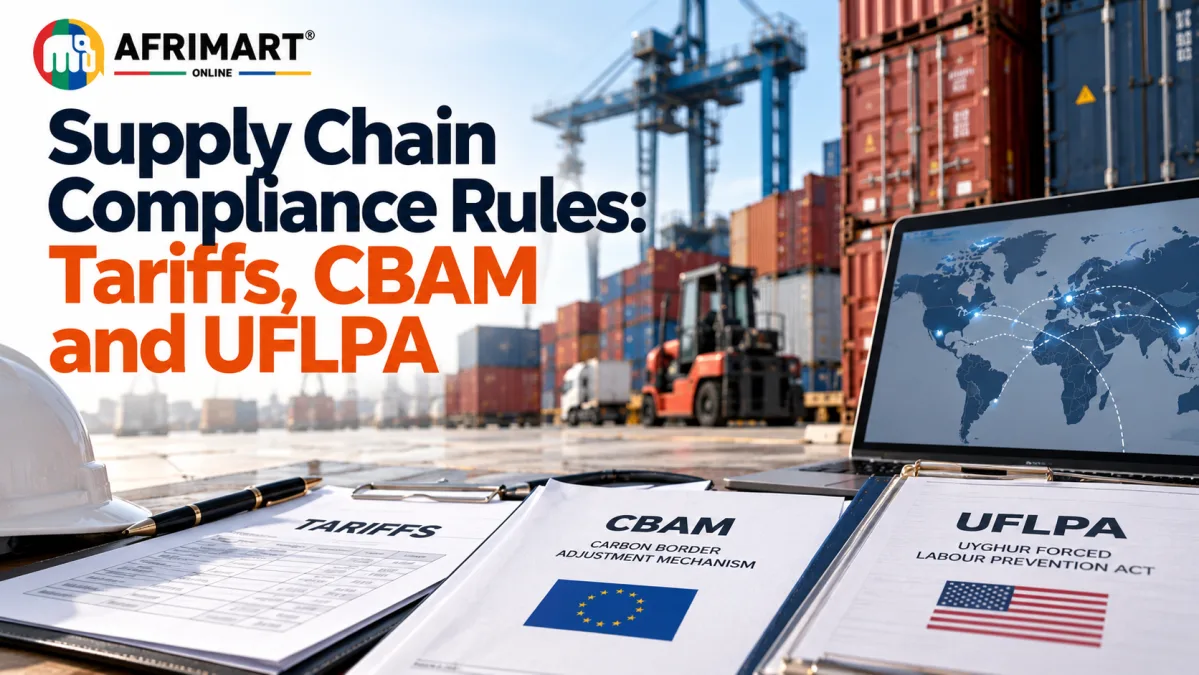
The United States has imposed or increased Section 301 duties on selected Chinese products in strategic sectors. The affected categories include electric vehicles, batteries, solar products, semiconductors and certain critical materials. The rate and effective date depend on the product’s tariff classification.
The European Union’s Carbon Border Adjustment Mechanism entered its definitive phase on 1 January 2026. It initially covers selected products in cement, iron and steel, aluminium, fertilisers, electricity and hydrogen. Importers above the applicable threshold must meet authorisation, emissions-data and certificate requirements.
The mechanism should not be described as a general surcharge on every Chinese product. Its effect depends on the product classification, embedded emissions, declared carbon price and destination.
For procurement teams, the practical requirement is clear: customs classification and carbon exposure should be investigated before the purchase order is issued.
Why supply-chain traceability now reaches beyond the direct supplier
Regulations such as the United States’ Uyghur Forced Labor Prevention Act have made sub-tier supply-chain information increasingly important.
The UFLPA establishes a rebuttable presumption against the importation of goods mined, produced or manufactured wholly or partly in Xinjiang, as well as goods connected to listed entities. US authorities advise importers to conduct due diligence and understand suppliers and labour sources across multiple levels of the supply chain.
In July 2026, the US Department of Homeland Security announced the addition of another 43 companies to the UFLPA Entity List.
This means that a declaration from the direct factory may not be sufficient. Buyers in affected markets may need evidence covering:
Raw-material origin
Component manufacturers
Processing locations
Labour sources
Transport and custody records
Bills of materials
Purchase invoices
Production records
Supplier declarations
Entity-list screening
The required level of traceability depends on the destination, product and applicable law. Buyers should obtain specialist legal or customs advice when regulatory exposure is significant.
China’s supply-chain security rules add another layer
Regulatory pressure does not operate in only one direction.
China introduced its Regulations on Industrial and Supply Chain Security through State Council Decree No. 834 in March 2026. The regulations establish monitoring and response mechanisms for risks affecting strategically important Chinese supply chains.
They allow authorities to investigate certain foreign measures or commercial actions considered damaging to China’s industrial and supply-chain security. Potential responses can include restrictions on trade, investment, cooperation and market activity.
The practical implication is not that every supplier change will trigger state action. It is that companies operating across competing regulatory systems must understand how decisions made to satisfy one jurisdiction may create exposure in another.
Procurement, compliance and legal teams can no longer work independently when supply chains involve sensitive industries or controlled technologies.
Why critical minerals affect more than mining companies
China’s position in critical-mineral processing affects manufacturers of batteries, electric vehicles, electronics, renewable-energy equipment, specialised magnets and advanced industrial systems.
Export controls have been introduced across several mineral and material categories. Depending on the controlled product and end use, exporters may need to obtain licences and provide information about the buyer, application and final destination.
China’s Ministry of Commerce has published controls covering certain rare-earth items and other dual-use products. The rules require licences for controlled exports and can apply more restrictive treatment to military or sensitive end uses.
Buyers should therefore confirm:
Whether a product contains controlled material
Whether the supplier has the required export licence
Whether the end use requires additional documentation
Whether licence delays could affect the delivery programme
Whether technically acceptable substitute materials exist
Whether critical spare parts are subject to the same controls
For industrial projects, material controls can affect a small component that is essential to the operation of a much larger system.
Which categories are moving away from China?
Relocation is most visible in products where labour represents a large proportion of the cost and manufacturing can be transferred without rebuilding a complex supplier ecosystem.
These categories can include:
Basic apparel
Footwear
Selected textiles
Simple household products
Low-complexity assembly
Certain entry-level consumer goods
However, relocation decisions still depend on production scale, quality expectations, shipping routes, trade preferences and material availability.
A lower wage rate does not automatically produce a lower landed cost. Productivity, reject rates, component imports and logistics can offset the apparent labour advantage.
Which categories remain closely connected to China?
China remains particularly strong where manufacturing depends on specialist suppliers, tooling, engineering knowledge and rapid coordination.
These categories include:
Industrial machinery
Production lines
Electrical and electronic components
Automation equipment
Commercial and industrial vehicles
Battery and energy-storage systems
Solar and renewable-energy components
Precision tooling and moulds
Complex plastic products
Pumps, motors and drive systems
Food-processing equipment
Packaging machinery
Construction and mining equipment
Even when final production moves elsewhere, Chinese components or machinery may remain embedded in the process.
What does this mean for African industrial buyers?
African procurement teams face a different risk profile from buyers importing into North America or Europe.
Tariffs and carbon regulations may still matter when the final product is exported into those markets, but many African equipment projects are more directly affected by:
Port and corridor reliability
Customs classification
Currency volatility
Long inland-delivery distances
Power and voltage compatibility
Site readiness
Installation capability
Operator training
Spare-parts availability
Warranty administration
Technical communication
Lead-time management
Access to qualified maintenance personnel
For these buyers, diversification should not be reduced to choosing a different manufacturing country. The real objective is to build a supply route that can deliver, install and support the equipment at the project site.
A cheaper supplier does not create value if the machinery cannot be operated, maintained or repaired locally.
A 2026 procurement playbook for sourcing from China
1. Begin with the operational requirement
Define the required output, materials, operating conditions, utilities, product standards and level of automation before requesting quotations.
A vague enquiry produces quotations that may appear comparable but are based on different technical assumptions.
2. Compare equivalent configurations
Confirm that every quotation covers the same capacity, materials, controls, accessories, safety systems, spare parts and services.
Do not compare complete production lines with base machines presented without auxiliary equipment.
3. Calculate the total landed cost
Include freight, insurance, customs, delivery, site preparation, installation, commissioning and initial spare parts.
Where uncertainty remains, include a realistic contingency rather than assuming the lowest possible cost.
4. Investigate the supplier’s manufacturing role
Determine whether the quoted company is the manufacturer, an authorised representative, an engineering integrator or a trading intermediary.
The business model itself is not necessarily a problem, but the buyer should know who controls the design, production, quality and warranty.
5. Audit critical sub-tier suppliers
Identify the manufacturers of essential motors, drives, programmable logic controllers, bearings, hydraulic systems and other high-risk components.
This is especially important when a single replacement component could stop production.
6. Use milestone-based quality control
Inspection should take place at appropriate production stages rather than only after the machine has been completed.
Depending on the project, this may include:
Design approval
Material verification
Production inspection
Electrical and control-system checks
Factory acceptance testing
Packing inspection
Container-loading supervision
7. Maintain qualified alternatives
A backup supplier is useful only if it has already been assessed.
Procurement teams can keep alternative factories qualified through sample orders, limited production or periodic technical reviews rather than waiting for a disruption.
8. Align payment with verifiable progress
Payment terms should reflect the equipment’s production stages, inspection requirements and commercial risk.
Buyers should understand exactly what evidence is required before each payment milestone is released.
9. Secure spare parts before shipment
Initial spare and wear parts should travel with the equipment where practical. Ordering an inexpensive component after a breakdown can create weeks of avoidable downtime.
10. Define after-sales responsibility in writing
The contract should specify who handles installation, commissioning, training, troubleshooting, warranty claims and replacement parts.
A general promise of “technical support” is not sufficient for a production-critical machine.
How Afrimart supports project-based sourcing
Afrimart helps African businesses source industrial machinery and project equipment through a quotation-led process rather than treating complex equipment as an immediate ready-stock purchase.
Buyers can submit a request for quotation based on:
Industry and intended application
Required production capacity
Product or material specifications
Preferred level of automation
Destination country and project location
Available power and utilities
Installation and training requirements
Spare-parts expectations
OEM or ODM requirements
Target commissioning date
This allows the equipment configuration, supplier scope, logistics and support requirements to be considered together.
For qualifying orders, Afrimart’s procurement model can also include structured payment arrangements, production coordination, quality-control stages, shipping, customs support, local delivery and after-sales planning.
Submit your industrial equipment requirements to Afrimart or contact [email protected] to discuss a project-specific sourcing plan.
Frequently asked questions
Is China still competitive for industrial equipment in 2026?
Yes. China remains highly competitive in industrial machinery, components, automation and engineered products because of its production scale and specialised supplier networks. However, competitiveness should be assessed using total landed cost, technical suitability and after-sales support rather than the factory price alone.
What is the difference between ex-works price and landed cost?
The ex-works price covers the equipment at the supplier’s premises. Landed cost adds inland transport, export charges, freight, insurance, customs, taxes and destination delivery. A complete project cost may also include foundations, installation, commissioning, training and spare parts.
Does sourcing from another Asian country eliminate dependence on China?
Not necessarily. A product assembled in another country may still contain Chinese raw materials, components, tooling or electronic systems. Buyers should examine the supply chain below the final assembler when origin, continuity or compliance is important.
Should buyers stop signing annual supplier contracts?
Not automatically. Long-term agreements can support pricing, capacity and supplier investment. However, contracts should contain review mechanisms for tariffs, regulations, raw-material changes, currency movements and force-majeure events where these risks are material.
What is the most important document before ordering machinery?
A detailed technical specification is one of the most important documents. It should define capacity, input materials, output requirements, operating conditions, utilities, safety requirements, acceptance criteria and the complete supply scope.
How can African buyers reduce machinery-import risk?
Buyers can reduce risk by defining the correct specification, verifying the supplier, comparing equivalent configurations, conducting inspections, confirming logistics, preparing the site and securing spare parts and technical support before shipment.
Can Afrimart source customised machinery?
Afrimart can support project-based OEM and ODM enquiries where suppliers can manufacture or configure equipment around defined buyer requirements. The feasibility, engineering scope, minimum order and lead time depend on the product and requested customisation.
Sources
General Administration of Customs of China: January–August 2026 trade statistics
International Federation of Robotics: China’s industrial robot installations
European Commission: Carbon Border Adjustment Mechanism
US Department of Homeland Security: Uyghur Forced Labor Prevention Act
China State Council: Regulations on Industrial and Supply Chain Security
China Ministry of Commerce: Export-control policies
Office of the United States Trade Representative: China Section 301 tariff actions