Balers in Africa help farms, recycling operations, factories and waste-management facilities compress loose materials into manageable bundles. Agricultural models collect crop residues, while industrial machines process cardboard, textiles, plastics, tyres or metal scrap. Choosing the correct baler requires comparing material type, compression force, chamber dimensions, bale weight, throughput, tying method, power and safety systems.
Balers in Africa at a Glance
A baler reduces the volume of loose material by compressing it into a dense, transportable bale. The resulting bale may be tied with wire, twine, straps or another compatible binding material.
The Afrimart balers category covers equipment for different agricultural and industrial applications. These machines should not be treated as interchangeable. A field baler designed for hay or straw operates differently from a vertical hydraulic press used for cardboard, tyres or textiles. Scrap-metal balers require much greater compression forces and stronger chambers than machines intended for packaging waste.
Before selecting a baler, buyers should define:
- Material to be baled
- Material condition and moisture
- Loose-material volume
- Required hourly or daily throughput
- Desired bale dimensions
- Preferred bale weight
- Available floor space
- Loading method
- Bale-ejection method
- Tying or wrapping requirement
- Electrical or tractor-power availability
- Expected number of operating shifts
- Finished-bale handling method
- Transport or storage limitations
- Operator-training requirements
A baler is most effective when its output matches the downstream handling system. Bale dimensions and mass must be compatible with available forklifts, pallet trucks, storage areas and transport vehicles.
What Is a Baler and How Does It Work?
A baler uses mechanical or hydraulic force to compress material inside a chamber. Once the material reaches the required density or bale length, it is bound and removed for storage, processing or transport.
A typical industrial hydraulic baler follows these stages:
- Material is sorted and prepared.
- The operator loads it through a feed opening.
- A door, gate or feed mechanism secures the chamber.
- The hydraulic system moves a compression ram.
- The material is compacted against the chamber.
- Additional material may be added for another compression cycle.
- The completed bale is tied or wrapped.
- The bale is ejected or removed.
- The chamber is inspected before the next cycle.
An agricultural baler operates continuously or intermittently while moving through a field. A pickup gathers cut crop material, which is fed into a chamber and formed into a round or rectangular bale. The machine then applies twine, net or wire before discharging the bale.
Operating sequences vary considerably. Controls, loading methods and isolation procedures should always follow the manual for the selected machine.
Which Types of Balers Suit Different Applications?
Vertical hydraulic balers
Vertical balers use a downward-moving ram to compress material inside an upright chamber. They are frequently used for cardboard, paper, plastic film, textiles and other relatively compressible waste.
Their upright design can reduce the required floor area, making them useful in shops, warehouses, factories and recycling collection points. Loading and bale removal may be manual or mechanically assisted.
Vertical models are available in different compression forces and chamber sizes. Buyers should check whether the completed bale can be safely moved using their available handling equipment.
Horizontal balers
Horizontal balers compress materials along a horizontal chamber. They are commonly selected for larger waste volumes and may be connected to conveyors, hoppers or sorting systems.
Semi-automatic models may require operators to tie bales manually. Fully automatic systems can form and tie continuous bales with less direct intervention.
Horizontal equipment generally requires more floor space than a vertical machine. It may also require adequate access around the chamber, hydraulic power unit, tying mechanism and discharge area.
Closed-door balers
Closed-door balers compress the material against a closed chamber door. After tying, the door is opened and the bale is ejected.
These machines can produce dense bales but require a controlled area in front of the discharge door. Operators must never stand in the ejection path.
Open-end channel balers
Open-end balers process material continuously through a channel. Bale density is developed through compression and resistance within the channel, while an automatic tying system secures each completed bale.
They are normally considered for high-volume recycling or manufacturing operations. Feed consistency, tying reliability and downstream bale removal become important system requirements.
Scrap-metal balers
Scrap-metal balers compress aluminium, copper, steel offcuts, cans and other metallic waste into dense blocks or bundles. They use high hydraulic forces and heavily reinforced chambers.
The feed material must fall within the machine’s accepted thickness, size and composition. Sealed containers, pressurised cylinders, batteries and hazardous materials require specialised procedures and must not be introduced without proper controls.
Tyre balers
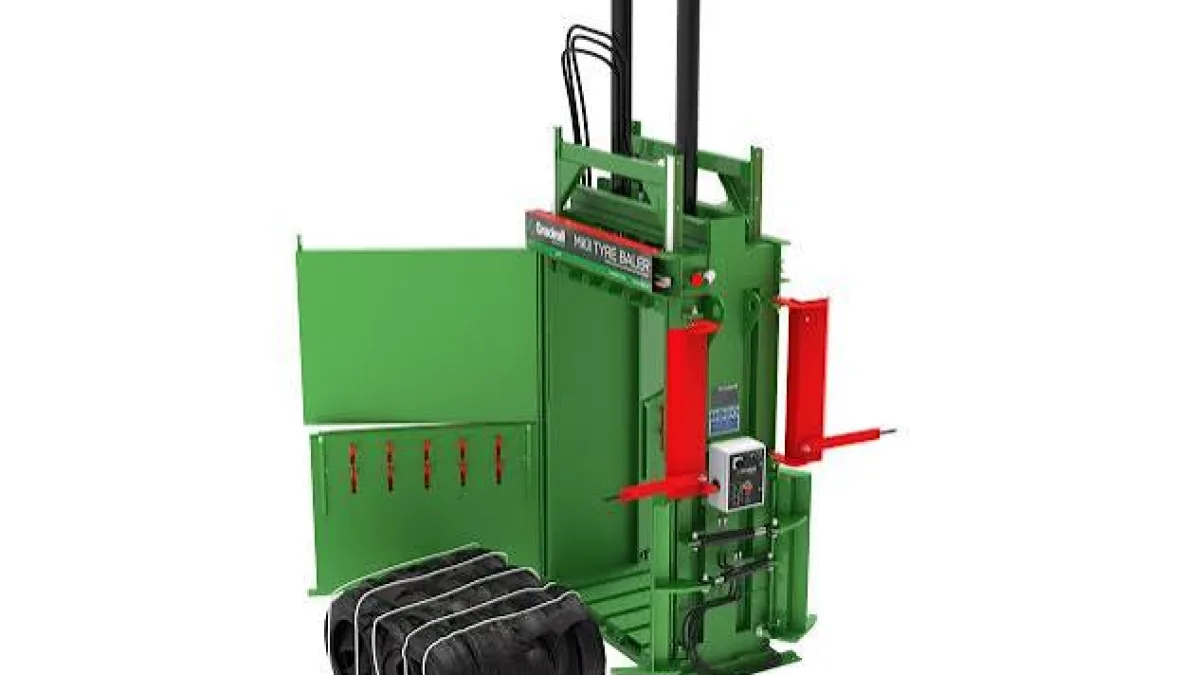
Tyre balers compress used tyres into compact bundles for storage, transport or further processing. Tyres are highly elastic and can release stored energy when restraints fail or the chamber opens.
The machine, tying material and operating procedure must be specifically suitable for tyres. A general-purpose cardboard baler should not be assumed capable of processing them.
Textile balers
Textile balers compress clothing, fibre, fabric offcuts, wool or similar materials. They may use vertical or horizontal compression and can include bagging or wrapping arrangements.
Bale density, material recovery and packaging requirements influence machine selection. Some loose fibres can create dust or fire risks requiring additional controls.
Round agricultural balers
Round balers collect hay, straw or other crop material and form cylindrical bales. Chamber design affects bale formation, density and size.
Round bales may be easier to produce and handle in certain farming systems, but storage and transport planning must account for their shape and potential to roll.
Square and rectangular agricultural balers
Square balers create compact rectangular bales that can be stacked efficiently. Machines range from small-bale units to large high-density balers.
Bale size should match available tractors, loaders, trailers, storage buildings and feeding systems. A large baler may produce bales that cannot be moved safely without mechanised handling equipment.
Compression Force, Pressure and Bale Density
Compression force is usually expressed in tonnes or kilonewtons. It indicates the force applied by the ram, but it does not independently determine bale density or machine productivity.
Bale density also depends on:
- Material composition
- Moisture level
- Chamber dimensions
- Ram-face area
- Number of compression cycles
- Material spring-back
- Feed consistency
- Retention system
- Tying tension
- Operator technique
Two machines with the same stated force may produce different results because their ram sizes and chamber geometries differ.
Hydraulic pressure should not be confused with pressing force. Hydraulic pressure acts within the cylinder, while pressing force depends on pressure and effective piston area. Buyers should compare the manufacturer’s stated ram force for the exact machine configuration.
The densest possible bale is not always the best objective. Excessive compression can damage recoverable materials, increase energy use or exceed the capacity of tying materials and handling equipment.
Bale Size, Weight and Throughput
Bale size and bale weight are separate specifications. A fixed chamber may create bales of similar dimensions but varying weights depending on material type, density and moisture.
For example, a cardboard bale and a plastic-film bale from the same chamber may have different weights. A published bale-weight range should therefore identify the reference material and test conditions.
Throughput may be expressed as:
- Bales per hour
- Kilograms per hour
- Tonnes per hour
- Compression cycles per hour
Production depends on more than the ram cycle. Operators must load, position, tie and eject the material. Poor sorting or an inefficient loading arrangement can prevent the machine from achieving its nominal capacity.
When evaluating output, ask for:
- Reference material
- Loose bulk density
- Input dimensions
- Bale dimensions
- Expected bale weight
- Cycle time
- Number of filling cycles per bale
- Loading method
- Tying time
- Ejection time
- Number of operators
- Sustainable hourly throughput
The planned bale should fit standard storage positions and transport vehicles without overloading floors, pallets or handling equipment.
Technical Specification Comparison
The following table identifies the principal requirements for common baler categories.
| Baler category | Common material | Critical specification | Typical feed method | Bale-removal requirement |
|---|---|---|---|---|
| Vertical baler | Cardboard, paper, plastic film and textiles | Chamber size, pressing force and bale weight | Manual or trolley loading | Pallet truck, trolley or forklift |
| Horizontal closed-door baler | Cardboard, plastics, textiles and general recyclables | Throughput, force and feed-opening size | Conveyor, loader or manual feed | Hydraulic ejector and forklift |
| Automatic channel baler | High-volume paper, cardboard and plastics | Tonnes per hour and automatic tying reliability | Conveyor or feed hopper | Powered discharge conveyor or forklift |
| Scrap-metal baler | Steel, aluminium, copper and cans | Compression force, box size and accepted scrap thickness | Grab, conveyor or loader | Forklift, crane or grapple |
| Tyre baler | Used vehicle tyres | Chamber dimensions, bundle size and binding arrangement | Manual or mechanical loading | Forklift or loader |
| Textile baler | Clothing, fibre and fabric offcuts | Bale size, density and wrapping method | Manual or conveyor loading | Trolley or forklift |
| Small square agricultural baler | Hay and straw | Bale dimensions, pickup width and tractor power | Tractor-powered field pickup | Manual or mechanised collection |
| Large square agricultural baler | Hay, straw and crop residues | Bale density, chamber size and tractor power | Tractor-powered field pickup | Loader with suitable attachment |
| Round agricultural baler | Hay, silage and crop residues | Bale diameter, chamber design and wrapping method | Tractor-powered field pickup | Tractor loader or bale handler |
Actual specifications vary by configuration. Buyers should verify whether conveyors, tying systems, bale-ejection devices, power cables, hydraulic oil and handling accessories are included.
Published Hydraulic Baler Reference Specifications
One Afrimart listing describes a heavy-duty vertical hydraulic baler with several published Y82 model configurations.
| Model | Main cylinder force | Feed opening | Bale cross-section | Published cardboard bale weight | Motor power |
|---|---|---|---|---|---|
| Y82-10 | 10 tonnes | 1,000 × 400 mm | 1,000 × 500 mm | 50–80 kg | 3 kW |
| Y82-20 | 20 tonnes | 1,000 × 400 mm | 1,000 × 750 mm | 80–120 kg | 4 kW |
| Y82-40 | 40 tonnes | 1,150 × 500 mm | 1,150 × 750 mm | 120–200 kg | 7.5 kW |
| Y82-63 | 63 tonnes | 1,150 × 500 mm | 1,150 × 750 mm | 200–260 kg | 11 kW |
| Y82-80 | 80 tonnes | 1,150 × 500 mm | 1,150 × 750 mm | 300–400 kg | 15 kW |
| Y82-100 | 100 tonnes | 1,150 × 500 mm | 1,150 × 750 mm | 360–450 kg | 18.5 kW |
| Y82-120 | 120 tonnes | 1,150 × 600 mm | 1,150 × 800 mm | 460–560 kg | 22 kW |
The listing’s technical table associates these bale-weight ranges with cardboard. Buyers intending to process tyres, plastics, textiles or another material should request performance data for that specific material.
The same page contains broad application and feature statements that may refer to different configurations. For this reason, the selected model number, chamber arrangement, tying method, overall dimensions and accepted feed material should be confirmed in writing.
Agricultural Baler Selection
Agricultural balers must be matched to crop, field and tractor conditions.
Important factors include:
- Crop type
- Windrow width and density
- Crop moisture
- Desired bale shape
- Bale dimensions
- Target bale density
- Field size
- Terrain
- Tractor power
- Power take-off speed
- Hydraulic connections
- Twine, wire or net system
- Expected annual bale count
Moisture control is critical. Baling material that is too wet can reduce storage quality and contribute to heating, spoilage or fire. Very dry material may shatter, increasing leaf loss and reducing bale quality.
Tractor capacity should exceed the baler’s minimum requirement under the actual terrain and field conditions. A tractor may have sufficient engine power but inadequate mass, hydraulic capacity or stability for a large baler.
The entire bale-handling chain should be planned before increasing bale size. Large bales require compatible loaders, attachments, trailers and storage procedures.
Recycling and Industrial Baler Selection
Industrial buyers should begin with a waste audit. Measure the quantity and type of material produced over a representative period rather than estimating from occasional peak volumes.
Separate materials where their recovery value or processing requirements differ. Mixing cardboard, plastic film and contaminants can reduce bale quality and create operational problems.
Record:
- Kilograms produced per day
- Loose volume
- Peak hourly generation
- Material dimensions
- Contamination
- Moisture
- Current collection frequency
- Available labour
- Required finished-bale specification
A small vertical baler may be appropriate where material is generated gradually and operators can load it manually. A horizontal or automatic line becomes more relevant when large volumes arrive continuously.
The feed opening must accommodate the actual material. Large cartons may require flattening if the opening is too small. This creates additional labour and may expose workers to cutting or handling hazards.
Power and Hydraulic-System Requirements
Industrial balers commonly use electric hydraulic power packs. Buyers should confirm:
- Supply voltage
- Number of phases
- Electrical frequency
- Motor rating
- Full-load current
- Starting method
- Control voltage
- Hydraulic reservoir capacity
- Maximum system pressure
- Oil grade
- Recommended ambient temperature
- Cooling requirements
A motor’s kilowatt rating does not represent total electrical installation requirements. Cables, isolators, breakers, earthing and protection must be designed by a qualified person for the machine’s starting current and duty cycle.
The hydraulic system includes the pump, valves, cylinders, hoses, reservoir and filtration. Oil contamination or overheating can reduce performance and damage components.
Hydraulic hoses should be routed away from sharp edges and protected from impact. Operators must never use their hands to search for pressurised leaks. Escaping hydraulic fluid can penetrate the skin and requires urgent medical attention.
Tying, Wrapping and Bale Ejection
The binding system keeps compressed material under control after it leaves the chamber.
Common options include:
- Steel wire
- Plastic strap
- Polyester strap
- Polypropylene twine
- Agricultural baler twine
- Net wrapping
- Film wrapping
The binding material must be compatible with bale density, edges, storage duration and recycling process. Steel scrap or sharp materials can cut unsuitable plastic straps.
Manual tying requires access to designated channels or slots. The machine must remain in a safe state while the operator inserts and tensions the ties.
Automatic tying can improve throughput but adds components requiring adjustment and maintenance. Ask about wire or strap dimensions, tying reliability and consumable availability.
Bale ejection may use a hydraulic ram, mechanical chain, tilting platform or manual trolley. The ejection zone must remain clear because the bale may move suddenly or contain stored energy.
Benefits of Using the Correct Baler
Reduced storage volume
Compression reduces the floor space occupied by cardboard, plastic, textile, agricultural or metallic materials.
More efficient transport
Denser loads can improve vehicle utilisation and reduce the number of collection or delivery trips.
Easier material handling
Uniform bales can be counted, stacked and moved more easily than loose waste or crop residue.
Cleaner work areas
Regular baling helps prevent loose material from spreading across production, warehouse or agricultural sites.
Improved material separation
Dedicated baling procedures can support the separation of recoverable materials and reduce contamination.
More consistent downstream processing
Uniform bale sizes help recycling facilities, storage operations and transport teams plan their work.
Reduced manual loading
Conveyors, loaders and automated feed systems can reduce repetitive handling where they are correctly designed.
Better stock measurement
The number and average weight of completed bales can provide useful records of recovered material or agricultural production.
Baler Safety and Risk Controls
Balers generate high forces and can cause crushing, shearing, entanglement or ejection injuries. No operator should enter a chamber, reach through a guard or interfere with a moving ram.
The UK Health and Safety Executive’s guidance on bales and bale handling identifies hazards including unsafe lifting, unstable bale stacks, poor manual handling and unsafe bale-opening practices. It also recommends guarding access to rams, protecting conveyor nip points and using safe isolation procedures during cleaning or maintenance.
The International Labour Organization’s machinery-safety guidance provides broader principles covering control systems, machinery guarding and protection against mechanical hazards.
Important baler controls include:
- Interlocked loading and chamber doors
- Fixed guards
- Emergency-stop devices
- Lockable electrical isolation
- Hydraulic-energy isolation
- Controlled restart after power failure
- Safe tying access
- Clearly marked ejection zones
- Warning signs and signals
- Conveyor pull cords where applicable
- Operator training
- Written clearing and maintenance procedures
Door interlocks should stop hazardous movement when the door is open. They must not be bypassed to increase speed.
A blocked machine should only be cleared after electrical, hydraulic, gravitational and mechanical energy has been isolated. The ram should be prevented from moving unexpectedly.
Agricultural balers introduce additional hazards around power-take-off shafts, pickups, knotters, belts and discharged bales. Guards must remain installed, and the tractor and baler should be isolated before adjustments or blockage removal.
Safe Bale Storage and Handling
A completed bale can be extremely heavy. Its shape, density and wrapping affect stability.
Storage areas should have:
- Firm and level floors
- Sufficient load-bearing capacity
- Clear gangways
- Controlled stack heights
- Suitable fire separation
- Mechanical handling access
- Protection from rain where required
- Safe distance from ignition sources
- Regular stack inspections
Plastic wrapping can make stacked bales prone to slipping. Round agricultural bales can roll if placed on a slope or stored without suitable restraints.
The HSE recommends managing bale storage under competent supervision and considering bale size, weight, density and wrapping when establishing stacking procedures.
Handling equipment must be rated for the bale mass and load centre. Forks or attachments should provide stable support without damaging the binding. No person should stand beneath an elevated bale or close to an unstable stack.
Bale opening also requires a safe procedure. Cut binding can release stored energy, causing wire, straps or material to move suddenly.
Installation and Factory Layout
Industrial balers require a stable foundation and safe space for loading, operation, maintenance and bale removal.
Layout planning should account for:
- Machine footprint
- Door-opening radius
- Feed access
- Bale-ejection distance
- Electrical isolator
- Hydraulic power-unit access
- Conveyor route
- Finished-bale staging
- Forklift manoeuvring
- Pedestrian separation
- Fire equipment
- Maintenance clearance
- Ceiling height
- Floor loading
A vertical baler can be tall even when it occupies limited floor area. Verify ceiling clearance, doors and any overhead services before delivery.
Large machines may need engineered foundations, embedded plates or anchor bolts. Installation instructions should be obtained before preparing the site.
The input area should support efficient sorting without allowing material to block escape routes or accumulate near ignition sources.
Maintenance and Spare Parts
Preventive maintenance helps maintain bale quality, hydraulic performance and machine safety.
Routine work may include:
- Checking hydraulic-oil level
- Inspecting hoses and fittings
- Monitoring leaks
- Cleaning the chamber
- Removing material around sensors
- Lubricating hinges and guides
- Checking ram alignment
- Inspecting door locks
- Testing emergency stops
- Checking interlocks
- Inspecting tying channels
- Replacing damaged seals
- Cleaning or changing hydraulic filters
- Checking motor and pump condition
Operators should record cycle irregularities, overheating, unusual noise, slow ram movement and inconsistent bale density.
Useful initial spare parts may include seals, filters, sensors, switches, contactors, hoses, tying components and wear plates. The exact kit should reflect machine design and expected operating hours.
Only competent personnel should adjust hydraulic pressures or modify controls. Increasing system pressure above the approved setting can overload the machine structure and create severe hazards.
Buyer Checklist for Balers
Use this checklist before requesting a quotation:
- Identify every material to be baled.
- Measure daily and peak material volumes.
- Record loose-material density.
- Define the desired bale dimensions.
- Establish the preferred bale-weight range.
- Confirm the required hourly throughput.
- Select vertical, horizontal, channel or field operation.
- Confirm the compression force.
- Check the feed-opening dimensions.
- Define manual, conveyor or loader feeding.
- Confirm the tying material and method.
- Determine whether tying is manual or automatic.
- Confirm the bale-ejection system.
- Plan finished-bale handling.
- Verify voltage, phase and frequency.
- Check motor and hydraulic-system ratings.
- Measure the installation area and ceiling height.
- Confirm foundation and anchoring requirements.
- Review guards and door interlocks.
- Identify all emergency-stop positions.
- Request isolation and blockage-clearing procedures.
- Confirm operator-training requirements.
- Obtain manuals and electrical diagrams.
- Request preventive-maintenance schedules.
- Identify critical spare and wear parts.
- Confirm the applicable reference material for capacity.
- Arrange a performance test where appropriate.
- Review fire risks and bale-storage procedures.
- Check local machinery and workplace regulations.
- Obtain written confirmation of the final configuration.
How to Request Balers Through Afrimart
Buyers can review available machines through the Afrimart balers category.
A useful request should describe the material, daily quantity, loose density, item dimensions, desired bale size and available power. It should also identify the preferred feeding, tying and ejection methods.
Agricultural enquiries should include crop type, moisture range, field conditions, desired bale format, tractor power, power take-off specification and available handling equipment.
Recycling enquiries should describe contamination, current collection volumes and downstream bale requirements. Scrap-metal projects should identify metal type, thickness, maximum feed dimensions and any restricted materials.
Providing this information helps ensure that machine force, chamber size, power and output are compared against actual operating needs.
Frequently Asked Questions
What materials can a baler compress?
Depending on its design, a baler may process cardboard, paper, plastics, textiles, tyres, crop residues or metal scrap. The intended material must be confirmed because chamber construction and required force differ significantly.
Is pressing force the same as bale weight?
No. Pressing force is the force applied by the ram. Bale weight depends on the material, chamber size, density, moisture and number of compression cycles.
Is a vertical or horizontal baler better?
Vertical balers generally require less floor space and can suit lower or intermittent volumes. Horizontal balers are commonly used for higher throughput and conveyor-fed operations. The correct choice depends on material flow and available space.
Can one baler process several materials?
Some machines can process multiple compatible materials, but each material may produce a different bale weight and require different binding. Confirm approved materials and clean the chamber when contamination must be avoided.
What electrical supply does a hydraulic baler require?
Requirements vary by motor and control system. Confirm voltage, phases, frequency, full-load current and starting method before installation.
How should completed bales be moved?
Use handling equipment rated for the bale mass and centre of gravity. Forklifts, pallet trucks or bale clamps may be required, depending on bale size and construction.
What safety features should a baler have?
Important features include guards, door interlocks, emergency stops, safe isolation points, controlled restart and protected tying access. Safety must be evaluated for the complete installed machine.
Sources and Technical Review
This guide was prepared using the Afrimart balers category, the published heavy-duty vertical hydraulic baler specifications, the HSE’s bale-handling guidance, and the International Labour Organization’s machinery-safety code.
Bale weights, output rates and operating requirements depend on the material and selected configuration. Buyers should confirm the final specifications, site requirements, safety systems and accepted feed materials before ordering or operating a baler.