Storage and handling materials in Africa help factories, warehouses, farms, construction sites and distribution centres organise inventory and move loads efficiently. Available equipment includes pallet racking, electric stackers, lifting tables, trolleys, bulk-bag unloaders and loading platforms. Selection must consider load capacity, dimensions, floor conditions, traffic flow, ergonomics and workplace safety.
Storage and Handling Materials in Africa at a Glance
Storage and handling equipment connects the different stages of an industrial operation. Raw materials must be received and stored, components supplied to production, finished goods moved to dispatch areas and vehicles loaded without damaging products or exposing workers to unnecessary risks.
The Afrimart storage and handling materials category includes equipment for lifting, stacking, storing, transferring and loading materials. Listed solutions include:
- Semi-self-lifting electric stackers
- Vacuum bag lifters
- Stationary hydraulic dock levellers
- Walking electric pallet stackers
- Bulk-bag unloading systems
- Hydraulic loading platforms
- Selective pallet racking
- Mobile scissor-lift tables
- Electric goods-transport trolleys
- Fork attachments for loaders and excavators
- Forklift attachments
These products perform different functions and should not be selected from lifting capacity alone. Buyers must also consider load dimensions, centre of gravity, lift height, aisle width, floor quality, operating frequency and the environment in which the equipment will work.
Before requesting a quotation, define:
- Material or product being handled
- Maximum load mass
- Load dimensions
- Pallet type and condition
- Required lifting height
- Travel distance
- Daily operating hours
- Indoor or outdoor use
- Aisle and doorway dimensions
- Floor gradient and condition
- Required storage density
- Available electrical supply
- Battery-charging arrangements
- Operator-training requirements
- Applicable workplace regulations
What Are Storage and Handling Materials?
Storage materials are systems used to hold, separate, organise and protect goods. They include pallet racks, shelving, bins, stillages, containers, drums, pallets and purpose-built storage frames.
Handling equipment moves, lifts, positions or transfers those goods. Examples include pallet trucks, stackers, forklifts, lift tables, trolleys, conveyors and dock equipment.
A complete material-flow system often combines both groups. For example, an electric stacker may move a pallet from receiving to a selective rack, while a lift table positions cartons at a suitable height for manual unpacking.
The equipment must work as a coordinated system. A stacker cannot safely place a load in racking if its maximum lift height, residual capacity, fork dimensions or aisle requirements are incompatible with the installation.
Likewise, high-capacity racking provides little benefit when warehouse vehicles cannot turn or manoeuvre in the planned aisles.
Which Storage and Handling Systems Suit Different Applications?
Selective pallet racking
Selective pallet racking provides direct access to individual pallet positions. Horizontal beams connect to upright frames, creating storage levels for palletised goods.
It is commonly used where warehouses hold several product types and operators need frequent access to different stock-keeping units. Its advantages include straightforward inventory access and compatibility with common forklift operations.
Buyers should confirm:
- Bay width
- Frame depth
- Upright height
- Beam length
- Capacity per beam level
- Maximum bay load
- Pallet dimensions
- Number of storage levels
- Floor anchoring
- Required rack protection
Load capacity applies to a specific configuration. Changing beam positions, adding levels or substituting components can alter the structure’s safe capacity.
Pallet stackers
Pallet stackers lift loads from floor level and place them at an elevated position. They can be manual, semi-electric or fully electric.
A stacker may be suitable for smaller warehouses that do not require a counterbalanced forklift. However, compatibility depends on pallet design. Straddle legs or supporting arms may interfere with closed-bottom pallets.
The stated maximum capacity may only apply at a defined load centre and lower lift height. Residual capacity at maximum height must be checked separately.
Pallet trucks
Pallet trucks lift palletised loads slightly above floor level and move them horizontally. Manual versions use a hydraulic pump, while powered pallet trucks use electric traction and, in some cases, electric lifting.
They are intended for transport rather than high stacking. Buyers should check fork length, outside fork width, lowered height, turning radius, gradient capacity and wheel material.
Mobile lift tables
Scissor-lift tables raise materials to a practical working height. They can support packing, assembly, machine loading and maintenance activities.
The platform size must support the complete load without unstable overhang. Operators should also understand whether the equipment is intended for stationary positioning, mobile transport or both.
Dock levellers and loading platforms
Dock levellers bridge the height and distance between a loading bay and a truck. They help forklifts, pallet trucks and other equipment enter or leave the vehicle.
Selection depends on vehicle-bed heights, dock dimensions, rated dynamic load, lip type and expected traffic. The surrounding civil structure and restraining systems must also be suitable.
A leveller’s rated capacity should be assessed against the combined mass of the vehicle, load and attachments crossing it—not only the pallet mass.
Vacuum lifters
Vacuum lifters use suction to grip bags, sheets, cartons or other suitable materials. They can reduce repetitive manual lifting when the product surface allows reliable sealing.
The lifting head must match the load’s size, porosity and surface condition. A bag lifter designed for one packaging material may not securely grip a different bag.
Bulk-bag unloading systems
Bulk-bag unloaders support and discharge flexible intermediate bulk containers into production or transfer equipment. They may include frames, lifting arrangements, discharge controls, massage paddles and dust-containment features.
Buyers should specify bag dimensions, filled mass, discharge-spout arrangement, material flow characteristics and downstream process requirements.
Trolleys and powered transporters
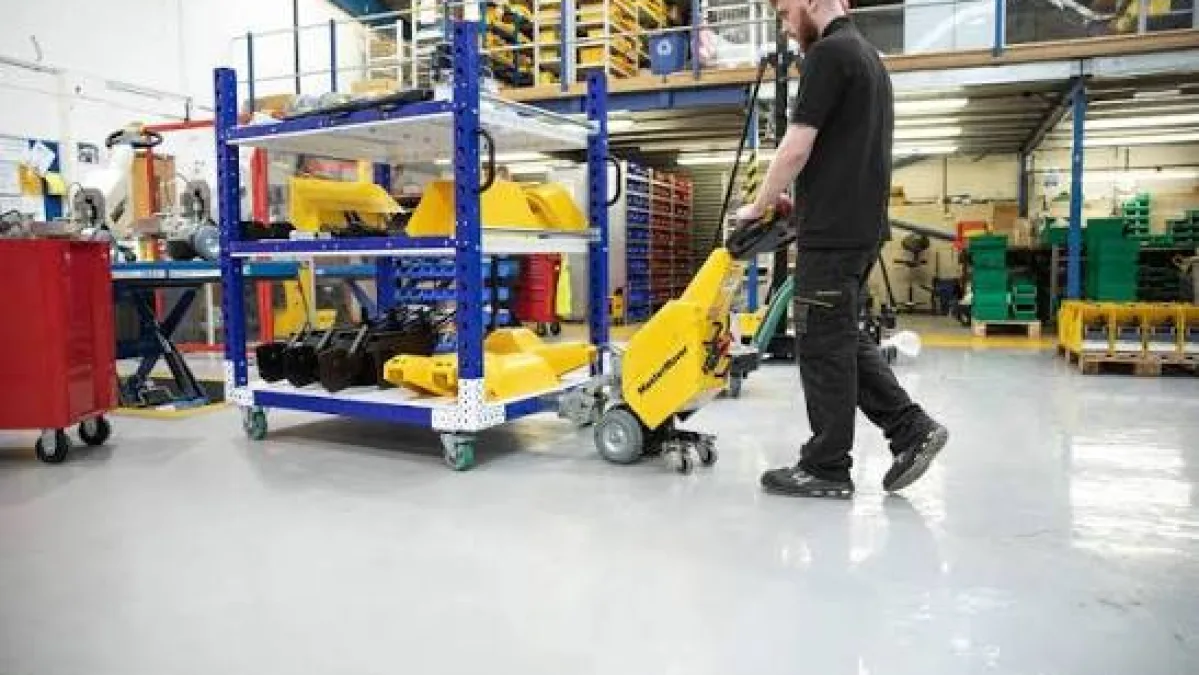
Manual and electric trolleys carry tools, cartons, materials and equipment between work areas. Platform dimensions, wheel construction, braking and maximum gradient can be as important as load capacity.
Powered transporters used on farms or construction sites require suitable tyres, ground clearance, traction and environmental protection.
Forklift and loader attachments
Fork extensions, clamps, rotators and pallet-fork attachments can expand the functions of a base machine. However, an attachment changes the load centre and may reduce the machine’s usable capacity.
Compatibility and revised capacity must be confirmed before use. An attachment should not be fitted merely because its mounting points appear to match.
How Does an Efficient Material-Handling System Work?
An efficient system moves goods from receipt to dispatch through the fewest practical handling steps.
- Receiving: Goods are unloaded, inspected and identified.
- Staging: Loads wait in a controlled area before being moved into storage or production.
- Put-away: Pallets, bins or containers are transferred to assigned storage locations.
- Replenishment: Materials are moved from reserve storage to picking or production areas.
- Picking: Required goods are collected according to production orders or customer demand.
- Processing or packing: Products are assembled, processed, labelled or packed.
- Finished-goods storage: Completed products are held under suitable conditions.
- Dispatch staging: Loads are grouped, checked and prepared for loading.
- Vehicle loading: Suitable dock or handling equipment transfers goods into the transport vehicle.
Every additional transfer consumes labour and creates an opportunity for delay, damage or injury. Layout planning should therefore reduce unnecessary travel, congestion and double handling.
Load Capacity, Load Centre and Residual Capacity
Rated capacity is one of the most important—and frequently misunderstood—handling-equipment specifications.
A stacker or forklift’s rated capacity normally applies at a stated load centre. The load centre is the horizontal distance from the fork face to the load’s centre of gravity. A longer or uneven load moves the centre of gravity forward and can reduce stability.
Capacity can also decline as lift height increases. This is called residual capacity: the mass the equipment can safely handle at a particular height and load centre.
Buyers should provide the heaviest load and its dimensions, not only its mass. A compact 1,000-kilogram pallet may be easier to handle than a long 800-kilogram item with its centre of gravity far from the mast.
Racking capacity also needs careful interpretation. Distinguish among:
- Capacity per shelf
- Capacity per beam pair
- Capacity per storage level
- Capacity per bay
- Total capacity per rack run
- Uniformly distributed load
- Concentrated or point load
A stated capacity cannot be transferred to another arrangement without engineering confirmation.
Technical Specification Comparison
The following table outlines the main criteria for common storage and handling equipment.
| Equipment category | Primary function | Critical capacity | Important dimensional check | Key operating consideration |
|---|---|---|---|---|
| Selective pallet racking | Store palletised goods at multiple levels | Capacity per level and per bay | Pallet size, beam length and frame depth | Floor anchoring, impact protection and aisle clearance |
| Electric pallet stacker | Lift and stack pallets | Rated and residual capacity | Lift height, fork size and turning radius | Pallet compatibility and battery runtime |
| Manual pallet truck | Move pallets at floor level | Rated load at specified centre | Fork length, width and lowered height | Floor quality and travel distance |
| Electric pallet truck | Powered horizontal pallet movement | Load and traction capacity | Turning radius and overall width | Battery charging and gradient capability |
| Scissor-lift table | Raise goods to working height | Platform load capacity | Table length, width and maximum height | Load distribution and pinch-point protection |
| Dock leveller | Bridge a dock and vehicle | Dynamic crossing capacity | Platform size, lip length and working range | Vehicle restraint and dock construction |
| Vacuum lifter | Lift bags, sheets or cartons | Safe working load | Suction-head size and lifting range | Surface porosity and vacuum-loss protection |
| Bulk-bag unloader | Support and discharge bulk bags | Frame and hoist capacity | Bag size, frame height and discharge clearance | Dust control and material-flow behaviour |
| Goods trolley | Transport loose or packaged materials | Platform load | Deck size and handle height | Wheel type, brakes and floor condition |
| Fork attachment | Adapt a forklift or loader for specific loads | Attachment and revised machine capacity | Mounting, fork spacing and load centre | Base-machine compatibility |
Specifications must be verified for the selected configuration. Optional mast heights, batteries, forks, platforms or attachments may change performance and overall dimensions.
Verified Reference Specifications
The Afrimart category includes a heavy-duty selective pallet-racking system. Its published specifications provide a reference for the information buyers should verify when assessing warehouse racking.
| Specification | Published detail |
|---|---|
| Rack type | Selective pallet rack |
| Primary material | Cold-rolled steel |
| Published layer options | One, two, three or five layers |
| Surface treatment | Galvanising or electrostatic powder coating |
| Installation arrangement | Plug-in design |
| Wire-mesh dimension | 50 × 50 mm |
| Listed rack accessories | Pallet support bar and screw bracket |
| Published layer capacity | 800–3,000 kg per layer |
| Capacity qualification | Dependent on column specification |
| Intended use | Industrial warehouse shelving |
| Corrosion protection | Protective surface treatment |
The broad published capacity range should not be applied to every possible configuration. Final capacity depends on upright sections, beam length, bracing, connections, level spacing, floor anchoring and load distribution.
The category also includes a 1,500-kilogram electric pallet truck example with a published 600-millimetre load centre, 1,360-millimetre turning radius and laden travel speed of four kilometres per hour. These details demonstrate why capacity, load centre and manoeuvring space must be evaluated together.
Warehouse Layout and Aisle Planning
A warehouse layout should support safe movement, storage density, stock rotation and emergency access.
Important zones include:
- Receiving and inspection
- Inbound staging
- Reserve storage
- Fast-moving stock
- Picking and packing
- Returns or quarantine
- Finished goods
- Dispatch staging
- Battery charging
- Waste handling
- Maintenance access
- Pedestrian routes
Aisle width depends on the handling equipment’s turning geometry, pallet orientation and lift height. Using the vehicle’s overall width alone will produce an inaccurate result. The supplier’s recommended working-aisle dimension should be checked against the rack and pallet configuration.
Pedestrian and vehicle routes should be separated where practical. Intersections, doorways and blind corners require visibility controls, signs, barriers or traffic-management procedures.
The floor must support rack leg loads and moving equipment. It should also be sufficiently level for elevated handling. Damaged, uneven or weak floors can reduce stability and accelerate wheel wear.
Vertical space must be assessed as carefully as floor area. Consider roof members, lighting, sprinklers, ventilation ducts, doors and legal clearance requirements before establishing the top storage level.
Pallets, Containers and Load Compatibility
Handling equipment and racking must match the actual load carrier. Pallets vary in length, width, entry direction, deck construction and underside design.
Confirm:
- Pallet dimensions
- Two-way or four-way entry
- Open or closed underside
- Runner orientation
- Maximum pallet mass
- Load overhang
- Pallet condition
- Required fork spacing
- Storage orientation
Damaged pallets can fail during lifting or storage. Inspection should identify broken boards, missing blocks, protruding nails, contamination and deformation.
Containers, stillages and cages should have clear load ratings. Stackable units must be designed for stacking, with compatible feet and locating points. A general-purpose bin should not be elevated or stacked merely because its shape appears suitable.
Liquids and hazardous materials may require bunding, separation, ventilation or compatible spill-control equipment. Food, pharmaceutical and chemical materials may also require dedicated storage conditions.
Battery, Charging and Power Requirements
Electric stackers, pallet trucks and transport trolleys may use lead-acid or lithium-based batteries. The equipment’s voltage does not by itself establish working duration.
Runtime depends on:
- Battery capacity
- Load mass
- Travel distance
- Lift frequency
- Floor gradient
- Operating temperature
- Driving behaviour
- Battery age
- Charging practice
Confirm whether the battery and charger are included and compatible with the site’s electrical supply. Ask how long charging takes and whether the planned shift pattern requires an additional battery or opportunity charging.
Charging stations should be positioned away from traffic and protected from impact. Ventilation, fire precautions and emergency arrangements should correspond with the battery technology and local requirements.
Battery condition affects vehicle performance. Maintenance teams should inspect connectors, cables and charging equipment and follow the manufacturer’s instructions.
Benefits of Correct Storage and Handling Equipment
Better use of available space
Appropriate racking and shelving can use vertical volume while keeping inventory accessible.
Faster material movement
Powered trucks, stackers and trolleys can reduce transfer time between receiving, storage, production and dispatch.
Reduced product damage
Stable storage locations, correct pallets and suitable lifting equipment reduce drops, crushing and uncontrolled movement.
Improved inventory control
Clearly defined storage positions make it easier to count, locate and rotate stock.
Lower manual-handling exposure
Lift tables, stackers and vacuum equipment can reduce repetitive lifting, bending and carrying. These devices still require safe procedures and trained operators.
Improved production flow
Timely movement of raw materials and components helps prevent production delays and congested work areas.
Safer loading operations
Correctly specified dock equipment can provide a controlled transition between the warehouse and transport vehicle.
Greater scalability
Modular storage and suitable handling equipment can support changes in inventory volumes and product ranges when expansion is planned correctly.
Safety, Inspection and Load-Control Requirements
Storage and handling systems can create serious risks if they are overloaded, damaged or used by untrained workers. Hazards include falling goods, collapsing racks, unstable vehicles, crushing points and collisions.
Safety controls should include:
- Clearly displayed load limits
- Trained and authorised operators
- Pre-use equipment checks
- Rack-upright protection
- Secure floor anchoring
- Pedestrian segregation
- Speed controls
- Warning devices
- Safe parking procedures
- Emergency-stop systems
- Battery-charging controls
- Housekeeping
- Incident and damage reporting
The International Labour Organization’s model safety code for industrial establishments provides broader guidance for managing industrial workplace hazards. Local occupational health and safety legislation must also be followed.
Rack inspections should look for:
- Bent or damaged uprights
- Deformed beams
- Missing locking devices
- Loose anchors
- Damaged bracing
- Corrosion
- Overloaded positions
- Unsafe modifications
- Poor pallet placement
- Impact damage
- Missing load notices
Damaged equipment should be isolated when its safety is uncertain. Racking components must not be heated, straightened, welded or modified without approval from a competent person.
Handling vehicles require checks of forks, chains, mast, wheels, brakes, controls, warning devices, hydraulics and batteries. Faults affecting safe operation should be corrected before the equipment returns to service.
Maintenance and Operational Planning
Preventive maintenance helps reduce unexpected downtime and unsafe equipment deterioration.
Maintenance requirements may include:
- Hydraulic-fluid checks
- Hose and cylinder inspection
- Mast-chain lubrication
- Fork inspection
- Wheel and bearing replacement
- Brake adjustment
- Battery servicing
- Charger inspection
- Fastener tightening
- Platform and hinge lubrication
- Guard and interlock checks
- Rack-anchor inspection
- Paint and corrosion repair
Wheel selection has a direct effect on operation. Hard wheels may roll efficiently on smooth floors but transmit more vibration. Softer materials can provide quieter movement or improved grip but may wear faster under certain conditions.
Daily housekeeping is also part of maintenance. Debris, shrink wrap, broken pallets and spilled materials can obstruct wheels or cause slips and unstable travel.
Keep equipment records showing inspections, maintenance, damage and repairs. These records help identify repeated impacts, unsuitable layouts or operator-training gaps.
Buyer Checklist for Storage and Handling Materials
Use this checklist before requesting equipment:
- Identify the material or product to be handled.
- Confirm the maximum load mass.
- Measure the load’s length, width and height.
- Establish the load’s centre of gravity.
- Specify the pallet type and entry direction.
- Define the required lift height.
- Request residual capacity at maximum lift.
- Measure aisles, doors and turning areas.
- Inspect floor condition and gradients.
- Determine indoor or outdoor use.
- State daily travel and lifting frequency.
- Confirm required battery runtime.
- Verify charger and electrical compatibility.
- Define rack bay and level capacities.
- Obtain an engineered rack layout.
- Confirm floor anchoring requirements.
- Include upright and end-of-row protection.
- Display approved load notices.
- Check dock height and vehicle range.
- Define required platform or fork dimensions.
- Confirm attachment compatibility.
- Assess the effect of attachments on capacity.
- Request operating and maintenance manuals.
- Define commissioning and training needs.
- Identify critical spare and wear parts.
- Plan inspection intervals.
- Review local workplace regulations.
- Separate vehicle and pedestrian traffic.
- Confirm emergency and fire-access requirements.
- Approve final dimensions before ordering.
How to Request Storage and Handling Equipment Through Afrimart
Buyers can compare available solutions on the Afrimart storage and handling materials category page.
A detailed enquiry should describe the load, maximum mass, dimensions, pallet type, lifting height, daily operating hours and site conditions. For powered equipment, include aisle width, floor gradient and available electricity.
A racking enquiry should contain pallet dimensions, maximum pallet mass, number of pallets, building dimensions, clear height, floor details and the intended handling vehicle. A site drawing can help establish suitable aisle and rack arrangements.
For dock equipment, provide the dock dimensions, range of vehicle-bed heights, maximum crossing load and expected loading frequency. For vacuum lifters or bulk-bag systems, include samples or technical details of the bags and materials being handled.
Detailed information helps ensure the selected equipment is compatible with the warehouse, goods and operating process.
Frequently Asked Questions
What is the difference between a pallet truck and a stacker?
A pallet truck raises a pallet slightly for horizontal movement. A stacker can lift the pallet to a greater height for placement on racks or platforms.
Can equipment always lift its rated capacity to maximum height?
Not necessarily. Usable capacity may decrease as lift height or load centre increases. Request the residual-capacity chart for the required configuration.
How is pallet-racking capacity determined?
Capacity depends on upright sections, beam length, level spacing, bracing, connectors, anchors and load distribution. Use the capacity approved for the exact installed configuration.
What aisle width is required for a stacker?
It depends on the stacker’s turning radius, load dimensions, pallet orientation and rack layout. Use the manufacturer’s working-aisle requirement rather than estimating from machine width.
Can forklift attachments reduce lifting capacity?
Yes. An attachment adds mass and may move the load centre forward. The base machine’s revised capacity must be established before operation.
What information is needed for a dock leveller?
Provide dock dimensions, vehicle-bed height range, maximum vehicle and load mass, traffic frequency, required lip design and surrounding civil details.
How often should racking and handling equipment be inspected?
Operators should conduct routine pre-use and visual checks, while formal inspections should follow applicable legislation, risk level and manufacturer guidance. Any significant impact or visible damage requires prompt assessment.
Sources and Technical Review
This guide was prepared using the Afrimart storage and handling materials category, the published heavy-duty selective pallet-racking specifications, the listed 1,500-kilogram electric pallet truck, and the International Labour Organization’s industrial safety guidance.
Final load capacities, operating dimensions, site requirements and safety provisions must be confirmed for the selected configuration. Storage structures and powered handling equipment should be installed, inspected and operated by competent personnel under applicable local regulations.