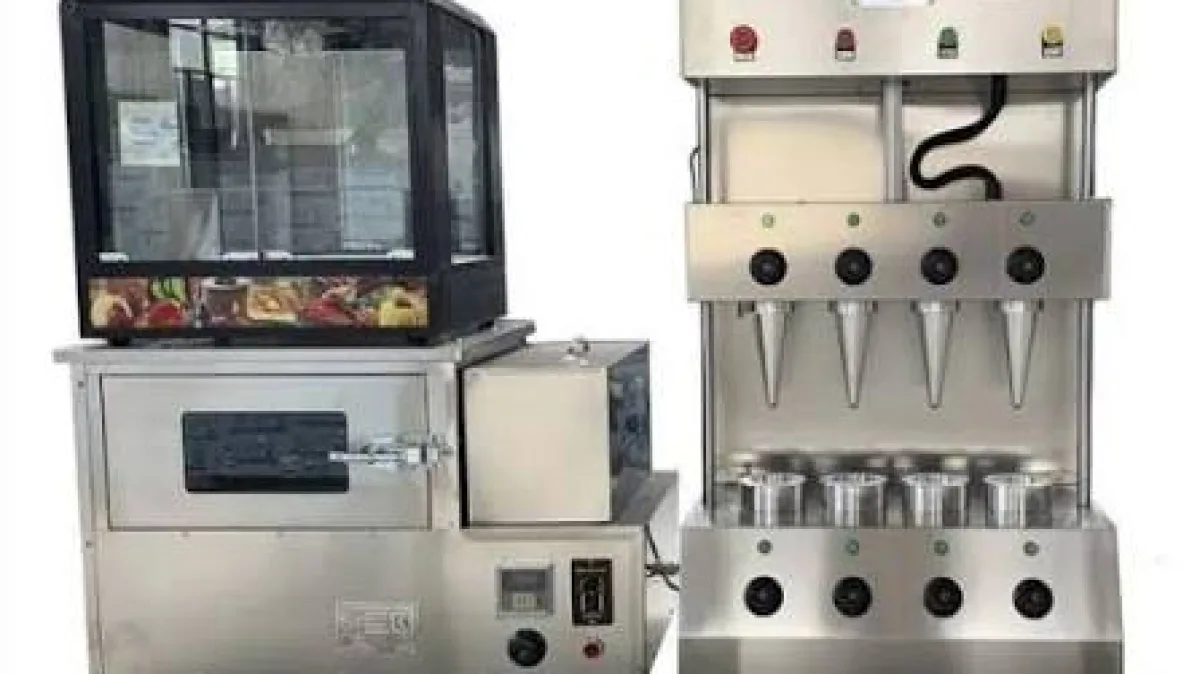
Pizza cone machines form and bake pizza dough into edible cone-shaped shells that can be filled with cheese, sauce, meat, vegetables or dessert ingredients. Available as forming machines, baking ovens and integrated production sets, they are designed for pizzerias, food trucks, kiosks, caterers and quick-service businesses seeking a portable pizza format with controlled shape and portion size.
Pizza cone machines at a glance
Primary function: Forming and baking edible pizza cones
Typical users: Pizzerias, cafés, food trucks, kiosks, caterers and street-food operators
Equipment formats: Moulding machines, baking ovens, rotating ovens, holding units and complete sets
Published mould options: Two, three or four moulds on selected Afrimart-listed models
Published temperature range: 0–330°C on selected models
Power source: Electric, with voltage depending on the selected configuration
Cone shapes: Conical, spiral, umbrella and other model-specific profiles
Selection priorities: Cone dimensions, output, dough recipe, electrical supply and workflow
The Afrimart pizza cone machines category includes commercial moulding machines, automatic pizza cone makers, multi-head models, rotating ovens, holding equipment and complete production sets.
These products should not be treated as technically identical. Some machines form raw dough into a cone, others bake the shaped shell, and complete configurations may combine forming, baking and display equipment. Buyers must confirm which production stages are included with the selected model.
What are pizza cone machines?
Pizza cone machines are specialised commercial food appliances used to turn prepared pizza dough into hollow, edible cones. The finished shells can be filled with pizza ingredients and baked or heated to produce a handheld food product.
The pizza cone format changes the shape and service method of conventional pizza without changing its basic components. A typical cone may contain:
Tomato or other pizza sauce
Cheese
Cooked meat
Vegetables
Herbs
Seasonings
Alternative savoury fillings
Approved dessert ingredients
The machinery category includes several distinct equipment types.
A forming or moulding machine shapes dough around or between heated cone moulds. A baking oven cooks or finishes the shell. A filling stand holds the cone upright while ingredients are added. A rotating oven may heat several filled cones during one cycle, while a holding or display unit may keep finished products in an appropriate service position.
Businesses should identify each stage in the intended workflow. Purchasing a moulding machine does not necessarily provide a complete pizza cone production setup.
The equipment must also be distinguished from waffle-cone and edible-cup machines. Although the products may appear similar, pizza dough, waffle batter and biscuit formulations behave differently. A machine should only be used for a particular recipe when its moulds, temperature range and process are suitable.
How does a pizza cone production process work?
The exact process depends on the selected equipment, but commercial pizza cone production generally follows seven stages.
Prepare the dough
The operator mixes dough using a controlled recipe. Flour type, hydration, fat, yeast, mixing time and resting period affect how the dough forms and bakes.
Divide the portions
Dough is divided into pieces of consistent weight. Uniform portions help control wall thickness, baking and finished product size.
Form the cone
The portion is placed into or around the moulding system. Heat and pressure shape the dough into a hollow cone.
Bake or set the shell
Depending on the machine, the cone may be partially or fully baked during forming. Some operations use a separate oven to complete the shell.
Cool or stabilise the cone
A short cooling period may allow the shell to firm before filling. The required handling method depends on the recipe and production process.
Add the filling
The cone is held upright while sauce, cheese and prepared ingredients are added. Fill distribution should allow the product to heat evenly without overflowing.
Finish and serve
The filled cone may enter a rotating or other suitable oven to melt cheese and heat the ingredients. The business must apply validated cooking, holding and food-safety controls.
An efficient workflow keeps forming, baking, filling and finishing capacity reasonably balanced. A four-mould former cannot deliver its practical output if only one cone can be filled or baked at a time.
What equipment is needed for a pizza cone business?
A pizza cone operation normally requires more than the main forming machine.
Dough mixer
A commercial mixer can help prepare repeatable dough batches. Mixer size should match the daily production plan and recipe.
Dough divider or weighing station
Consistent portion weight contributes to uniform shell thickness. Small businesses may weigh portions manually, while larger operations may use dividing equipment.
Pizza cone forming machine
The former shapes the dough. Buyers should confirm the mould count, cone dimensions, temperature range, cycle time and whether the machine only forms or also bakes.
Baking or finishing oven
Some shells or filled cones require a separate baking stage. Afrimart lists rotating and other pizza cone ovens within the category.
The oven’s capacity should match the former’s output. Otherwise, formed cones may wait too long or create a production bottleneck.
Cone holder or filling stand
A holder keeps the shell upright during filling and service. It should suit the exact cone diameter and length.
Ingredient preparation equipment
Depending on the menu, the business may need refrigeration, preparation tables, slicers, utensils, sauce dispensers and protected ingredient containers.
Hot or refrigerated holding
Prepared ingredients must be held under conditions appropriate to their food-safety requirements. A decorative display cabinet should not be assumed to provide validated hot or cold holding unless its temperature performance is specified.
Packaging and service materials
The finished cone may require a paper sleeve, stand or other food-contact package that allows safe handling without trapping excessive steam and softening the shell.
Which pizza cone machine configuration should a buyer choose?
The correct configuration depends on menu size, demand, available space and the degree of manual work the business can support.
Single-purpose forming machines
A forming machine may suit a business that already has compatible baking equipment. It can also be appropriate for testing a small pizza cone menu before investing in a complete line.
The buyer must verify whether the cone emerges fully baked, partially baked or only shaped.
Two-mould machines
A two-mould model can be appropriate for lower-volume operations, menu testing or sites with limited electrical capacity and preparation space.
Fewer moulds may simplify loading and unloading, but the practical output must still meet peak service demand.
Three- or four-mould machines
Multi-mould configurations can form several cones per cycle. They may suit food trucks, kiosks and quick-service outlets requiring repeated batches.
Production capacity remains dependent on cycle time, dough preparation, filling and final baking.
Automatic pizza cone machines
Automatic equipment may control more of the forming or baking cycle. The word “automatic” does not necessarily mean that dough loading, cone removal, filling and cleaning are automated.
Buyers should request a step-by-step operating description identifying every manual intervention.
Rotating ovens
A rotating oven moves cones through a heated chamber or around a heat source. It can support even exposure and visible preparation at customer-facing outlets.
Confirm the number of holders, adjustable temperature, rotation speed, cooking time and method used to prevent fillings from spilling.
Complete production sets
A complete set may combine moulding, holders, a rotating oven and display equipment. The written quotation should identify every machine and accessory rather than relying on the phrase “full set”.
Chocolate-coated and edible-cup configurations
Some Afrimart-listed equipment is described for chocolate coating, edible coffee cups or related cone products. These applications may require different recipes, temperatures and moulds from pizza cones.
Confirm product compatibility instead of assuming that every cone machine can produce every edible format.
Pizza cone machine specifications
The following specifications are published on an Afrimart pizza cone product page for selected JY-series configurations. They provide a useful comparison, but buyers must verify the exact model linked to their quotation.
| Model | Machine format | Number of moulds | Temperature range | Machine weight | Machine dimensions |
|---|---|---|---|---|---|
| JY-Pz01 | Holding pizza cone machine | Four | 0–330°C | 45 kg | 530 × 350 × 980 mm |
| JY-Pz04 | Spiral pizza cone machine | Three | 0–330°C | 60 kg | 640 × 430 × 1120 mm |
| JY-Pz02 | Pizza cone machine | Two | 0–330°C | 35 kg | 380 × 350 × 980 mm |
| JY-Pz03 | Umbrella pizza machine | Two | 0–330°C | 35 kg | 380 × 350 × 980 mm |
The same product information lists a rated current of 12 A for the four configurations and states that mould size can be customised. Voltage and power information should be confirmed directly because the published formatting combines different electrical options in a way that does not support an unambiguous model-by-model value.
Specifications vary across the broader Afrimart category. Every buyer should obtain the selected machine’s voltage, power, plug, mould dimensions, cycle time, output, included accessories and operating instructions in the current written quotation.
What are the main operational benefits?
Correctly selected pizza cone machines can create several practical benefits for commercial food businesses.
Distinctive handheld presentation
The cone format gives customers a recognisable alternative to a conventional pizza slice. It can be suitable for takeaway, events and locations where customers eat while moving.
Defined portion format
Using a consistent mould and dough weight can help the operator standardise shell dimensions. A controlled filling recipe can also support more repeatable portions.
Portion consistency still depends on dough preparation, ingredient measurement and staff practice.
Multiple cones per cycle
Selected models use two, three or four moulds. Producing several shells during one operating cycle can support batch preparation.
Practical throughput must include loading, forming, removal, filling, final cooking and service rather than counting the moulding stage alone.
Adjustable heating
The published 0–330°C range on selected models allows the operator to adjust the equipment for the chosen dough and process.
A high maximum temperature does not mean every recipe should be operated at that setting. The correct temperature must be established through testing.
Potential menu flexibility
Pizza cones can support different savoury or sweet recipes when the dough, filling and food-safety process are suitable. This may help an operator offer vegetarian, meat-based or dessert options from one service concept.
Compact service concept
Some pizza cone equipment is designed for counter or kiosk operation. The finished footprint must include the machine, ingredient storage, preparation space and safe working clearances.
Visible preparation
Forming, filling and rotating-oven processes can be presented as part of a customer-facing service. Guards, hygiene and safe separation from customers must still be maintained.
Suitability for different business models
The category includes individual machines and complete sets. This allows an established kitchen to add only the missing production stage, while a new operation can evaluate a more integrated setup.
These benefits do not guarantee demand or profitability. Location, menu quality, service speed, ingredient costs and customer acceptance remain central to the business case.
How should production capacity be calculated?
Pizza cone capacity should be calculated from complete, saleable products per hour.
Start with the number of moulds and verified cycle time. Then add the time required for:
Dough portioning
Machine loading
Cone removal
Cooling or stabilisation
Filling
Final cooking
Packaging
Customer service
Cleaning between batches
For example, a four-mould machine may produce four shells during one forming cycle, but the outlet cannot serve four finished cones at that rate unless the filling and final oven stages keep pace.
The peak-hour requirement is more important than the daily average for a fast-food business. An outlet may sell most of its cones during lunch, after-school or evening periods.
Capacity planning should consider:
Expected orders during the busiest 15 minutes
Number of cones per order
Maximum acceptable customer waiting time
Number of trained operators
Batch preparation limits
Oven capacity
Ingredient holding
Electrical load
Cleaning interruptions
Businesses should conduct a timed production trial using the intended dough and menu. The trial should measure the percentage of shells that release cleanly, remain intact during filling and reach customers at the required quality.
Dough, mould and filling compatibility
The relationship between the recipe and the mould is central to pizza cone production.
Dough behaviour
Dough that is too wet may stick or fail to hold its shape. Dough that is too dry may crack during forming or filling.
Relevant variables include:
Flour protein
Hydration
Yeast level
Fat
Sugar
Mixing time
Resting time
Dough temperature
Portion weight
A recipe developed for flat pizza may require adjustment for heated cone moulding.
Mould dimensions
Cone length, top diameter, wall angle and tip profile determine the finished portion and available filling volume.
Custom moulds are referenced for selected configurations, but buyers should request dimensioned drawings and confirm whether custom tooling affects the machine, delivery and replacement parts.
Release performance
Non-stick surfaces or an approved food-release method may help the shell separate from the mould. The buyer must confirm the mould surface and cleaning restrictions.
Metal tools should not be used where they can damage a coated surface.
Filling consistency
Large pieces can leave gaps, concentrate near the opening or obstruct even heating. Ingredients should be sized and distributed for the selected cone.
Overfilling can cause spillage, slow heating and contamination of the oven. Underfilling may create poor presentation and inconsistent portions.
Moisture management
Watery sauce or high-moisture vegetables can soften the shell. The recipe should balance sauce quantity, ingredient preparation, baking and service time.
A cone that performs well when eaten immediately may lose crispness during delivery. Businesses planning takeaway or delivery should test the complete time between filling and consumption.
Food safety and hygienic design
Pizza cone equipment contacts dough and may operate close to ready-to-eat ingredients. It must therefore be incorporated into the business’s food-safety system.
The European Hygienic Engineering and Design Group explains that poorly designed equipment can be difficult to clean effectively, increasing the risk of microbial growth and cross-contamination.
Buyers should examine:
Food-contact materials
Mould coatings
Seams and joints
Removable components
Areas where crumbs or filling can collect
Access beneath and behind the machine
Electrical protection during cleaning
Cleaning-chemical compatibility
Drainage and drying
Replacement of damaged food-contact surfaces
A pizza cone workstation must separate raw and ready-to-eat ingredients. Raw meat should not be handled with the same utensils or on the same surface used for cheese, vegetables or finished cones unless an effective cleaning and sanitation procedure is completed.
Food-safety controls should address:
Ingredient receiving
Refrigerated storage
Thawing
Preparation
Cross-contamination
Cooking
Hot holding
Service
Cleaning
Waste disposal
Staff hygiene
Where raw animal products are used, the business must validate the time and temperature needed to cook them safely. Alternatively, it may use properly precooked ingredients and control reheating according to local requirements.
The heated cone shell should not be assumed to prove that every filling has reached a safe internal temperature.
Installation, electricity and workspace requirements
Pizza cone machines are electrical heating appliances. Installation should provide suitable power, ventilation and safe operator access.
Before ordering, confirm:
Supply voltage
Frequency
Rated power
Rated current
Plug configuration
Protective earthing
Circuit-breaker requirement
Cable length
Local electrical compliance
Selected JY-series configurations are listed at 12 A, but buyers must verify the exact voltage and power of their chosen machine. A plug shape or nominal voltage should not be changed without confirming appliance compatibility.
The workstation should have:
A level, heat-resistant surface
Clearance from combustible materials
Space to open or operate the moulds
Safe separation from customers
Ingredient preparation space
Refrigeration where required
Hand-washing access
Adequate ventilation
Accessible fire-safety equipment
Non-slip flooring
Protected cable routing
Food trucks and mobile kiosks must include every appliance when calculating generator or electrical-connection capacity. Starting and heating loads for refrigeration, ovens, mixers and extraction equipment should be considered together.
Cleaning, maintenance and operator training
The machine should be cleaned after use according to its operating manual. Power must be isolated and hot surfaces allowed to cool before cleaning begins.
A typical routine may include:
Removing loose crumbs
Wiping approved food-contact surfaces
Cleaning mould recesses
Removing baked-on dough carefully
Cleaning handles and controls
Inspecting hinges and fasteners
Checking electrical cables
Verifying temperature controls
Cleaning the surrounding workstation
Do not immerse electrical components or spray water into controls. Abrasive tools can damage non-stick or treated mould surfaces.
Operators should be trained to identify:
Uneven heating
Sticking dough
Damaged mould surfaces
Loose electrical connections
Abnormal odour
Excessive smoke
Inaccurate temperature control
Damaged cables
Unstable stands or frames
A spare-parts plan may include model-specific heating elements, thermostats, temperature controllers, switches, moulds, handles and electrical components. The actual list must be confirmed for the selected machine.
Training should cover dough portioning, preheating, loading, safe removal, cleaning, emergency shutdown and food handling. A short operating procedure displayed near the machine can help maintain consistency between shifts.
What should buyers confirm before ordering?
Use this pizza cone machine buyer checklist:
Define the required cone shape.
Confirm the cone length and opening diameter.
Establish the target dough weight.
Provide the intended dough recipe for testing.
Confirm whether the machine forms, bakes or completes both stages.
Verify the number of moulds.
Request the cycle time under normal production conditions.
Calculate complete finished cones per hour.
Confirm the adjustable temperature range.
Request temperature-control accuracy.
Verify voltage, frequency, current and power.
Confirm the plug and electrical connection.
Check machine dimensions and operating clearances.
Confirm machine weight for counters or mobile installations.
Request food-contact material specifications.
Confirm the mould surface and non-stick treatment.
Obtain instructions for releasing cones safely.
Verify whether mould size can be customised.
Request drawings for any custom mould.
Confirm whether a rotating or finishing oven is included.
Identify required cone holders and filling stands.
Confirm whether a display cabinet provides temperature control.
Establish refrigeration requirements for ingredients.
Review cleaning and sanitation procedures.
Confirm approved cleaning tools and chemicals.
Request operating and maintenance manuals.
Include operator training.
Obtain a recommended spare-parts list.
Confirm warranty scope and claims procedures.
Provide the project country and delivery location.
State the intended installation and opening date.
A buyer planning several outlets should first validate the recipe and workflow on one configuration. Standardising dough, moulds, cooking settings and training can make later expansion easier.
How to source pizza cone machines through Afrimart
Afrimart can help food businesses compare forming machines, ovens and complete pizza cone production sets.
A useful enquiry should include:
Intended menu
Required cone shape
Cone dimensions
Dough recipe
Target cones per hour
Peak service demand
Available electricity
Kitchen or food-truck dimensions
Required number of moulds
Oven requirements
Display or holding requirements
Project country
Operator-training needs
Target operating date
Ask for a written quotation identifying the exact model, production stages, mould count, mould dimensions, voltage, power, current, temperature range, cycle time, dimensions, weight, accessories, documentation and warranty.
Explore pizza cone machines and request a quotation through Afrimart.
Frequently asked questions
What does a pizza cone machine do?
A pizza cone machine shapes prepared dough into a hollow edible cone. Depending on the selected model, it may form, partially bake or fully bake the shell. Filling and final heating may require separate equipment, so buyers should confirm every production stage included in the quotation.
How many cones can the machine produce at once?
Selected Afrimart-listed JY-series machines use two, three or four moulds. Other category models may differ. Mould count is not the same as hourly output because cycle time, filling, final baking and service must also be included in the capacity calculation.
Can ordinary pizza dough be used?
A conventional pizza recipe may need adjustment for cone moulding. Dough moisture, elasticity, resting time, temperature and portion weight affect release and shell strength. Buyers should test their intended recipe using the selected mould rather than assuming that every pizza dough will produce a stable cone.
Does a pizza cone machine include an oven?
Not always. Some products are moulding machines, some are baking ovens and others are offered as complete sets with rotating ovens or stands. Request an itemised scope identifying the forming, baking, holding and display equipment included with the selected configuration.
Can the machine make sweet cones or edible cups?
Some category products reference sweet cones, chocolate coating or edible cups, but compatibility depends on the mould and recipe. A pizza cone machine should not automatically be used for waffle batter or biscuit formulations. Confirm the intended products and request suitable moulds and operating instructions.
What electrical supply is required?
Electrical requirements vary by model and configuration. Selected JY-series units are listed with a rated current of 12 A, but their exact voltage and power should be confirmed in writing. Mobile operators must include ovens, refrigeration and other appliances when sizing their power supply.
How should pizza cone equipment be cleaned?
Disconnect the machine, allow heated surfaces to cool and follow the model-specific manual. Remove crumbs and food residue using approved non-abrasive tools. Do not immerse electrical components or damage coated mould surfaces. The wider workstation, holders, utensils and ingredient containers must also follow a documented sanitation procedure.
Sources and technical review
Afrimart: Pizza Cone Machine technical reference
EHEDG: Hygienic Design Principles
SEO title: Pizza Cone Machines: African Buyer Guide | Afrimart