









































































































































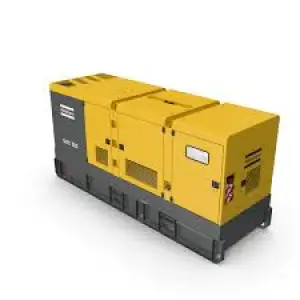















































































































































































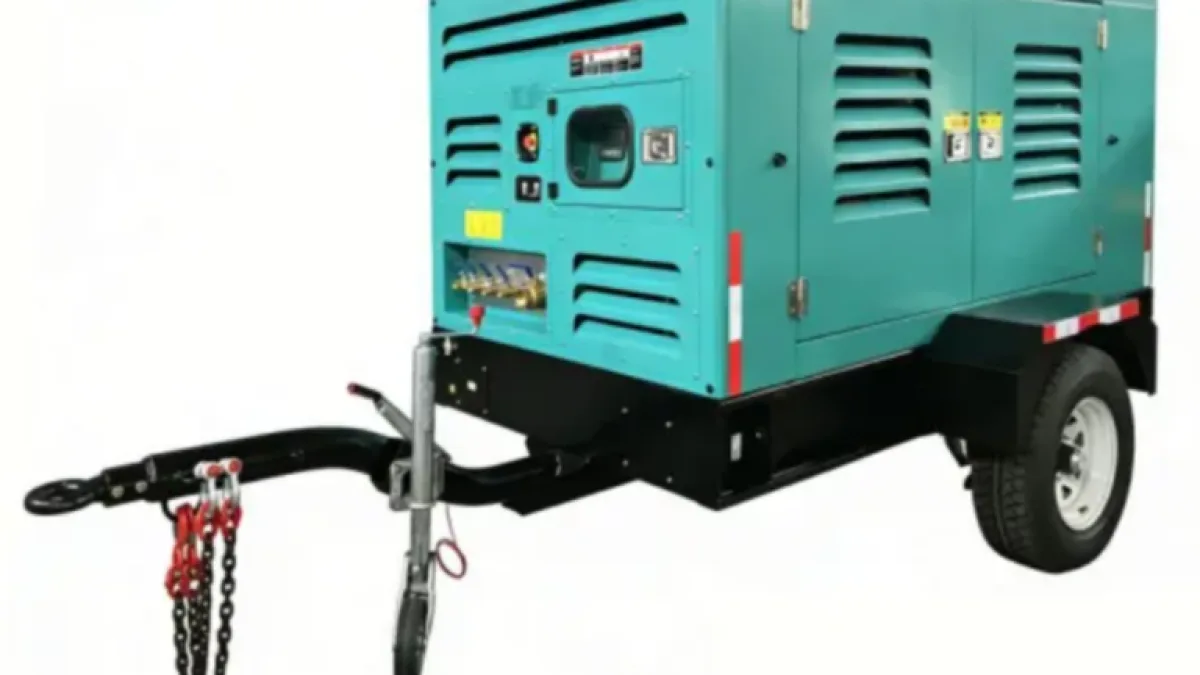
The Afrimart 400 CFM industrial screw air compressor is a diesel-powered, oil-lubricated unit designed to supply compressed air at working pressures of up to 10 bar. Its high airflow makes it suitable for construction, industrial maintenance, pneumatic tools and other applications requiring substantially more air than a conventional workshop compressor can provide.
At a Glance
- Compressor type
- Rotary screw air compressor
- Power source
- Diesel engine
- Rated airflow
- 400 CFM
- Approximate metric airflow
- 11.33 m³/min
- Working pressure
- 10 bar
- Approximate pressure equivalent
- 145 psi
- Lubrication
- Oil-lubricated
- Configuration
- Listed as stationary
- Enclosure
- Sound-attenuating canopy
- Dimensions
- 4,726 × 1,770 × 2,216 mm
- Inspection documents
- Machinery test report and outgoing inspection video listed
- Typical applications
- Construction, pneumatic tools, maintenance, agriculture and industrial air supply
The compressor is available through the Afrimart 400 CFM, 10-bar industrial screw air compressor listing.
What Is a 400 CFM Screw Air Compressor?
A rotary screw compressor produces compressed air using two intermeshing helical rotors. As the rotors turn, air is drawn into the compression element, trapped between the rotor profiles and progressively compressed before leaving the air end.
The Afrimart machine is described as an oil-lubricated diesel-driven screw compressor. In this configuration, oil is normally used to lubricate, seal and cool the screw-compression process. The oil is then separated from the compressed-air stream before the air leaves the machine.
A 400 CFM rating represents a significant industrial airflow. It is approximately equivalent to:
- 11.33 cubic metres per minute
- 188.8 litres per second
- 679.6 cubic metres per hour
These are mathematical conversions of 400 cubic feet per minute, not separate performance ratings. The purchaser should confirm whether the 400 CFM figure is the machine’s free-air delivery at 10 bar under a recognised test standard.
This distinction matters because compressor advertisements may reference theoretical displacement, inlet capacity or delivery at a pressure different from the intended operating pressure.
How the Diesel Screw Compressor Works
The diesel engine supplies mechanical power to the compressor’s screw air end. Depending on the design, power may be transferred through a direct coupling, gearbox or belt system.
A typical operating sequence is:
- Ambient air enters through the intake filter.
- The inlet valve regulates air entering the compressor.
- The screw rotors draw in and compress the air.
- Lubricating oil is injected into the compression chamber.
- The air-and-oil mixture moves into a separator vessel.
- Most of the oil is removed mechanically.
- A separator element removes remaining oil droplets.
- The oil is cooled, filtered and returned to the air end.
- The compressed air passes through a cooler.
- Air leaves through the service outlet at the controlled pressure.
The engine and compressor controller monitor conditions such as pressure, temperature and operating status. Protective shutdowns may activate if the machine overheats, loses oil pressure or experiences another critical fault.
The product page refers to “engine” and “motor” as core components, but identifies diesel as the power source. Buyers should clarify whether “motor” refers to an internal fan or auxiliary component rather than an electric main drive.
Understanding 400 CFM and 10 Bar
Airflow and pressure must be considered together when sizing a compressor.
Airflow
CFM measures the volume of air delivered per minute. Every connected pneumatic tool or process consumes a certain amount of air. The compressor must supply the combined demand, including an allowance for leakage and peak use.
Pressure
Bar or psi measures the pressure at which the air is delivered. The compressor must generate enough pressure to overcome:
- Tool operating pressure
- Pipe friction
- Hose losses
- Filter pressure drop
- Dryer pressure drop
- Fittings and valves
- Changes in site elevation
- Pressure variation between load and unload settings
A machine rated at 10 bar does not mean every tool should receive 10 bar. Most applications require a regulator to reduce pressure to the level specified by the tool or process manufacturer.
Operating at unnecessarily high pressure wastes energy, increases leakage and places additional stress on hoses and equipment.
Confirming the Duty Point
When requesting a quotation, ask Afrimart to state:
- Free-air delivery at 10 bar
- Test standard used
- Airflow tolerance
- Normal operating-pressure range
- Maximum allowable working pressure
- Minimum stable operating pressure
- Engine speed at rated delivery
- Performance at the expected site altitude and temperature
The selected compressor should meet the project requirement at the actual operating conditions, not only under a nominal catalogue condition.
Suitable Industrial Applications
Construction and Civil Works
A 400 CFM compressor may supply air for selected pneumatic breakers, rock drills, chipping tools, compactors and other construction equipment.
The exact number of tools that can run simultaneously depends on each tool’s rated and peak consumption. Starting demand and intermittent operation must also be considered.
Mining and Quarry Support
The compressor may be considered for pneumatic tools, maintenance work, exploration support and other compressed-air duties. It should not be assigned to underground work unless the complete engine, exhaust, fire protection and mine-safety configuration is approved for that environment.
Industrial Maintenance
Factories and maintenance contractors may use a diesel compressor during shutdowns, emergency repairs or work in areas without sufficient electrical capacity.
Compressed air used for instrumentation, food contact, breathing air or specialised production requires additional treatment and certification.
Abrasive Blasting
Abrasive blasting can consume large volumes of air continuously. The required CFM depends on nozzle diameter, pressure, nozzle wear and the number of operators.
Moisture and oil can affect blasting performance, so aftercooling, moisture separation and suitable filtration may be required.
Agricultural Operations
Possible applications include equipment cleaning, maintenance tools and selected pneumatic machinery. Compressed air should never be directed at people, animals or unprotected crops.
Pipeline and Pressure Work
The compressor may support certain pipeline-maintenance, cleaning or testing activities. However, air-pressure testing can store dangerous amounts of energy. Testing should follow an engineered method using properly rated equipment and controlled exclusion zones.
Automotive and Fleet Workshops
The unit may support high-demand tools or temporary workshop operations. Its airflow may be excessive for a small repair shop unless the demand has been properly measured.
Drilling Applications
Some drilling tools require substantial airflow. Air demand varies greatly by hole diameter, depth, ground condition and drilling method, so suitability must be confirmed using the drilling-equipment manufacturer’s requirements.
Technical Specifications
| Specification | Available information |
|---|---|
| Product category | Industrial rotary screw air compressor |
| Rated airflow | 400 CFM |
| Approximate metric airflow | 11.33 m³/min |
| Working pressure | 10 bar |
| Approximate pressure equivalent | 145 psi |
| Main power source | Diesel engine |
| Compressor configuration | Screw type, engine driven |
| Lubrication style | Oil-lubricated |
| Installation description | Stationary |
| Noise treatment | Sound-attenuating or low-noise canopy listed |
| Dimensions | 4,726 × 1,770 × 2,216 mm |
| Canopy colour | Customisable |
| Machinery test report | Listed as provided |
| Outgoing inspection video | Listed as provided |
| Engine manufacturer and model | Confirm before ordering |
| Rated engine power | Confirm before ordering |
| Free-air delivery at 10 bar | Confirm against a recognised test standard |
| Fuel-tank capacity | Confirm before ordering |
| Fuel consumption | Confirm at full load and partial load |
| Compressor air-end model | Confirm before ordering |
| Drive arrangement | Confirm direct, geared or belt drive |
| Air-outlet size and quantity | Confirm before ordering |
| Noise level | Confirm in dB(A), including test distance |
| Operating-temperature range | Confirm before ordering |
| Maximum operating altitude | Confirm derating requirements |
| Integrated aftercooler | Confirm before ordering |
| Water separator | Confirm before ordering |
| Integrated air dryer | Not established; confirm separately |
| Air receiver | Not established; confirm if required |
| Operating weight | Confirm before transport planning |
| Lifting points | Confirm certified lifting arrangement |
| Warranty | Confirm in writing |
The product’s “low-noise” description is not a numerical noise rating. Request the sound-pressure level in dB(A), test distance, operating load and applicable measurement standard.
Benefits of a Diesel Screw Compressor
Independent Power Source
The diesel engine allows the compressor to operate at sites where adequate three-phase electricity is unavailable. This can be valuable for construction, remote maintenance and temporary projects.
High Continuous Airflow
Rotary screw technology is commonly selected for applications requiring sustained airflow. A 400 CFM rating can support industrial tools that would quickly exhaust a small piston compressor.
10-Bar Working Pressure
The 10-bar rating provides pressure capacity for a wide range of general industrial and construction applications, provided the connected tools are appropriately regulated.
Sound-Attenuating Canopy
A properly designed enclosure can reduce mechanical and airflow noise while protecting major components. However, a canopy does not make the machine silent, and hearing protection may still be required.
Integrated Industrial Package
A packaged unit can combine the engine, screw air end, cooling system, controls and enclosure on a single base. This can simplify transport and site setup.
Oil-Lubricated Compression
Oil injection supports cooling, sealing and lubrication inside the air end. This configuration is widely used for general industrial compressed air where validated oil-free air is not required.
Temporary and Mobile Project Support
Although the listing calls the unit stationary, a skid-mounted package may be transportable between sites using suitable lifting and hauling equipment. Buyers must confirm its weight, lifting points and whether a wheeled chassis is available.
Compressor Sizing and Air-Demand Calculation
A compressor should be selected from measured or calculated air demand.
Start by listing every pneumatic consumer:
| Equipment information | Detail to collect |
|---|---|
| Tool or process | Name and model |
| Required pressure | Bar or psi at the tool |
| Average consumption | CFM or m³/min |
| Peak consumption | Maximum short-term demand |
| Duty cycle | Percentage of operating time |
| Quantity | Number running simultaneously |
| Hose length | Distance from compressor |
| Hose diameter | Internal diameter |
| Air-quality requirement | Moisture, particle and oil limits |
Do not simply add every tool’s nameplate consumption if they will not operate simultaneously. Conversely, do not rely solely on average demand when several tools can start together.
A planning allowance may be needed for:
- Existing leaks
- Future equipment
- Filter pressure losses
- Altitude derating
- High ambient temperature
- Tool wear
- Nozzle wear
- Demand fluctuations
The compressor should not be oversized without analysis. Excess capacity can increase capital cost, fuel use and time spent operating inefficiently at partial load.
Air Quality, Drying and Filtration
Compressing air concentrates atmospheric moisture. When hot compressed air cools in piping or a receiver, water can condense.
An oil-lubricated screw compressor may also allow small quantities of oil aerosol or vapour into the delivered air. The required treatment depends on how the air will be used.
A complete system may need:
- Aftercooler
- Moisture separator
- Automatic condensate drain
- Air receiver
- Refrigerated dryer
- Desiccant dryer
- Particulate filter
- Coalescing filter
- Activated-carbon treatment
- Pressure regulator
General Pneumatic Tools
Basic moisture separation and filtration may be sufficient for some construction tools, although each tool manufacturer’s instructions must be followed.
Abrasive Blasting
Dry air can improve abrasive flow and surface preparation. Moisture can block metering valves and affect the blasted surface.
Instrument Air
Instrumentation normally requires controlled pressure, dryness and cleanliness. A general compressor package should not be assumed to meet those requirements without a designed treatment system.
Food, Pharmaceutical and Medical Applications
The Afrimart product is described as oil-lubricated. It should not be represented as certified oil-free or suitable for direct food, pharmaceutical, medical or breathing-air use without a specifically engineered and validated treatment system.
Breathing Air
Compressed air from this diesel screw compressor must never be supplied directly to breathing apparatus. Carbon monoxide, oil, vapour, moisture and other contaminants can create fatal hazards. Breathing-air systems require dedicated purification, monitoring and compliance controls.
Installation and Ventilation
The compressor dimensions indicate a substantial industrial unit. The installation area must provide enough clearance for ventilation, servicing, lifting and safe operation.
Outdoor Installation
For outdoor use:
- Place the unit on a firm, level surface.
- Prevent floodwater from reaching the machine.
- Keep combustible materials away from the exhaust.
- Position the exhaust away from workers and air intakes.
- Maintain the required cooling clearances.
- Prevent recirculation of hot discharge air.
- Provide barriers where vehicles operate nearby.
Indoor or Enclosed Installation
A diesel-powered compressor should not be operated in an enclosed building without an engineered exhaust and ventilation system. A sound-reducing canopy does not remove carbon monoxide or other diesel exhaust hazards.
The room must safely manage:
- Engine exhaust
- Cooling-air flow
- Radiated heat
- Fuel storage
- Fire risk
- Noise
- Condensate
- Maintenance access
A qualified engineer should approve any indoor installation.
Compressed-Air Piping
Piping should be rated above the compressor’s maximum allowable pressure and installed according to applicable requirements.
Avoid undersized hoses because they can create excessive pressure drop. Flexible connections may be required to isolate vibration between the compressor and fixed piping.
Safety Requirements
Compressed air, hot oil, rotating machinery, pressure vessels, diesel fuel and engine exhaust create multiple hazards.
Important precautions include:
- Train and authorise operators.
- Read the engine and compressor manuals.
- Inspect hoses, couplings and safety clips.
- Never use damaged or incorrectly rated air lines.
- Depressurise the system before maintenance.
- Never open the separator vessel while pressurised.
- Keep guards and canopy panels in place.
- Avoid contact with the exhaust and hot components.
- Do not refuel while the engine is running or hot.
- Keep ignition sources away from fuel.
- Provide suitable fire extinguishers.
- Use hearing protection where required.
- Never direct compressed air at a person.
- Keep the discharge pressure within equipment ratings.
- Test emergency stops and protective shutdowns.
- Drain and dispose of oily condensate responsibly.
High-pressure hose failure can cause violent movement. Use suitable restraints, couplings and whip checks where required.
Maintenance and Operating Costs
The purchase price is only one part of compressor ownership. Fuel and maintenance can become major costs when the unit operates for long shifts.
Daily Checks
Operators should inspect:
- Engine-oil level
- Compressor-oil level
- Coolant level
- Fuel level
- Air-filter restriction
- Hoses and fittings
- Visible leaks
- Control-panel alarms
- Separator-vessel pressure
- Condensate drains
- Cooling-air passages
Scheduled Maintenance
Service tasks may include:
- Engine-oil replacement
- Engine filter replacement
- Fuel-filter replacement
- Compressor-oil replacement
- Air-intake filter replacement
- Oil-filter replacement
- Separator-element replacement
- Cooler cleaning
- Drive inspection
- Valve servicing
- Safety-valve testing
- Sensor calibration
- Battery maintenance
Fuel-Cost Calculation
Ask for verified fuel consumption at:
- Full load
- 75% load
- 50% load
- Unloaded operation
- Idle
Fuel use should be calculated against expected daily operating hours. An efficient machine can still produce high operating costs if it spends long periods unloaded while the engine continues running.
The US Department of Energy’s compressed-air system sourcebook emphasises system-level evaluation, including demand, leaks, controls, pressure and air treatment, rather than evaluating the compressor alone.
Buyer Checklist
Compressor Performance
- Is 400 CFM the free-air delivery at 10 bar?
- Which test standard was used?
- What is the full operating-pressure range?
- What is the maximum pressure?
- How does altitude affect delivery?
- What ambient-temperature range is approved?
- Is the compressor suitable for continuous duty?
Diesel Engine
- What is the engine brand and model?
- What is its rated power?
- What is the fuel-tank capacity?
- What is the full-load fuel consumption?
- Is the engine liquid- or air-cooled?
- Are filters and service parts available locally?
- Does the engine comply with applicable emissions requirements?
Air Treatment
- Is an aftercooler included?
- Is a moisture separator included?
- Are automatic drains fitted?
- Is an air receiver included?
- Is a dryer included?
- What residual oil level should be expected?
- What filtration is recommended for the application?
Controls and Protection
- Is the controller digital?
- Which operating parameters are displayed?
- Does it record alarm history and operating hours?
- Which automatic shutdowns are included?
- Is an emergency stop fitted?
- Can pressure settings be password protected?
- Is remote monitoring available?
Noise and Installation
- What is the verified sound level in dB(A)?
- At what distance was noise measured?
- What maintenance clearances are required?
- Where are the cooling-air inlet and outlet?
- Can hot cooling air be ducted?
- What exhaust arrangement is supplied?
- Is the unit approved for outdoor exposure?
Transport and Support
- What is the operating and packed weight?
- Are certified lifting points provided?
- Is it skid-mounted or trailer-mounted?
- Are forklift pockets provided?
- What warranty applies?
- Is commissioning included?
- Which spare parts are supplied?
- Can a full-load test report be provided before dispatch?
Request the Afrimart 400 CFM Screw Air Compressor
The Afrimart 400 CFM, 10-bar diesel screw air compressor may suit businesses requiring a large, independent compressed-air supply for construction, industrial maintenance, agriculture and selected pneumatic processes.
Before ordering, confirm that 400 CFM is the verified free-air delivery at 10 bar. The final quotation should also state the engine model, fuel consumption, operating weight, outlet configuration, numerical noise rating and included air-treatment equipment.
View the Afrimart 400 CFM industrial screw air compressor and submit the tools, pressure, simultaneous airflow and operating conditions for an application-based quotation.
Frequently Asked Questions
What does 400 CFM mean?
It indicates a nominal airflow of 400 cubic feet per minute, approximately 11.33 m³/min. Buyers should confirm that this is free-air delivery at the required 10-bar pressure.
What is 10 bar in psi?
Ten bar is approximately 145 psi.
Is the compressor electric or diesel?
The Afrimart listing describes it as a diesel-engine-driven compressor. Any reference to a motor should be clarified before ordering.
Is it an oil-free compressor?
No. The product is listed as oil-lubricated. Applications requiring certified oil-free air need a different compressor or a properly engineered treatment solution.
Can it be operated indoors?
A diesel compressor should not be operated in an enclosed indoor space without engineered exhaust extraction, cooling ventilation and appropriate safety controls.
Does low noise mean hearing protection is unnecessary?
No. “Low noise” is not a measured sound rating. Request the dB(A) value and conduct a workplace noise assessment.
Does it include an air dryer?
An integrated dryer is not established in the published specifications. Confirm whether a dryer, aftercooler, separator and filters are included.
How many pneumatic tools can it operate?
Divide the available airflow by the combined demand of the tools while accounting for simultaneous use, pressure loss, leakage and reserve capacity. Tool requirements vary considerably.
Can it be used for abrasive blasting?
Potentially, subject to nozzle size, pressure and air-treatment requirements. Blasting often requires dry, continuously delivered air.
Is the machine portable?
It can potentially be transported between sites, but the listing describes it as stationary. Confirm whether it is supplied on a skid or road-approved trailer.
Can the compressed air be used for breathing?
No. It must not be connected directly to breathing equipment. Dedicated purification, monitoring and certification are required.
What is the compressor’s fuel consumption?
The listing does not provide a verified figure. Request consumption at full load, partial load, unloaded operation and idle.
What maintenance parts should be ordered?
Common items include engine filters, compressor oil, oil filters, intake filters, separator elements, belts, seals and approved lubricants. The exact kit must match the supplied engine and air end.
What information should accompany a quotation request?
Provide the required pressure, total CFM, tools, number operating simultaneously, daily working hours, site altitude, ambient temperature, air-quality requirement and whether the machine must be trailer-mounted.