




































































































































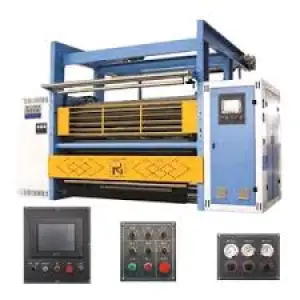





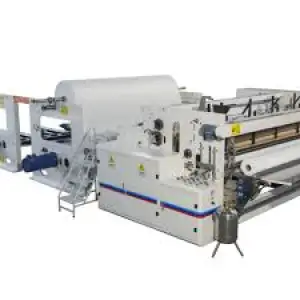



















































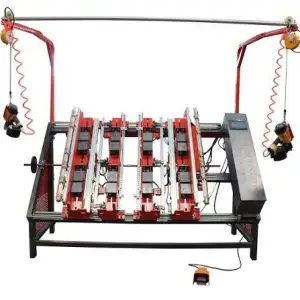




















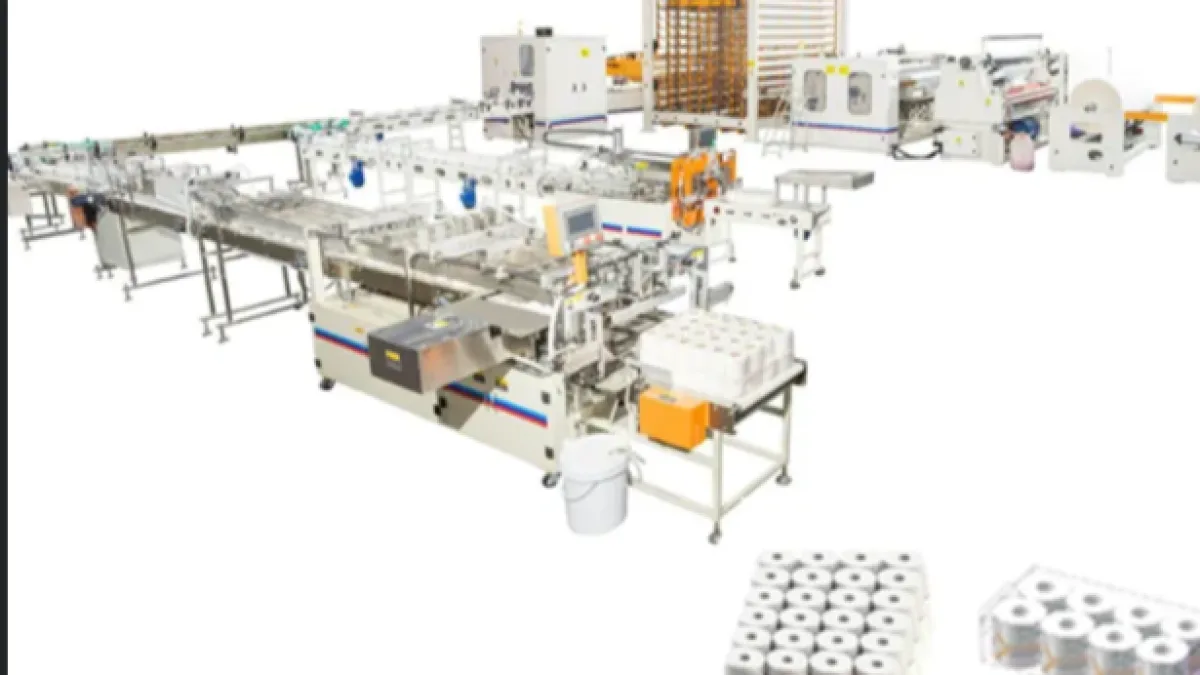
The Afrimart Tissue Paper Production Line Toilet Paper Making Machine converts jumbo tissue rolls into perforated, embossed toilet-paper logs with or without cardboard cores. Designed for tissue converters and toilet-roll manufacturers, it uses programmable logic controller (PLC) automation and a touchscreen human-machine interface (HMI), with a stated operating speed of up to 230 metres per minute.
At a glance
- Best suited to
- Toilet-paper converting and roll-manufacturing operations
- Input material
- Jumbo tissue rolls with a paper weight of 13–16 g/m²
- Final product
- Embossed and perforated toilet-paper logs
- Operating speed
- 0–230 metres per minute
- Stated production output
- 15,000–25,000 rolls per eight-hour shift
- Control system
- PLC with touchscreen HMI
- Available configurations
- Seven models for jumbo-roll widths from 1,350 to 2,750 mm
What is the Tissue Paper Production Line Toilet Paper Making Machine?
The Tissue Paper Production Line Toilet Paper Making Machine is an automatic converting machine that processes large parent or jumbo tissue rolls into smaller toilet-paper logs.
It does not manufacture tissue paper from pulp. Instead, it performs the downstream converting stages required after jumbo tissue has already been produced or purchased.
The machine can carry out several functions in one automated process:
- Feeding tissue from a jumbo roll
- Full or edge embossing
- Rewinding with or without a cardboard core
- Perforating the tissue into individual sheets
- Cutting the end of the log
- Applying adhesive to secure the tail
The resulting logs must then be cut into individual toilet rolls and packed. Buyers planning a complete production operation should therefore confirm whether compatible log-cutting and packaging machines are included or must be ordered separately.
How does the toilet-paper making machine work?
The machine converts jumbo tissue into finished logs through a continuous rewinding process.
- Jumbo-roll loading: The selected jumbo tissue roll is mounted on the appropriate stand and fed into the machine.
- Embossing: The tissue passes through a steel-to-rubber embossing unit. Depending on the selected configuration, full embossing or edge embossing can be applied.
- Core feeding or coreless setup: The machine’s core-feeding system allows toilet-paper logs to be produced with a cardboard core. It can also operate in a coreless configuration.
- Perforation and rewinding: The tissue is perforated at a selected distance between 100 and 150 mm and rewound into a log. Operating data is managed through the touchscreen HMI and PLC.
- End cutting and tail sealing: Once the required log diameter is reached, the machine cuts the end and applies adhesive to secure the loose tail.
- Downstream converting: The completed log is transferred to a separate cutting machine, which divides it into individual rolls. The rolls can then proceed to the required packaging equipment.
What materials and products can it process?
The machine is designed to process jumbo tissue rolls with a stated paper weight of 13–16 grams per square metre.
Its verified output applications include:
- Cored toilet-paper rolls
- Coreless toilet-paper rolls
- Standard toilet-roll logs
- Maxi-roll logs
The specified finished-log outside diameter ranges from 90 to 140 mm, while the inside diameter ranges from 38 to 76 mm.
Input compatibility should be confirmed against the chosen model, particularly the jumbo-roll width, tissue grammage, roll-core size, number of plies and parent-roll diameter.
Where is this toilet-paper production line used?
Toilet-paper converting plants
The machine is suited to manufacturers that purchase jumbo tissue rolls and convert them into consumer or institutional toilet rolls.
Hygiene-product businesses
Businesses entering the disposable-hygiene sector can use the rewinder as the principal converting machine within a broader toilet-roll cutting and packaging line.
Contract manufacturing operations
Contract converters can use different machine settings and optional equipment to manufacture toilet rolls for retailers, distributors and private-label customers.
Institutional tissue suppliers
Manufacturers supplying hotels, schools, healthcare facilities, offices and public institutions may configure the equipment for the required roll diameter, perforation length and core format.
Regional manufacturing projects
The equipment may support local tissue conversion in markets where finished toilet rolls are transported over long distances but jumbo tissue is available from domestic or regional paper producers.
Technical specifications
Afrimart lists seven available models. Several specifications apply across the range, while machine power and weight depend on the selected configuration.
| Specification | Verified value | Buyer note |
|---|---|---|
| Product SKU | 60699645108 | Use this reference when requesting a quotation |
| Available models | 1092B, 1575B, 1760B, 2150B, 2200B, 2500B and 2800B | Select according to required working width |
| Maximum jumbo-roll width: 1092B | 1,350 mm | Confirm compatibility with the intended parent roll |
| Maximum jumbo-roll width: 1575B | 1,750 mm | Confirm roll-handling requirements |
| Maximum jumbo-roll width: 1760B | 1,880 mm | Confirm available floor and loading space |
| Maximum jumbo-roll width: 2150B | 2,000 mm | Confirm required production configuration |
| Maximum jumbo-roll width: 2200B | 2,150 mm | Match the model to the supplied jumbo tissue |
| Maximum jumbo-roll width: 2500B | 2,400 mm | Confirm utilities and machine layout |
| Maximum jumbo-roll width: 2800B | 2,750 mm | Largest listed working width |
| Compatible paper weight | 13–16 g/m² | Tissue outside this range requires confirmation |
| Standard core size | 3 inches (76.2 mm) | Other sizes can be specified when ordering |
| Data setting interface | HMI | Human-machine interface for entering operating data |
| Controller | PLC and touchscreen | Programmable logic controller with operator interface |
| Operating speed | 0–230 m/min | Actual output may depend on material and configuration |
| Stated output | 15,000–25,000 rolls per eight hours | Confirm the assumptions behind the stated output |
| Finished-log outside diameter | 90–140 mm | Select according to the required finished-roll format |
| Finished-log inside diameter | 38–76 mm | Relevant when producing rolls with cores |
| Perforation distance | 100–150 mm | Determines the approximate individual sheet length |
| Mechanical drive | Stepless gearbox | Supports adjustable mechanical operation |
| Main drive | 7.5–15 kW | Required power depends on the selected model |
| Electrical supply | 380 V, 50 Hz | Buyers must confirm local three-phase compatibility |
| Speed regulation | Frequency conversion | Allows regulated drive speed |
| Air requirement | 3 hp compressor | Compressor is to be provided by the user |
| Minimum air pressure | 5 kg/cm² | Confirm the supplier’s required pressure notation |
| Standard embossing unit | Steel to rubber | Alternative embossing arrangements are available |
| Approximate dimensions | 6 × 3 × 1.7 m | Length × width × height |
| Approximate weight | 3–4 tonnes | Depends on the selected model |
| Optional embossing roller | Plain, single-set or double-set | Must be specified when ordering |
| Optional colour-printing unit | One or two colours | Available as an ordered option |
| Optional lamination unit | Available | Confirm the required lamination arrangement |
| Optional edge embossing | Pneumatic steel-to-steel system | Confirm compressed-air requirements |
Specifications may vary according to the selected model and configuration and must be confirmed in Afrimart’s current written quotation.
What are the main operational benefits?
Automated process control
The PLC and touchscreen HMI allow operators to enter and manage production data through a central control interface. This supports repeatable settings and reduces dependence on manually controlling every converting stage.
Multiple production widths
Seven models accommodate maximum jumbo-roll widths ranging from 1,350 to 2,750 mm. Buyers can therefore select a machine according to their parent-roll supply and intended production scale.
Cored and coreless production
The integrated core-feeding capability supports conventional rolls with cardboard cores, while the machine can also manufacture coreless products. This gives producers greater flexibility when serving different customer segments.
Integrated converting functions
Embossing, perforation, rewinding, end cutting and tail-glue application are combined within the machine. Integrating these stages can simplify product movement compared with performing each operation on separate equipment.
Adjustable roll formats
A finished-log outside diameter of 90–140 mm, inside diameter of 38–76 mm and perforation distance of 100–150 mm support different toilet-roll formats within the machine’s stated limits.
Configurable product presentation
Optional one- or two-colour printing, lamination and alternative embossing arrangements allow the line to be configured for different product designs. These options must be specified before manufacture and included in the quotation.
Frequency-controlled operation
The main drive uses frequency-conversion speed regulation. This allows the operating speed to be adjusted according to the tissue material, product format and production conditions.
Why does this equipment matter for African manufacturing?
Toilet paper is a frequently purchased hygiene product used by households, businesses, hotels, schools, healthcare facilities and government institutions. Local converting gives manufacturers an opportunity to turn jumbo tissue into finished products closer to the markets they serve.
Because this machine processes existing jumbo tissue rather than producing paper from pulp, it may offer a more focused entry point into tissue manufacturing. The complete project still requires dependable jumbo-roll supplies, cutting and packaging equipment, appropriate utilities, trained operators, maintenance capacity and a viable distribution network.
Local toilet-roll conversion can contribute to:
- Development of domestic hygiene-product manufacturing
- Regional procurement of jumbo tissue and packaging materials
- Production for institutional and private-label customers
- Reduced dependence on transporting bulky finished rolls over long distances
- Development of machine-operation and maintenance skills
- Expansion of regional manufacturing and distribution networks
The commercial case will differ by country. Buyers should assess local tissue supply, electricity reliability, logistics costs, labour availability, competing manufacturers and customer demand before choosing a production capacity.
What should buyers confirm before ordering?
Before ordering the Tissue Paper Production Line Toilet Paper Making Machine, confirm:
- The required number of rolls per shift
- The jumbo-roll width available from your tissue supplier
- The jumbo-roll diameter and weight
- Whether the tissue grammage falls within the stated 13–16 g/m² range
- The number of tissue plies to be processed
- Whether cored, coreless or both product formats are required
- The required finished-roll diameter and sheet length
- The appropriate model and working width
- Whether one, two or more jumbo-roll stands are required
- The correct electrical voltage, frequency and phase arrangement
- The availability of a 3 hp air compressor
- The required number and arrangement of embossing units
- Whether printing, lamination or edge embossing is needed
- Whether a compatible log saw or cutting machine is included
- The required packaging-machine configuration
- Adhesive and cardboard-core requirements
- Factory floor space and safe operating clearances
- Foundation, unloading and machine-positioning requirements
- Operator training and commissioning arrangements
- Preventive-maintenance intervals and recommended spare parts
- Safety guarding, emergency stops and applicable workplace requirements
- Warranty scope and technical-support arrangements
- Delivery destination, access conditions and project schedule
The stated output of 15,000–25,000 rolls per eight-hour shift should also be reviewed carefully. Buyers should confirm the roll size, tissue configuration, operating speed, changeover time and efficiency assumptions used to calculate that range.
How to source the Tissue Paper Production Line through Afrimart
Afrimart can help buyers identify the appropriate model, optional equipment and downstream machinery before preparing a project-specific quotation.
To receive an accurate recommendation, provide:
- Intended product and target customer
- Required output per shift
- Jumbo-tissue specifications
- Required roll dimensions and number of plies
- Project location and country
- Available electrical and compressed-air utilities
- Required printing, lamination or embossing options
- Cutting and packaging requirements
- Installation, commissioning and training needs
- Target project date
Buyers may also contact [email protected].
Frequently asked questions
Does this machine manufacture tissue paper from raw pulp?
No. This machine is designed to convert prepared jumbo tissue rolls into perforated, embossed toilet-paper logs. It does not include the stock preparation, pulping, sheet formation, pressing and drying systems used in a tissue-paper mill. Buyers need an appropriate supply of jumbo tissue rolls before operating the converting line.
What production capacity does the machine provide?
The product page states an operating speed of 0–230 metres per minute and output of approximately 15,000–25,000 rolls during an eight-hour shift. Actual production can depend on the selected model, roll dimensions, tissue quality, number of plies, operating settings, changeovers and downstream cutting and packaging capacity. Afrimart should confirm the capacity for the buyer’s specific product.
Which jumbo-roll widths can the machine handle?
The available models accommodate listed maximum widths from 1,350 to 2,750 mm. The 1092B handles up to 1,350 mm, while the largest 2800B configuration handles up to 2,750 mm. Buyers should select a model that matches the jumbo-roll widths available from their intended tissue supplier.
Can it produce toilet rolls with and without cores?
Yes. The machine includes a core-feeding capability and is described as suitable for manufacturing both cored and coreless toilet-paper products. The required inside diameter ranges from 38 to 76 mm, while the standard listed jumbo-roll core size is three inches or 76.2 mm. The precise configuration should be specified in the order.
What utilities are required?
The listed main drive requires 7.5–15 kW, depending on the machine model, with a stated supply of 380 V at 50 Hz. The user must also provide a 3 hp air compressor capable of meeting the specified minimum pressure. Local electrical compatibility and total connected load should be checked before installation.
Does the machine deliver individually cut and packaged toilet rolls?
Not by itself. The rewinder creates a completed toilet-paper log after embossing, perforation, rewinding, end cutting and tail sealing. A compatible cutting machine is then needed to divide that log into individual rolls, followed by suitable packaging equipment. Buyers should ask Afrimart to define every machine included in the proposed line.
Can the production line be customised?
Yes. The listing indicates that the machine can be manufactured according to client requirements. Available options include plain, single-set or double-set embossing rollers, one- or two-colour printing, lamination and pneumatic steel-to-steel edge embossing. Each option should be technically defined and confirmed in the written quotation.