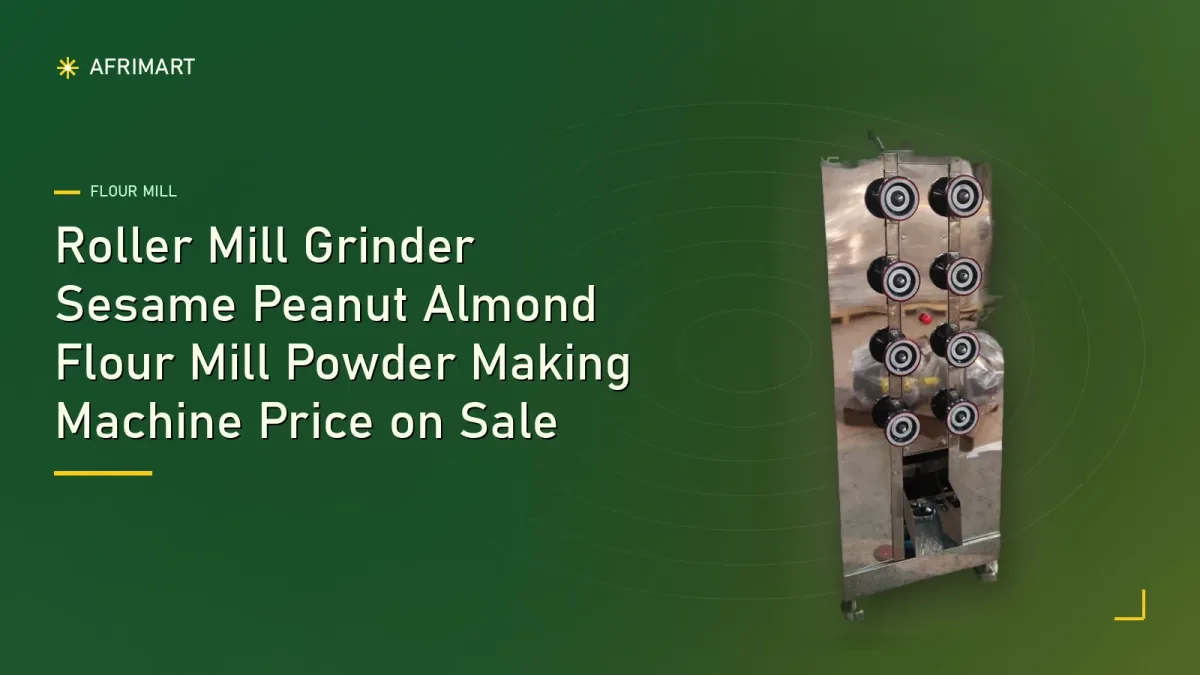
The Roller Mill Grinder Sesame Peanut Almond Flour Mill Powder Making Machine is a food-processing mill designed to grind sesame, peanuts and almonds into fine powder for workshops and small factories. It supports a verified production capacity of 50-200 kg/h, uses a 4 KW motor, and offers adjustable crushing fineness from 8 to 80 mesh.
At a glance
Best suited to: Small factories and food workshops producing nut and seed powders
Input material: Sesame, peanuts and almonds
Final product: Fine powder or flour from nuts and seeds
Rated capacity: 50-200 KG/H
Motor power: 4 KW
Construction material: SS304 or SS316L stainless steel
What is Roller Mill Grinder Sesame Peanut Almond Flour Mill Powder Making Machine?
The Roller Mill Grinder Sesame Peanut Almond Flour Mill Powder Making Machine is an industrial flour mill for grinding selected nuts and seeds into powder. It takes sesame, peanuts or almonds as input and reduces them to a fine powder or flour that can be used in bakery ingredients, drink blends, sauces and other food products.
Buyers should read it as a grinding machine rather than a complete food-processing line. It performs the powder-making step only. The published product information does not state that upstream cleaning, roasting, drying, feeding automation, sieving, blending or packaging are supplied as part of the machine.
For food-contact use, the verified construction materials are SS304 or SS316L stainless steel. SS means stainless steel. SS304 is widely used in food equipment, while SS316L is commonly selected where a buyer wants higher corrosion resistance. The named core component is the motor, which is the only internal component explicitly listed in the source material.
How does Roller Mill Grinder Sesame Peanut Almond Flour Mill Powder Making Machine work?
The machine works by using motor-driven grinding action to reduce nuts and seeds into powder within the stated fineness range. While the published source does not describe the full internal grinding assembly in detail, the operating sequence is clear enough for procurement and production planning.
Feed the selected material
Sesame, peanuts or almonds are introduced into the grinding chamber for processing. Because the machine is presented as a powder-making unit, buyers should ensure the intended input condition is suitable for dry milling rather than paste production.
Drive the grinding process with the motor
The verified core component is a motor, and the published power rating is 4 KW. This motor provides the driving force for the grinding action that reduces the input material to smaller particle sizes.
Adjust for the required fineness
The stated crushing fineness range is 8-80 mesh. This gives operators flexibility to target different powder grades depending on whether the product is intended for baking, blending, seasoning or another food application.
Discharge the finished powder
After grinding, the machine releases the processed material as powder or flour for the next production step. That downstream step may involve sieving, mixing, packing or further handling, depending on the buyer's line layout.
Clean the machine between runs or after production
The listed cleaning means are water cleaning and air compressor cleaning. These two verified cleaning methods are relevant for buyers planning routine sanitation, product changeovers and workshop housekeeping.
The product page does not specify the feeding system, discharge arrangement, dust collection, screening equipment, packaging interface or any auxiliary equipment supplied with the machine. Buyers should confirm the complete configuration and delivery scope before ordering.
Where is Roller Mill Grinder Sesame Peanut Almond Flour Mill Powder Making Machine used?
This machine is used in food processing operations that need ground nut or seed products rather than whole kernels or finished paste. Its published capacity of 50-200 KG/H makes it relevant to workshops, specialist processors and small factories that need repeatable mechanised output.
Peanut powder production for ingredient lines
Food businesses can use the machine to produce peanut powder for snacks, flavour systems, bakery mixes or further formulation. The verified 8-80 mesh fineness range is useful where different customers or recipes require different powder textures.
Sesame grinding for baking and intermediate ingredients
Processors can grind sesame for use in bakery formulations, ingredient preparation and other powdered food applications. The published SS304 or SS316L stainless steel construction supports food-contact use in hygienic processing environments.
Almond flour production for gluten-free baking
Almond flour is used in gluten-free recipes and speciality bakery products, and this machine is described as suitable for almonds. For smaller processors, the stated 50-200 KG/H capacity can fit an intermediate production scale between manual grinding and a larger automated line.
Protein and nutrition powder manufacture
Businesses producing powdered blends for drinks, health foods or specialist food ingredients may use the machine to prepare nut-based powder for later blending. This is especially relevant where the processor needs a dedicated powder-making step before filling or packaging.
Traditional sweets and sauce ingredient preparation
Across African markets, sesame and groundnut ingredients are used in a wide range of traditional foods, sweets and sauces. This machine supports local processing by converting those raw materials into powders that are easier to dose, blend and standardise in repeat recipes.
Spice or dry herb milling in mixed-product workshops
The Afrimart listing also mentions spices and dry herbs as applications in small food businesses. In a workshop handling multiple dry products, the published cleaning options of water cleaning and air compressor cleaning may help operators manage planned clean-down between runs, subject to their hygiene procedure.
Small contract processing operations
A contract food processor serving multiple brands may need one compact machine that can support more than one product type. The listing describes the machine as multifunctional, which aligns with use cases where a processor mills different approved materials in separate batches.
Workshop-scale mechanisation and plant expansion
Businesses moving from manual production to more formal processing often need a machine with a manageable footprint. The stated dimensions of 720 × 520 × 1640 mm make this unit relevant where a production room has limited space, although a buyer should still request clearance and installation drawings.
Technical specifications
The following specifications are verified for the Afrimart-listed Roller Mill Grinder Sesame Peanut Almond Flour Mill Powder Making Machine.
| Specification | Verified value | Buyer note |
|---|---|---|
| Brand | Hongda | Useful for matching the quoted machine to the published listing. |
| Afrimart SKU | 1600321603623 | Include this SKU in technical and commercial enquiries. |
| Product category | Flour Mill | Indicates a milling function rather than a full end-to-end processing line. |
| Production capacity | 50-200 KG/H | The range should be confirmed against the buyer's actual product and target fineness. |
| Core components | Motor | The source names the motor only; ask for a fuller parts list if maintenance planning requires it. |
| Key selling points | Multifunctional | The listing supports sesame, peanuts, almonds, spices and dry herbs as intended uses. |
| Machinery test report | Provided | Ask for the report as part of the quotation review pack. |
| Video outgoing-inspection | Provided | Useful for remote pre-shipment verification on cross-border orders. |
| Weight | 550 kg | The source gives 550 kg but does not state whether this is net or shipping weight. |
| Voltage | 220V / 380V / 415V / 440V / 600V | Confirm the exact selected voltage, plus phase and frequency, for your installation site. |
| Power | 4 KW | Verify that the quoted power matches the chosen electrical configuration. |
| Dimensions (L × W × H) | 7205201640 mm | Use for preliminary space planning, then request installation and service-clearance drawings. |
| Certification | GMP, ISO9001, CE | Request document copies if these are required by procurement, QA or compliance teams. |
| Cleaning means | Water cleaning, air compressor | Confirm the recommended cleaning procedure for your sanitation regime and product type. |
| Material | SS304, SS316L | Confirm which stainless steel grade is included in the quoted machine. |
| Crushing fineness | 8-80 mesh | Confirm achievable fineness on your actual material, especially if you have a strict product specification. |
| Warranty | 1 Year | Ask for written warranty scope, exclusions and claim procedure. |
Specifications may vary according to configuration and must be confirmed in Afrimart's current written quotation.
What are the main operational benefits?
Flexible powder specification: The verified 8-80 mesh crushing fineness gives buyers a practical range for producing either a coarser meal or a finer powder. That can help one machine serve several recipes or customer requirements.
Useful output for growing processors: A stated production capacity of 50-200 KG/H makes the machine relevant for food workshops and small factories that need more than manual or bench-scale output. It supports mechanised production without assuming the footprint of a much larger line.
Food-contact material choice: The use of SS304 or SS316L stainless steel supports hygienic food processing. For buyers, that translates into a more suitable machine construction for regular cleaning and product-contact duties.
Adaptability to local power conditions: The published voltage options of 220V, 380V, 415V, 440V and 600V are operationally useful in African markets where industrial electrical standards differ between sites. This can simplify matching the machine to available plant utilities.
Straightforward cleaning options: The listing states water cleaning and air compressor cleaning. Those verified methods can support routine clean-down, help manage powder residue and assist with product changeover planning in smaller facilities.
Remote pre-delivery verification support: A machinery test report and video outgoing-inspection are both listed as provided. That matters to buyers sourcing across borders because it supports technical review before dispatch.
Compact installation footprint: The published dimensions of 720 × 520 × 1640 mm allow the machine to fit into smaller production rooms more easily than larger processing lines. Buyers still need to allow additional space for access, cleaning and safe material handling.
Why does this equipment matter for African industry?
This equipment matters because it helps processors add value to agricultural materials locally rather than selling them only in raw form. Sesame, groundnuts and almonds are commercially relevant food materials in different African markets, and grinding them into powder can support ingredient production, packaged food manufacturing and specialised bakery supply.
It is also relevant to industrial growth at small and medium scale. Not every processor is ready for a high-capacity automated line. A verified throughput of 50-200 KG/H fits the needs of many workshops and emerging factories that want more controlled, repeatable output while managing space and utility constraints.
The broad voltage offering is particularly useful across the continent. Industrial sites do not all run the same electrical standard, and the published options of 220V / 380V / 415V / 440V / 600V give buyers more flexibility when matching equipment to local infrastructure.
For food production, hygienic construction is a practical requirement rather than a marketing point. The machine's listed SS304 or SS316L materials and its stated cleaning methods make it relevant where processors need regular sanitation and predictable food-contact surfaces.
Finally, the machine supports product diversification. African food businesses often build product lines around familiar local ingredients, and a grinder that handles sesame, peanuts and almonds can support powder products for baking, sauces, nutrition blends and traditional foods. That strengthens local value addition and regional supply chains when businesses process ingredients closer to the end market.
What should buyers confirm before ordering?
- Required throughput within the 50-200 KG/H capacity range
- Intended use: sesame powder, peanut powder, almond flour or mixed production
- Required final fineness within the 8-80 mesh range
- Whether the intended material condition is suitable for dry powder milling
- Required machine material: SS304 or SS316L
- Exact site voltage selection from 220V / 380V / 415V / 440V / 600V
- Electrical phase and frequency at site
- Local electrical protection and compliance requirements
- Installation space based on 720 × 520 × 1640 mm
- Access route, doorway width and lifting plan for 550 kg
- Operator access and maintenance clearance around the machine
- Upstream needs such as cleaning, roasting or drying
- Downstream needs such as sieving, blending or packaging
- Feeding arrangement required for the product
- Discharge handling and powder collection method
- Dust control and housekeeping plan for the milling area
- Cleaning method and sanitation procedure
- Frequency of product changeover between different materials
- Spare-parts requirement for motor-related service and wear items
- Operator training and commissioning support
- Test report and outgoing-inspection video in the document pack
- Certification documents needed for procurement records
- Written 1 Year warranty terms and exclusions
- Delivery destination, site conditions and unloading arrangements
The most consequential unstated figure is the confirmed output performance on the buyer's exact material and moisture condition. Buyers should request a written technical quotation supported by product test information for the intended application.
How to source Roller Mill Grinder Sesame Peanut Almond Flour Mill Powder Making Machine through Afrimart
Afrimart can help buyers confirm whether this milling machine matches the intended application, utility conditions and output target, then prepare a project-specific quotation for the correct configuration.
To receive a relevant quotation, provide:
- Required capacity
- Intended application
- Input materials
- Project location and country
- Available utilities
- Required accessories
- Installation and training requirements
- Target project date
Request a quotation for Roller Mill Grinder Sesame Peanut Almond Flour Mill Powder Making Machine through Afrimart. If a direct email route is useful for formal procurement, you may also contact [email protected].
Frequently asked questions
What is the Roller Mill Grinder Sesame Peanut Almond Flour Mill Powder Making Machine used for?
It is used to grind sesame, peanuts and almonds into fine powder or flour. The product listing also mentions spices and dry herbs for small food businesses. It should be treated as a powder-making mill rather than a complete processing line with roasting, drying, sieving and packaging automatically included.
What is the production capacity of this flour mill?
The verified production capacity is 50-200 KG/H. Because the value is published as a range rather than a single fixed output, buyers should confirm expected throughput on their own product and target fineness. Material condition and the desired particle size can affect practical performance.
What fineness can this machine achieve?
The stated crushing fineness is 8-80 mesh. That gives flexibility for applications requiring different particle sizes, from a relatively coarse meal to a finer flour-like powder. Buyers with a strict product specification should confirm the achievable mesh range on sesame, peanuts or almonds before ordering.
Which input materials are verified for this machine?
The verified materials named in the Afrimart listing are sesame, peanuts and almonds. The product description also mentions use for spices and dry herbs in small food businesses. If a buyer wants to process another material, suitability should be confirmed with Afrimart in writing before purchase.
What power supply does the machine need?
The machine is published with voltage options of 220V, 380V, 415V, 440V and 600V, and a power rating of 4 KW. Buyers should still confirm the exact selected voltage, together with phase and frequency, because those details are not fully defined in the listing and are site-specific.
What stainless steel options are available?
The published material options are SS304 and SS316L stainless steel. Both are standard food-equipment materials, with SS316L generally selected where higher corrosion resistance is preferred. Since both grades appear in the listing, buyers should make sure the quotation clearly states which material is included.
How is the machine cleaned?
The verified cleaning means are water cleaning and air compressor cleaning. This indicates the machine is designed for practical clean-down in food-processing environments. Buyers should still request the recommended cleaning procedure for their product, especially where sanitation protocols, allergen control or frequent changeovers are important.
What should I send when requesting a quotation?
A strong quotation request should include your target capacity, the material to be processed, required fineness, site country, available voltage, preferred stainless steel grade and any needed accessories or support services. It is also sensible to ask for the machinery test report, outgoing-inspection video, dimensional information and written warranty terms.
Sources and technical review
- Afrimart product page: Roller Mill Grinder Sesame Peanut Almond Flour Mill Powder Making Machine — https://afrimart.co.za/product/roller-mill-grinder-sesame-peanut-almond-flour-mill-powder-making-machine-on
- International Organization for Standardization (ISO): https://www.iso.org
- European Commission, CE marking guidance: https://europa.eu/youreurope/business/product-requirements/labels-markings/ce-marking/index_en.htm