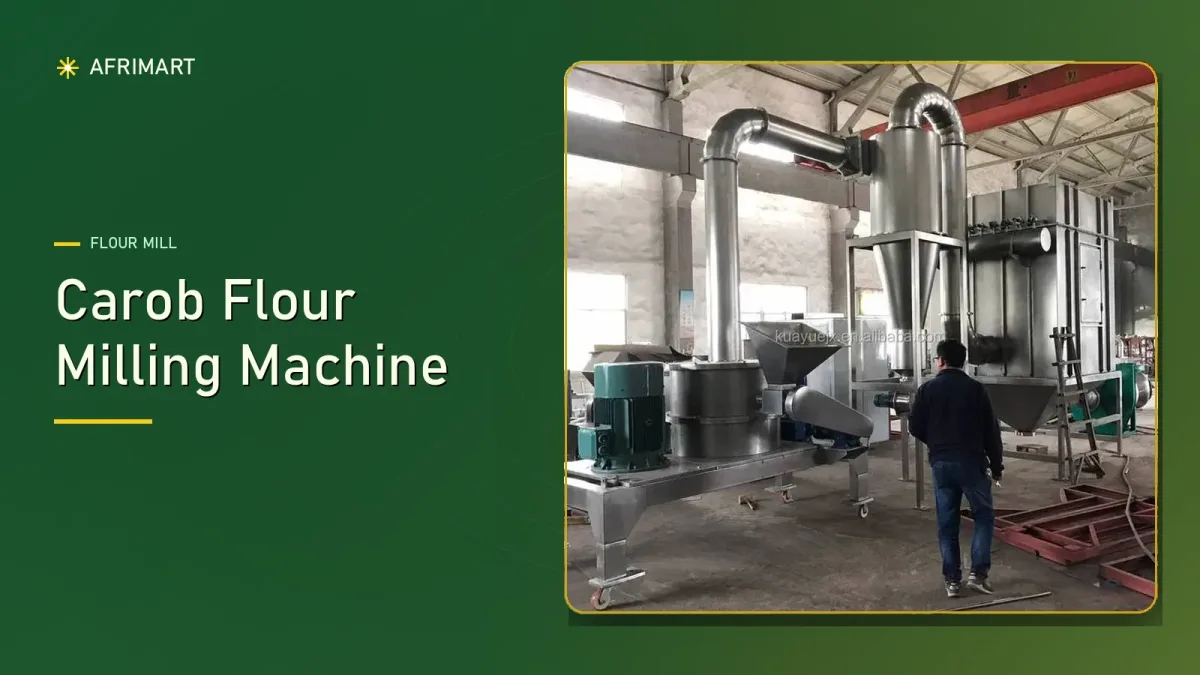
The Carob Flour Milling Machine is a grinder designed to turn dry carob pods into fine powder for food and industrial processing. It is intended for food makers, farms and factories that need controlled milling, with verified output from 10–2000 kg/h, feeding size of 5–20 mm and finished particle size from 40–600 mesh.
At a glance
Best suited to: Food makers, farms, factories and industrial processors handling dry milling
Input material: Dry carob pods, with feeding size 5–20 mm and ≤15 mm typical
Final product: Fine flour or powder at 40–600 mesh
Rated capacity: 10–2000 kg/h
Motor power: 13.37 kW, depending on model
Construction material: SUS304 / SUS316 stainless steel
What is Carob Flour Milling Machine?
The Carob Flour Milling Machine is an industrial grinder used to reduce dry carob pods into fine, smooth flour or powder. In practical terms, it takes prepared dry feed material within the stated feeding range and mills it to a selected fineness suitable for downstream food or industrial use.
It is important to read the category correctly. This machine grinds material; it does not dry wet carob pods, roast raw material or package the finished flour. Buyers planning a complete processing line should treat milling as one stage in a broader workflow that may also include preparation, conveying, screening, storage and packing.
The verified construction materials are SUS304 or SUS316 stainless steel, which matters for buyers comparing hygiene, corrosion resistance and material compatibility across food and industrial applications. The listing also identifies the main core components as the bearing, gear and motor. No named controller or automated control platform is published on the product page, so buyers who need a specific control arrangement should request the exact control specification in writing before ordering.
How does Carob Flour Milling Machine work?
The Carob Flour Milling Machine works by feeding suitably sized dry material into a high-speed grinding chamber where mechanical action reduces it into finer particles. Based on the published specifications, the operating sequence can be understood as follows:
Material preparation
Dry carob pods are prepared to a feeding size of 5–20 mm, with ≤15 mm stated as typical. This matters because feed that is too large can affect stable grinding and final particle consistency.
Material feeding
The prepared feed enters the grinder. The machine is described as suitable for both small jobs and large production runs, and the published output range of 10–2000 kg/h shows that throughput depends on the selected model and operating configuration.
High-speed milling
Grinding takes place at a spindle speed of 3200–5800 r.p.m. (revolutions per minute). At these speeds, the milling assembly acts on the feed material to reduce it into powder.
Particle size reduction
The machine is designed to produce output size from 40–600 mesh. For buyers, this wide fineness range is one of the main selection points because a coarse flour requirement and an ultra-fine powder requirement may call for different model choices or operating settings.
Powder discharge for further handling
The finished flour or powder exits the grinding process for collection, transfer or packaging. The published listing does not specify the supplied discharge arrangement, collection bin, cyclone, dust control or screening equipment, so buyers should confirm the complete line configuration before ordering.
What materials or products can it process?
The product page verifies that this is a grinder for dry carob pods and also lists its application scope as chemicals, plastics and food processing. That indicates a multi-industry milling platform rather than a machine restricted to a single product stream. For buyers, the key issue is not only whether the machine can grind a category of material, but whether the exact feed characteristics match the chosen configuration.
| Input requirement | Verified value |
|---|---|
| Material named in product description | Dry carob pods |
| Feeding size | 5–20 mm |
| Typical feeding size | ≤15 mm |
Because the listing does not state moisture limits, hardness range, oil content tolerance or whether one machine setup is equally suitable across all food, chemical and plastic duties, buyers should confirm the exact material characteristics for their intended product. These details matter because feed brittleness, moisture level and contamination risk can affect throughput, wear rate, hygiene requirements and achievable fineness.
Where is Carob Flour Milling Machine used?
Carob flour production for food processors
Food processors producing carob-based ingredients can use this machine to convert dry pods into flour for baking, beverage mixes or ingredient blending. The verified 40–600 mesh output range gives buyers a starting point for matching flour fineness to the intended end product.
Farm-based value addition
Agricultural businesses and farming groups can use the machine to move beyond raw crop handling into processed output. Instead of only selling unprocessed material, they can mill prepared dry carob pods into a higher-value flour form that is easier to handle, store or supply into local food chains.
Small to large batch production environments
The stated output range of 10–2000 kg/h makes the machine relevant to both smaller operations and higher-throughput plants, depending on the selected model. This is useful for buyers scaling from pilot production to commercial runs without changing the basic process category from grinding to powder production.
Ingredient preparation in mixed food factories
Factories handling more than one dry ingredient often need a grinder built from food-suitable metals and capable of repeatable fineness control. The use of SUS304 or SUS316 stainless steel can be relevant where cleaning, corrosion resistance and product-contact material choice are part of the procurement brief.
Industrial powder preparation outside food
Because the verified application scope includes chemicals and plastics, the machine may also fit industrial plants preparing dry powders for non-food use. In those cases, buyers should focus closely on the exact feed material, contamination controls and whether the selected stainless-steel grade suits the process environment.
Regional processing hubs and contract milling operations
Businesses serving multiple growers or manufacturers can use a machine with a broad output range to support contract grinding jobs. The published 10–2000 kg/h capacity span suggests that different configurations can be matched to different service volumes rather than forcing every buyer into one throughput level.
Factory replacement or line expansion projects
Plants expanding an existing dry-processing line may consider this grinder when they need a separate milling stage for fine powder production. The published voltage options of 220V, 380V and 440V are especially relevant where industrial power availability differs between facilities or countries.
Applications requiring finer powder control
Where the product specification is driven by particle fineness rather than only tonnage, the output range up to 600 mesh becomes commercially important. Buyers needing finer carob flour or industrial powder can use this as a screening criterion when comparing milling options for their process.
Technical specifications
The following table summarises the verified published information for the Carob Flour Milling Machine available through Afrimart.
| Specification | Verified value | Buyer note |
|---|---|---|
| Product name | Carob Flour Milling Machine | Quote the full product name when requesting a written offer. |
| Category | Flour Mill | Useful for internal project classification and budget coding. |
| Afrimart SKU | 1600131014595 | Include the SKU in enquiries to reduce configuration errors. |
| Type | Grinder | Confirms the machine's function is milling rather than drying or packaging. |
| Output capacity | 10–2000 kg/h | Capacity spans multiple configurations; request the rated output for your exact material and fineness. |
| Application | Chemicals, Plastics, Food Processing | Buyers should confirm the exact duty because one installation may not suit every material category equally. |
| Voltage | 220V / 380V / 440V | Confirm the required supply standard for the destination site before manufacture or dispatch. |
| Power | 13.37 kW (depends on model) | The listing states that power depends on model, so match motor size to the chosen capacity and fineness. |
| Core components | Bearing, Gear, Motor | Ask for the detailed parts list if you need a spare-parts holding plan. |
| Warranty | 2 Years (core parts) | Clarify which items are treated as core parts and what labour or exclusions apply. |
| Feeding size | 5–20 mm | Feed preparation may be needed if incoming pods exceed this range. |
| Typical feeding size | ≤15 mm | This typical figure is useful for planning pre-breaking or sizing steps. |
| Output size | 40–600 mesh | Confirm the target mesh range required for your product specification and whether it affects throughput. |
| Spindle speed | 3200–5800 r.p.m | Speed range indicates performance depends on model or operating setup. |
| Construction material | SUS304 / SUS316 Stainless Steel | Ask which stainless-steel grade is supplied in the quoted configuration, especially for food-contact duties. |
Specifications may vary according to configuration and must be confirmed in Afrimart's current written quotation.
What are the main operational benefits?
Wide production range
The verified 10–2000 kg/h output range means the machine can support very different production scales. For buyers, that allows selection around real throughput demand rather than paying for one fixed-capacity design that may be too small or unnecessarily large.
Broad fineness capability
The 40–600 mesh output range gives buyers flexibility in targeting different powder grades. In operation, this can support applications that need anything from relatively coarse flour to much finer powder, provided the chosen model is matched correctly.
High-speed grinding action
A spindle speed of 3200–5800 r.p.m. provides the mechanical basis for rapid particle reduction. The operational consequence is a machine designed for fine grinding duties rather than only coarse crushing.
Material choice for process suitability
The published SUS304 / SUS316 stainless-steel construction gives buyers two recognised stainless options. This matters where product-contact hygiene, wash-down conditions or corrosion considerations form part of the equipment selection criteria.
Compatibility with multiple power environments
Voltage options of 220V, 380V and 440V make the machine easier to consider across different facilities. For African buyers operating in varied industrial power contexts, this can simplify integration into existing plants if the correct option is ordered.
Core mechanical simplicity
The named core components—bearing, gear and motor—indicate a conventional mechanical grinding platform. In procurement terms, that helps maintenance teams think in practical terms about wear parts, lubrication, motor protection and spare component planning.
Use across more than one industry
The application listing covers chemicals, plastics and food processing. For diversified plants or contract processors, that broad positioning can support better equipment utilisation, provided material compatibility and cleaning requirements are confirmed before purchase.
Why does this equipment matter for African industry?
This equipment matters because milling is one of the core steps that turns raw or semi-processed agricultural material into a tradable industrial ingredient. In many African markets, the business case for machinery is not only about production volume; it is about local value addition, more stable supply chains and greater control over product quality.
For agro-processing businesses, a carob flour milling machine can support local transformation of dry feedstock into flour rather than shipping only unprocessed material. That may help firms participate in regional ingredient markets, supply bakeries or food processors, or develop branded products with more processing retained closer to the source.
The broad capacity range also matters in Africa’s diverse industrial landscape. A smaller processor, cooperative or farm enterprise may be looking for a modest-output configuration, while a larger food factory or contract milling operation may require substantially higher throughput. A machine range published at 10–2000 kg/h is therefore relevant across multiple business sizes, not only one production model.
Material choice is another practical issue. In humid coastal conditions, in food environments with regular cleaning, or in plants handling more than one dry product, stainless-steel construction is often an important procurement requirement. The availability of SUS304 or SUS316 stainless steel gives buyers a basis for specifying the right finish for local operating conditions.
Finally, multi-voltage availability is useful in a continent where industrial sites are far from uniform in their power arrangements. A grinder offered in 220V, 380V and 440V can be considered for a wider range of facilities, though the exact site supply and motor configuration still need formal confirmation before ordering.
What should buyers confirm before ordering?
- Required hourly output in kg/h
- Target finished particle size in mesh
- Exact feed material: dry carob pods or other approved product
- Actual feed size distribution before milling
- Need for pre-breaking or pre-sizing to reach 5–20 mm
- Moisture condition of the incoming material
- Selected stainless-steel grade: SUS304 or SUS316
- Required voltage: 220V, 380V or 440V
- Motor power for the chosen model
- Spindle speed for the quoted configuration
- Whether quoted capacity applies at the required mesh size
- Product-contact and cleaning requirements
- Dust collection and powder containment arrangement
- Discharge, collection or conveying equipment included
- Screening or classification equipment included
- Available installation space and access route
- Foundation and floor loading requirements
- Electrical protection and cabling scope
- Operator training included in supply scope
- Recommended spare parts for bearings, gears and motor-related items
- Warranty coverage for core parts and exclusions
- Delivery destination, commissioning scope and documentation set
The most consequential unstated figure in the published listing is the exact rated output for a specific material and target mesh, because the broad 10–2000 kg/h range covers multiple configurations. Buyers should request a formal technical quotation or datasheet for the exact model being offered, showing capacity against feed material and fineness.
How to source Carob Flour Milling Machine through Afrimart
Afrimart can help buyers match the Carob Flour Milling Machine to the required application and prepare a quotation based on the right capacity, fineness and electrical configuration. This is especially important because the published figures cover a wide model range rather than one single fixed-output version.
To receive a useful quotation, buyers should provide:
- Required capacity
- Intended application
- Input materials
- Project location and country
- Available utilities
- Required accessories
- Installation and training requirements
- Target project date
Request a quotation for Carob Flour Milling Machine through Afrimart. If your procurement process requires direct email contact, you can also write once to [email protected].
Frequently asked questions
What is a Carob Flour Milling Machine used for?
A Carob Flour Milling Machine is used to grind dry carob pods into fine flour or powder. The published application scope also includes chemicals, plastics and food processing, so the equipment is positioned as a general industrial grinder rather than a machine limited to one product only.
What capacity does the Carob Flour Milling Machine offer?
The verified output range is 10–2000 kg/h. That is a broad range covering different models or configurations, so buyers should not treat it as one fixed production rate. The actual output to request in a quotation is the rated capacity for your feed material and required mesh size.
What feed size can this milling machine accept?
The published feeding size is 5–20 mm, with ≤15 mm stated as typical. This means material preparation may be necessary before milling if incoming dry pods are larger than the accepted range. Confirming feed size upfront helps buyers avoid underperformance and unnecessary wear.
How fine can the finished powder be?
The verified output size is 40–600 mesh. In buyer terms, that means the machine is designed for a wide fineness range, from flour-like output to much finer powder. The required mesh should always be stated in the enquiry because fineness can affect model choice and throughput.
What power supply does the machine require?
The product page lists 220V, 380V and 440V options. Buyers should specify the site power available at the installation location and confirm the exact motor and electrical arrangement in the quotation. The published power figure is 13.37 kW, but it also depends on the model selected.
Is this machine suitable only for food processing?
No. The published application field includes chemicals, plastics and food processing. Even so, suitability depends on the exact material being milled, the required cleanliness standard and the selected construction grade. Buyers moving between food and non-food duty should confirm cleaning and contamination-control expectations before purchase.
What material is the machine made from?
The verified construction material is SUS304 or SUS316 stainless steel. For procurement teams, the key point is to confirm which of these grades applies to the offered configuration. That choice can matter for hygiene, corrosion resistance and compatibility with the planned operating environment.
What should I ask for when requesting a quotation?
Ask for the exact model linked to your required kg/h output, target mesh size, feed material, voltage and stainless-steel grade. It is also sensible to request the supply scope, any included accessories, warranty detail for core parts, and installation or commissioning support if needed for your project.
Sources and technical review
- Afrimart product page: https://afrimart.co.za/product/carob-flour-milling-machine