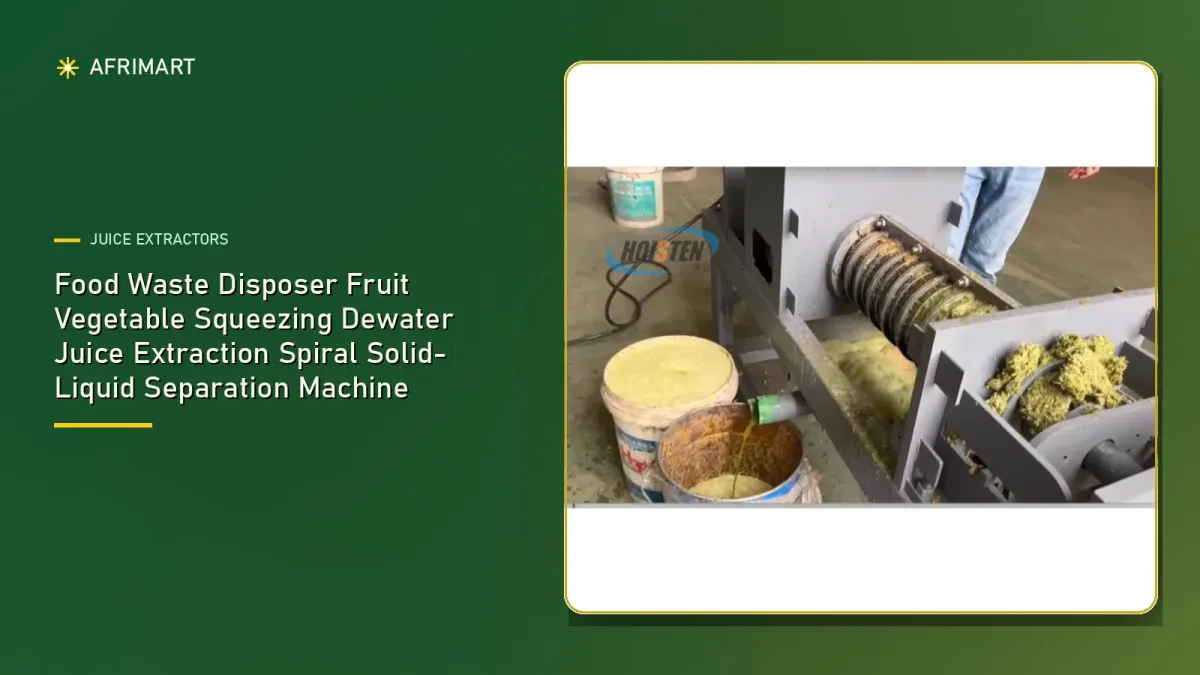
The Food Waste Disposer Fruit Vegetable Squeezing Dewater Juice Extraction Spiral Solid-Liquid Separation Machine is a food waste disposer juice extraction machine for squeezing fruit, vegetable and food-waste streams and separating liquid from solids in one step. It is designed for large kitchens, farms, recycling centres and processing plants, with a verified handling capacity of 8 to 12 tons per hour and 15 kW motor power.
At a glance
Best suited to: Large kitchens, farms, recycling centres, juice factories and vegetable processing plants
Input material: Food waste, fruits and vegetables
Final product: Separated juice or liquid stream and dry pulp or solids
Rated capacity: 8 - 12 tons / hour
Motor power: 15 kW
Model: HSYZ-400
What is Food Waste Disposer Fruit Vegetable Squeezing Dewater Juice Extraction Spiral Solid-Liquid Separation Machine?
It is a heavy-duty solid-liquid separation machine for squeezing wet organic material and splitting it into two outputs: a liquid fraction and a drier solid fraction. In practical terms, it is used where operators need to reduce the moisture content of fruit, vegetable or food-waste material while recovering juice or free liquid at the same time.
This machine does not create fruit or vegetable pulp from whole-process preparation stages, and the published product information does not describe upstream washing, crushing, shredding or feeding equipment as part of the supplied package. Its stated role is the squeezing and separation step.
The verified construction information in the listing is limited. The machine is described as using a strong spiral action to push material through a screen, and it is shipped in wooden box packaging. The product page does not publish the frame material, screen material or a named control component, so buyers should obtain a detailed machine layout and component list before committing the order.
How does Food Waste Disposer Fruit Vegetable Squeezing Dewater Juice Extraction Spiral Solid-Liquid Separation Machine work?
It works by mechanically pressing wet organic material with a spiral mechanism so that liquid passes through a screen while solids are discharged separately.
Material feeding: Fruit, vegetables or food waste are fed into the machine for continuous processing. The published description supports these input types but does not state the required feed size, so buyers should confirm whether pre-cutting or maceration is needed for their material.
Spiral conveying: A strong spiral action moves the material forward inside the machine. This conveying motion also creates the pressure needed for squeezing, which is the core operating principle described on the product page.
Screen-based separation: As the material is pushed through the working zone, liquid is forced through a screen. The listing states that the juice comes out one side, showing that liquid removal happens during the same pass rather than as a separate downstream operation.
Solid discharge: After liquid has been expressed, the remaining pulp or solids exit from the other side. This gives the operator two distinct output streams: recoverable liquid and a drier solid residue that may be easier to handle, transport or further process.
High-throughput operation: The machine is rated to handle 8 to 12 tons of material every hour and is powered by a 15 kW motor. In use, actual throughput can vary with feed consistency, moisture level and the selected operating setup, so buyers should request performance data for their specific material.
The source does not confirm whether feed hoppers, pumps, discharge conveyors, collection tanks, control panels, starter systems or run-out handling equipment are supplied with the machine. Buyers should confirm the complete configuration before ordering.
Where is this food waste disposer juice extraction machine used?
This food waste disposer juice extraction machine is used in operations that need to squeeze wet organic material and separate liquid from solids at industrial scale.
Large restaurant and institutional kitchens: High-volume kitchens generate mixed wet food waste that is bulky and difficult to store. A spiral dewatering machine can help reduce the free liquid content before waste handling, making downstream collection and movement more manageable.
Fruit juice processing plants: Juice operations often need mechanical extraction from fruit feedstocks and recovery of a separate pulp stream. Because this machine is designed to squeeze fruit and separate liquid from solids, it can fit plants that need a continuous mechanical separation step.
Vegetable processing lines: Vegetable processors dealing with trimmings, offcuts or rejected batches may need to remove water or juice before disposal or further processing. The machine’s one-step separation approach supports continuous handling without requiring separate pressing and draining stages.
Food recycling centres: Recycling operations handling organic waste benefit when wet feedstock is converted into a drier solids stream plus recovered liquid. The verified 8 to 12 tons per hour handling capacity makes the machine relevant where manual dewatering is too slow.
Farms and packhouses with crop waste: Farms and produce packhouses may accumulate unsold, damaged or surplus fruits and vegetables. Using a spiral separator can help convert this material into a drier residue that is easier to manage than loose wet waste.
Supermarket and wholesale produce waste handling: Retail chains and fresh produce depots often deal with spoiled or expired stock. A machine that separates liquid from solids in one step can support back-of-house waste reduction and improve handling of soft, wet produce.
Waste management contractors: Contractors serving municipalities, hospitality sites or food businesses may need to process organic waste before transportation. By reducing the free-liquid component, the machine can support cleaner, more controlled handling of perishable wet waste streams.
Integrated agro-processing facilities: Multi-product agricultural processors sometimes deal with both juice extraction and by-product management. A machine with 15 kW motor power and a stated 8 to 12 tons per hour capacity can suit sites that require a robust mechanical separation stage within a broader processing flow.
Technical specifications
The following verified specifications apply to the published HSYZ-400 product listing available through Afrimart.
| Specification | Verified value | Buyer note |
|---|---|---|
| Product name | Food Waste Disposer Fruit Vegetable Squeezing Dewater Juice Extraction Spiral Solid-Liquid Separation Machine | Use the full product name when requesting a quotation to avoid confusion with smaller food waste presses. |
| Afrimart SKU | 1601733274216 | Quote this SKU in procurement correspondence for traceability. |
| Brand | Hui Sheng | Useful for matching manuals, drawings and spare-parts references. |
| Model number | HSYZ-400 | Confirm whether all quoted accessories and performance data relate to HSYZ-400 specifically. |
| Type | Food Waste Disposer | The listed type describes the application class rather than the full process scope. |
| Power | 15 kW | Buyers should confirm supply voltage, phase and starter requirements because the listing gives power only. |
| Handling capacity | 8 - 12 tons / hour | Treat this as the published handling range; ask for material-specific throughput data for your feedstock. |
| Process function | Separates solids and liquids in one step | Request a process flow diagram showing inlet, liquid outlet and solids discharge arrangement. |
| Core components | Other | The listing does not identify named core parts; request a complete component list before ordering. |
| Machinery test report | Provided | Ask for the report to confirm what was tested and under which conditions. |
| Video outgoing-inspection | Provided | Request the inspection video for evidence of machine assembly and pre-shipment condition. |
| Warranty | 1 Year | Buyers should obtain the written warranty scope, exclusions and parts coverage. |
| Technical support | Online technical support | Confirm whether support includes commissioning guidance, troubleshooting and response times. |
| Spare parts support | Free replacement parts | Clarify which parts are included, for how long, and whether wear parts are excluded. |
| Packaging | Wooden box package | Packaging information is useful for shipment planning but is not the operating construction material. |
| Package weight | 2700 kg | Confirm whether 2700 kg is gross shipping weight and request lifting and handling instructions. |
Specifications may vary according to configuration and should be confirmed in Afrimart’s current written quotation before purchase.
What are the main operational benefits?
High throughput for bulk waste streams: The verified 8 to 12 tons per hour handling capacity makes the machine relevant for operations where wet organic material accumulates faster than small presses can manage. This supports continuous processing in large kitchens, recycling sites and industrial food plants.
Combined squeezing and separation: The published function is to separate solids and liquids in one step. That can simplify line design compared with using separate pressing and draining stages, especially where floor space and handling time matter.
Strong mechanical pressing force: The 15 kW motor is a concrete indicator that the machine is built for substantial mechanical work. For buyers processing soft but heavy wet loads, this helps distinguish it from light-duty bench or small workshop equipment.
Useful dual output streams: The machine is described as discharging juice from one side and dry pulp from the other. This gives operators a clearer route for liquid recovery and solid handling instead of managing a single mixed waste stream.
Suitable for multiple organic inputs: The listing states that it works with many fruits and vegetables and is also positioned for food waste. That versatility can be useful for sites with seasonally changing feedstocks or mixed produce waste.
Procurement support through documentation: A machinery test report and video outgoing-inspection are both listed as provided. For project buyers, these documents can support technical review before shipment and reduce uncertainty during factory acceptance discussions.
Support after delivery: The published offer includes a 1-year warranty, free replacement parts and online technical support. These are practical procurement points for buyers operating outside major industrial centres and planning for post-delivery assistance.
Why does this equipment matter for African industry?
This type of machine matters because many African businesses are under pressure to process more agricultural and food material locally while controlling waste, transport costs and plant hygiene. Wet organic waste is expensive to move, messy to store and difficult to integrate into orderly production environments.
For agro-processing businesses, local value addition depends not only on the main product but also on how by-products are handled. A spiral solid-liquid separation machine can support cleaner recovery of juice or liquid fractions while leaving a drier solids stream for further handling. That is relevant to fruit and vegetable packhouses, juice operations and mixed food-processing facilities across different African markets.
The machine is also relevant to waste handling and circular-economy efforts. In many regions, food waste management capacity is developing alongside urban growth, hospitality expansion and supermarket distribution networks. Equipment that mechanically reduces wet waste volume before transport or further treatment can support more organised waste logistics.
Conditions differ across the continent, so buyers should evaluate the machine against local power stability, site access, operator skill levels and maintenance support. A 15 kW industrial machine may fit well in one country’s large processing cluster and require more careful utility planning in another. The key point is that solid-liquid separation at 8 to 12 tons per hour is an industrial, not domestic, capability.
What should buyers confirm before ordering?
- Required throughput within the published 8 - 12 tons / hour range
- Exact input material type: food waste, fruit, vegetables or mixed stream
- Typical feed condition and moisture level
- Whether pre-cutting, shredding or pulping is required upstream
- Expected liquid recovery objective
- Required dryness of discharged pulp
- Suitability of HSYZ-400 for the intended duty cycle
- Power supply specification for the 15 kW motor
- Motor voltage, phase and frequency
- Start-up method and control panel scope
- Inlet and outlet arrangement for the planned layout
- Installation footprint and access for the 2700 kg packaged machine
- Lifting method and unloading equipment at site
- Discharge handling for both liquid and solids streams
- Need for collection tanks, pumps or conveyors
- Cleaning method and wash-down requirements
- Wear parts list and recommended spare-parts package
- Warranty terms and exclusions within the 1-year period
- Scope of free replacement parts
- Availability of online technical support during commissioning
- Delivery packaging and site receipt conditions
- Local safety and electrical compliance requirements
The most consequential unstated figure is the machine’s electrical supply specification, because the listing gives 15 kW power but does not publish voltage, phase or frequency. Buyers should request the formal technical datasheet and electrical drawing before finalising site preparation.
How to source Food Waste Disposer Fruit Vegetable Squeezing Dewater Juice Extraction Spiral Solid-Liquid Separation Machine through Afrimart
Afrimart can help buyers confirm whether the HSYZ-400 configuration matches the intended duty, material and site conditions, then prepare a project-specific written quotation. This is especially important where the buyer needs clarity on utilities, accessories, discharge handling and documentation.
To speed up quotation accuracy, provide:
- Required capacity
- Intended application
- Input materials
- Project location and country
- Available utilities
- Required accessories
- Installation and training requirements
- Target project date
Request a quotation for Food Waste Disposer Fruit Vegetable Squeezing Dewater Juice Extraction Spiral Solid-Liquid Separation Machine through Afrimart. If you prefer to send your requirement directly, you may also email [email protected].
Frequently asked questions
What does this food waste disposer machine actually do?
It is a spiral solid-liquid separation machine for squeezing food waste, fruits and vegetables. Its job is to press wet organic material so that liquid or juice is separated from the solids, producing two outputs in one process: a liquid stream and a drier pulp or residue stream.
What capacity does the HSYZ-400 machine handle?
The published handling capacity is 8 to 12 tons per hour. Buyers should treat that as the verified listing range and request confirmation for their specific material, because actual throughput can vary according to feed consistency, moisture content and how the machine is integrated into the process line.
Can this machine process both fruit and vegetable waste?
Yes. The product listing explicitly states that it works with many fruits and vegetables and is also presented for food waste disposal. However, the published information does not define feed size, hardness limits or required pre-processing, so mixed or oversized materials should be reviewed with Afrimart before ordering.
What power supply is required for this 15 kW machine?
The verified published figure is motor power of 15 kW. The listing does not state voltage, phase or frequency, so buyers should request the electrical specification and motor data before planning cabling, switchgear, backup power or generator sizing for the installation site.
Does the machine include all auxiliary equipment?
The product page confirms the machine, wooden box packaging, warranty support, free replacement parts, online technical support, a machinery test report and a video outgoing-inspection. It does not clearly state whether hoppers, pumps, conveyors, tanks or control accessories are included, so the complete supply scope should be confirmed in writing.
Is this machine suitable for large kitchens and recycling centres?
Yes. The listed applications include large restaurant kitchens and food recycling centres, and the 8 to 12 tons per hour capacity indicates an industrial-scale machine rather than a small commercial unit. It is suited to sites that need fast separation of wet organic material into liquid and solids.
What maintenance and support should buyers expect?
The published support package includes a 1-year warranty, free replacement parts and online technical support. The listing does not detail service intervals, wear components or exclusions, so buyers should request a spare-parts list, maintenance guidance and the written warranty terms as part of the quotation process.
How do I request a quotation from Afrimart?
The best approach is to send Afrimart your required capacity, intended application, input materials, project location, available utilities, accessory needs, installation requirements and target project date. Then request a quotation for the exact HSYZ-400 product so the offer can match your operating and site conditions.
Sources and technical review
- Afrimart product page: Food Waste Disposer Fruit Vegetable Squeezing Dewater Juice Extraction Spiral Solid-Liquid Separation Machine — https://afrimart.co.za/product/food-waste-disposer-fruit-vegetable-squeezing-dewater-juice-extraction-spiral-solidliquid-separation-machine
- International Labour Organization, occupational safety and health topic guidance — https://www.ilo.org/global/topics/safety-and-health-at-work
- IEC (International Electrotechnical Commission), electrical standards overview — https://www.iec.ch/standards