B21, China Town Mall, Midrand

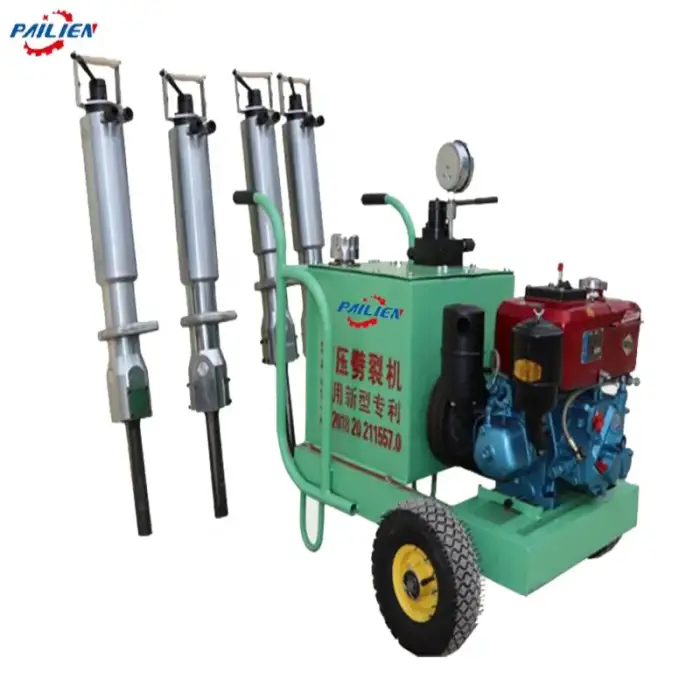
Non explosive hydraulic system drive small quarrying machine stone rock splitting splitter machine manufacture
Asset finance available
Do you want funding for this equipment?
Afrimart can connect you with trusted funding partners who specialise in asset finance for businesses like yours. Compare options and apply in minutes — final approval is subject to provider review.
Check funding options
Secure & no obligation

- Section : Machinery
- Category : Stone Machinery
- SKU : 1601046527825

Non explosive hydraulic system drive small quarrying machine stone rock splitting splitter machine manufacture

working principle:
Hydraulic splitting machines is the patent product of our company, it is a power station to produce high pressure hydraulic oil as a source of energy and by oil pipe delivery to the various cylinder pipe (also known as splitting gun), To control the expansion of piston rod in the splitting machine, and ingenious application of the principle of wedge device, make the split rock forces hundreds of tons of even thousands of tons.
Any object has its own characteristics, rock and concrete have extremely high external compressive strength, but The tensile strength from the inside is very small.Its compressive and tensile strength hydraulic pressure is 100:2--10 difference,in the brittle state.
The splitting machine captures the brittleness of rock and concrete, and uses the wedge principle to design it - the maximum splitting force can be released in the narrowest hole.The high pressure oil output from the pump station drives the cylinder and generates a huge thrust. The intermediate wedge in the wedge block is driven forward, and the reverse wedge is pushed open to both sides.So the splitting machine can split the rock easily in a few seconds, separating the hard rock from the mountain.

hydraulic splitting machinetechnical parameters
| Type | drilling diameter
| drilling depth
| Wedge length | crack width
| splitting time | Theory splitting force | Actual splitting force | Single piece packing measurement
| Weight kg |
| TYPE | MM | MM | MM | MM | S | T | T | MM | KG |
| PLE90-150 | 40 | 400 | 150 | 10-40 | 8-15 | 800 | 640 | 1070*180*310 | 39 |
| PLE90-250 | 42 | 500 | 250 | 10-40 | 8-15 | 800 | 640 | 1150*180*310 | 40 |
| PLE90-350 | 45 | 600 | 350 | 10-40 | 8-15 | 800 | 640 | 1230*180*310 | 41 |
| PLE90-450 | 50 | 700 | 450 | 10-40 | 8-15 | 800 | 640 | 1310*180*310 | 42 |
| PLE100-150 | 40 | 400 | 150 | 10-40 | 3-11 | 1200 | 960 | 1070*180*310 | 30 |
| PLE100-250 | 42 | 500 | 250 | 10-40 | 3-11 | 1200 | 960 | 1150*180*310 | 31 |
| PLE100-350 | 45 | 600 | 350 | 10-40 | 3-11 | 1200 | 960 | 1230*180*310 | 32 |
| PLE100-450 | 50 | 700 | 450 | 10-40 | 3-11 | 1200 | 960 | 1310*180*310 | 33 |


- Shipping Timeframes: All orders are processed within 2-5 business days (excluding weekends and holidays). After your order has been processed, the estimated delivery time is before 12 Aug, 2026, depending on customs, Please note that due to high demand, some items may experience longer shipping times, which will be communicated at order confirmation email.
- Order Processing Time: Please allow 2-5 business days for us to process your order before it is shipped . Orders placed after 16:00 on Fridays, or during weekends and public holidays, will begin processing on the next business day. Processing times may be extended during peak seasons or sales events.
- Manufacturing Time: Some products needs manufacturing time, the manufacturing process will take approximately 10-30 business days depending on the product. This timeframe may vary depending on the complexity of the product and current demand. but this will be communicated with you during order confirmation.
- Returns and Exchanges: We offer a 30-day return policy for most items. If you are not completely satisfied with your purchase, you may return it within 30 days of receipt for a refund or exchange. Items must be unused, in their original packaging, and accompanied by proof of purchase. Return shipping costs are the responsibility of the customer, unless the item was damaged or defective upon arrival.
1. What is the working principle of the non-explosive hydraulic splitting machine?
The non-explosive hydraulic splitting machine operates using a hydraulic system that generates high-pressure hydraulic oil, which is delivered to various splitting cylinders. By controlling the expansion of the piston rod and utilizing the wedge principle, it can exert splitting forces of hundreds to thousands of tons to split rocks and concrete.
2. What types of materials can this machine split?
This machine is designed to split hard materials such as rock and concrete, taking advantage of their brittleness and low tensile strength.
3. How long does it take to split rock using this machine?
The splitting process is very quick, typically taking just a few seconds to effectively separate the hard rock from its surroundings.
4. What are the technical parameters for this machine?
Technical parameters include drilling diameter, drilling depth, wedge length, crack width, theoretical splitting force, actual splitting force, and weight. For example, the PLE100-150 model has a drilling diameter of 40mm, drilling depth of 400mm, and a weight of 30kg.
5. Is the machine safe to use?
Yes, the non-explosive hydraulic system is designed for safety, as it does not involve explosives and operates under controlled hydraulic pressure.
6. What is the maximum splitting force this machine can achieve?
The maximum splitting force can reach hundreds to thousands of tons, depending on the specific model and conditions.
7. Can this machine be used for quarrying operations?
Yes, this machine is specifically designed for small quarrying operations, effectively splitting rocks without the need for explosives.
8. What are the dimensions and weight of the machine?
The dimensions and weight vary by model. For instance, the PLE100-150 model measures 1070*180*310 mm and weighs 30 kg.
9. What is the advantage of using a hydraulic splitting machine over traditional methods?
The hydraulic splitting machine offers a safer, more controlled, and efficient method of splitting rock compared to traditional explosive methods, reducing risks and environmental impact.
10. How is the machine powered?
The machine is powered by a hydraulic pump station that produces high-pressure hydraulic oil, which drives the splitting cylinders.
11. Is training required to operate the machine?
Yes, proper training is recommended to ensure safe and effective operation of the hydraulic splitting machine.
12. What maintenance is required for the hydraulic splitting machine?
Regular maintenance includes checking hydraulic oil levels, inspecting hoses and cylinders for leaks, and ensuring all components are functioning properly.
13. Can the machine be used in confined spaces?
Yes, the machine is suitable for use in confined spaces, as it can operate effectively with minimal clearance due to its design.
14. What is the warranty period for the machine?
The warranty period varies by manufacturer, but typically includes a limited warranty covering parts and manufacturing defects for a specified duration.
15. Are there any specific safety measures to consider while using this machine?
Yes, operators should wear appropriate personal protective equipment (PPE), ensure the area is clear of personnel, and follow all operational guidelines to maintain safety.
Latest Order Arrivals
Discover our latest orders

12 Heads Embroidery Machine

Toilet Paper Machine Machine

Order Collection

Cross Border Clients

Order cros border countries Collected

Industrial Machine Cllection

Agriculture Processing Machines

Ready for collection

Water Pump Equipment

Packaging Machine and accessories

Fabrics Manufacturing Equipment

Mining Equipments

Food Processing Machine

Batch of Orders

Batch of Orders

Latest Orders Labelled

wheel alignment machines

new arrivals

Pre Orders Offloading

Latest Arrivals

Latest Arrivals

Latest Arrivals

Loading

Toilet paper making machine

Toilet paper making machine

Toilet paper Rewinding Machine

latest arrivals

offloading

order success

order collection

order offloading