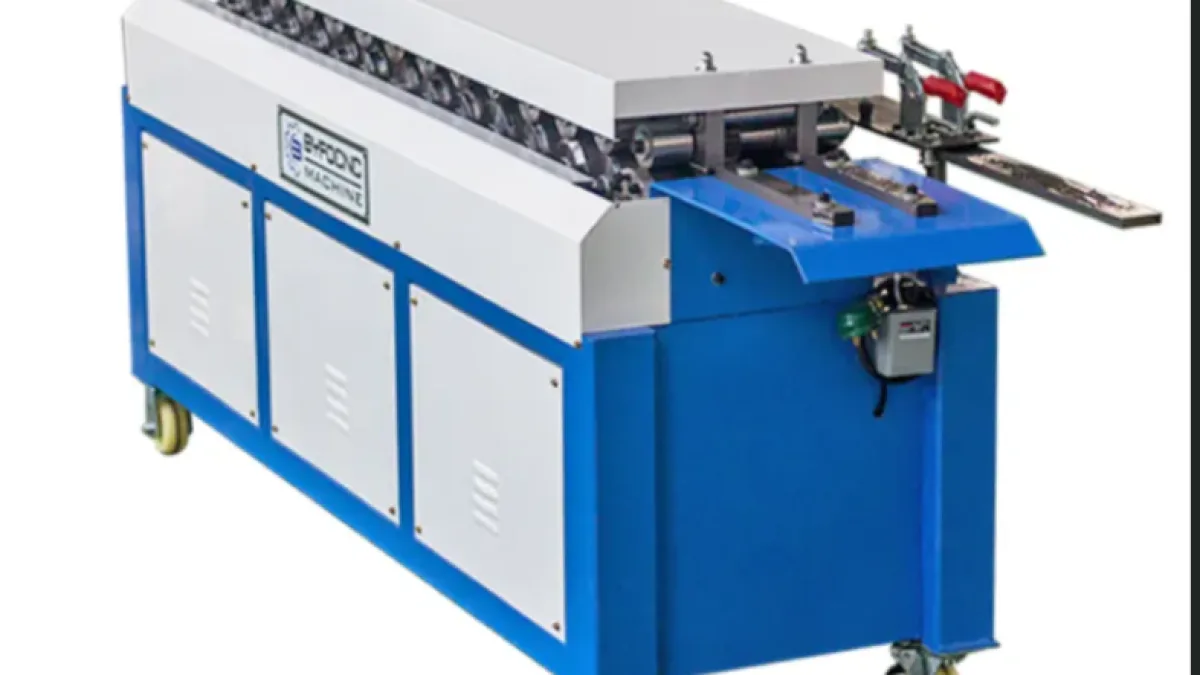
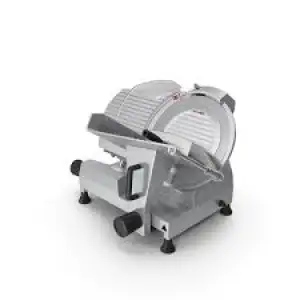
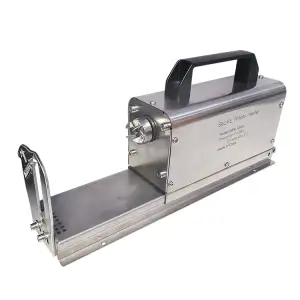



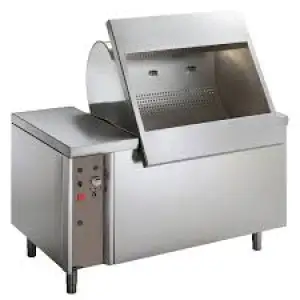



























































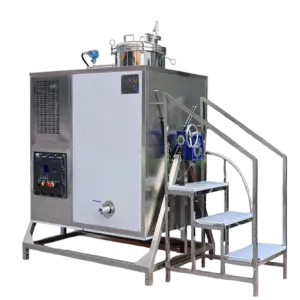


























































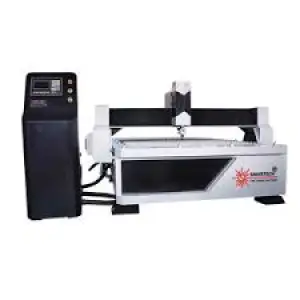

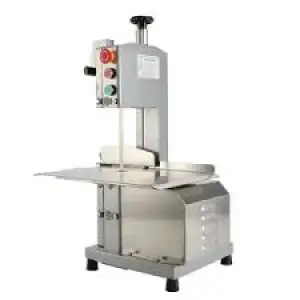

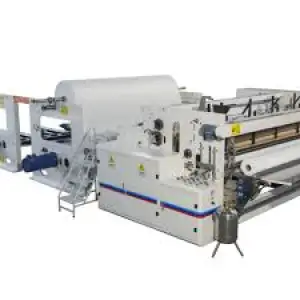





























































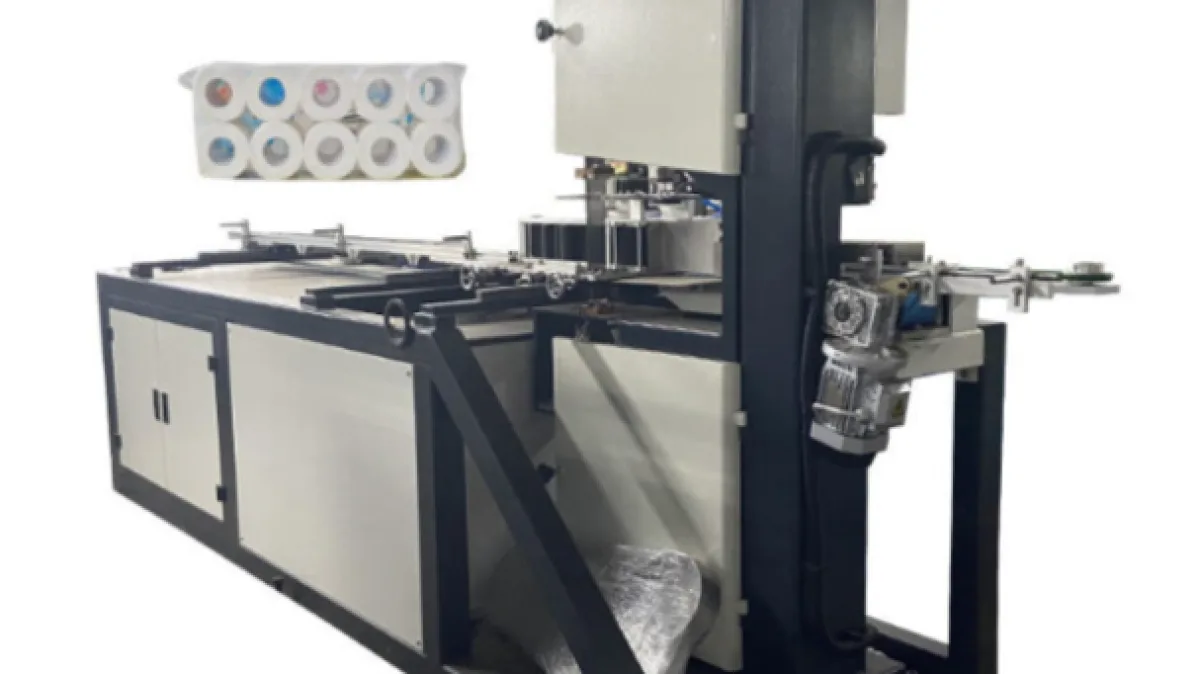
The Trade Market Afrimart Small Toilet Paper Manufacturing Machine is a band-saw cutting machine designed to divide long toilet-paper or tissue logs into individual rolls. Available in semi-automatic or fully automatic configurations, it supports adjustable cutting lengths and a stated model-dependent capacity of approximately 40–120 rolls per minute.
At a glance
- Equipment type
- Toilet-roll band-saw cutting machine
- Best suited to
- Small and medium-sized tissue-converting businesses
- Principal function
- Cuts prepared tissue logs into individual rolls
- Listed capacity
- Approximately 40–120 rolls per minute, depending on the model
- Automation options
- Semi-automatic or fully automatic
- Electrical options
- 220 V or 380 V and 50 Hz or 60 Hz, subject to configuration
- Cutting system
- Band-saw mechanism with stainless-steel blades
- Product reference
- GTM-04022025-022
What is the Small Toilet Paper Manufacturing Machine?
The Small Toilet Paper Manufacturing Machine is a tissue-log cutting machine used during the downstream conversion of toilet paper and related tissue products.
Despite its product name, the machine is not presented as a complete toilet-paper manufacturing line. Its verified principal function is to cut previously rewound tissue logs into individual toilet rolls of the required width.
The machine can be used with products such as:
- Toilet-paper logs
- Kitchen-towel logs
- Other compatible tissue-paper logs
- Selected facial-tissue and napkin products, depending on their presentation and configuration
Before reaching this machine, jumbo tissue normally needs to pass through a rewinding and perforating system. That upstream equipment converts the jumbo roll into a finished log with the required diameter, core, embossing and perforation pattern.
After cutting, the individual rolls generally move to a packaging stage. Buyers establishing a complete toilet-paper converting operation should therefore consider the cutting machine as one component of the wider production line.
How does the toilet-roll cutting machine work?
The machine uses a band-saw cutting system to divide a long tissue log into individual rolls.
A typical operating sequence consists of the following stages:
The tissue log is prepared
A separate rewinding machine produces a long toilet-paper or kitchen-towel log. The log should already have the required outside diameter, inside diameter, perforation pattern, embossing and number of plies.
The required cutting length is set
The operator configures the machine according to the intended width of each finished roll. The listing states that the cutting length is adjustable to accommodate different roll sizes and thicknesses.
The tissue log is positioned
The completed log is placed in the machine’s feeding or cutting area. The exact loading method depends on whether the selected machine is semi-automatic or fully automatic.
The band saw cuts the log
A stainless-steel band-saw blade passes through the tissue log, separating it into individual rolls. Accurate positioning and an appropriate blade condition are important for producing consistent cuts.
The individual rolls are discharged
The separated rolls leave the cutting section and can proceed to inspection, rejection of damaged units and packaging.
The next log is introduced
The process is repeated manually or automatically according to the machine configuration.
The cutting machine’s output must be coordinated with both the upstream rewinder and the downstream packaging equipment. A machine capable of cutting rolls quickly will not deliver its intended line capacity if logs cannot be supplied or finished rolls cannot be packaged at a compatible rate.
What products can the machine cut?
The equipment is intended primarily for cutting toilet-paper and kitchen-towel logs into individual rolls.
The product listing also identifies applications involving:
- Toilet-paper production
- Kitchen-roll production
- Facial-tissue cutting
- Napkin cutting
- Commercial tissue processing
- Industrial tissue processing
However, facial tissues and napkins are commonly produced in different formats from toilet rolls. Buyers intending to process folded or flat tissue products should obtain written confirmation that the selected machine configuration is technically suitable.
The listing refers to jumbo tissue rolls and recycled tissue paper as raw materials. In practice, the band-saw cutter does not appear to cut the jumbo roll directly. The tissue would ordinarily need to be rewound into a smaller finished log before entering the cutting machine.
Buyers should clarify the complete material flow and confirm:
- The required tissue-log diameter
- Maximum and minimum log length
- Minimum and maximum cutting width
- Compatible core diameters
- Permitted number of tissue plies
- Supported tissue grammage
- Whether the machine accepts coreless logs
- Whether it can cut kitchen-towel logs
- The maximum tissue-log weight
- Required blade specification
These details are not provided on the product page and should be established before an order is placed.
Where is the Small Toilet Paper Manufacturing Machine used?
Toilet-paper converting workshops
The machine can form part of a compact production arrangement in which jumbo tissue is rewound, cut and packaged within a small or medium-sized facility.
Existing tissue manufacturers
Manufacturers that already have a rewinding machine may use a dedicated cutter to increase log-cutting capacity, replace a manual process or add another finished-roll format.
Kitchen-towel production
The adjustable cutting arrangement may support compatible kitchen-towel logs. Buyers should confirm the permitted log diameter and cutting width for their intended product.
Private-label tissue production
Contract manufacturers can use the cutter to produce individual rolls for different retail, wholesale and institutional customers, provided the selected model supports the required dimensions.
Institutional hygiene-product supply
Toilet-paper converters supplying offices, hotels, schools, healthcare establishments and other institutions may configure the machine for the roll widths required by those customers.
Small manufacturing businesses
The equipment’s compact positioning and automation options may suit businesses with more limited production space. “Compact” should not be interpreted as confirmation that the machine will fit a particular workshop; buyers still need the exact dimensions and safe working clearances.
Technical specifications
The following information applies to the Small Toilet Paper Manufacturing Machine listed under product reference GTM-04022025-022. Several values depend on the model and must be confirmed in the final technical quotation.
| Specification | Verified value | Buyer note |
|---|---|---|
| Product name | Small Toilet Paper Manufacturing Machine | Listed as a toilet-roll and band-saw cutting machine |
| Product reference | GTM-04022025-022 | Use this reference when requesting a quotation |
| Machine type | Automatic toilet-roll cutting machine | Confirm whether the offered model is semi-automatic or fully automatic |
| Cutting system | Band saw | Intended to cut prepared tissue logs |
| Listed cutting capacity | Approximately 40–120 rolls/min | Capacity varies according to the selected model |
| Automation level | Semi-automatic or fully automatic | Confirm the exact operating sequence and labour requirement |
| Electrical supply | 220 V or 380 V | Regional configuration is available |
| Electrical frequency | 50 Hz or 60 Hz | Must match the installation site |
| Blade material | Stainless steel | Confirm blade dimensions and replacement requirements |
| Cutting length | Adjustable | Minimum and maximum settings must be confirmed |
| Applicable materials | Prepared tissue-paper logs | Jumbo tissue normally requires prior rewinding |
| Principal outputs | Toilet rolls and kitchen-towel rolls | Confirm compatibility with the intended dimensions |
| Installation format | Compact configuration | Exact machine dimensions are not stated |
| Product categories | Industrial machinery; machinery and equipment | Listed commercial classification |
Specifications may vary according to configuration and must be confirmed in Trade Market Afrimart’s current written quotation.
What are the main operational benefits?
Adjustable cutting lengths support different roll sizes
The machine’s cutting length can be adjusted for different finished-roll widths. This may allow a converter to manufacture more than one toilet-roll or kitchen-towel format on the same machine.
The minimum and maximum cutting lengths are not stated and should be confirmed for every intended product.
Semi-automatic and fully automatic options are available
The choice between semi-automatic and fully automatic operation allows buyers to match the machine to their production scale, staffing model and investment plan.
A semi-automatic machine may require more manual log loading, positioning or roll removal. A fully automatic model may integrate more of these movements, but the exact differences must be defined in the quotation.
The band-saw system is designed for consistent cutting
The machine uses a band saw to separate tissue logs into individual rolls. A properly selected and maintained blade can support uniform cutting when the log dimensions and tissue characteristics are compatible.
Actual cut quality also depends on blade sharpness, blade tension, machine setup, log density and operator practice.
Stainless-steel blades support repeated operation
The listing identifies stainless-steel blades as a machine feature. Buyers should still ask how frequently blades require sharpening or replacement and whether different blade types are needed for different tissue products.
Capacity options support different production scales
The stated capacity range of approximately 40–120 rolls per minute suggests that multiple machine configurations may be available. Businesses can evaluate a model against their required shift output instead of selecting capacity based only on the highest advertised figure.
A compact machine can simplify workshop planning
The product is described as space-saving and suitable for smaller workshops. This may make it easier to incorporate into a developing tissue-converting operation.
Exact dimensions, maintenance clearances and material-flow requirements must be obtained before the production area is finalised.
Regional electrical configurations are available
The machine can be configured for 220 V or 380 V and 50 Hz or 60 Hz. This gives buyers options for different electrical systems, although voltage alone does not confirm whether the supply is single-phase or three-phase.
What equipment is required for a complete toilet-paper line?
A cutting machine does not independently convert raw pulp or jumbo tissue into packaged toilet rolls. A complete operation may require several machines and supporting systems.
Jumbo-roll rewinding machine
The rewinder converts jumbo tissue into smaller logs. Depending on its configuration, it may add embossing, perforations, cardboard cores and tail glue.
Toilet-roll cutting machine
The Trade Market Afrimart machine performs this stage by dividing the prepared log into individual rolls.
Core-making or core-cutting equipment
Businesses producing cored toilet paper may require equipment to manufacture or cut cardboard tubes to the correct length.
Packaging machine
Individual rolls must be wrapped, bagged or bundled according to the chosen retail, wholesale or institutional format.
Air compressor
Pneumatic rewinding, feeding or packaging equipment may require compressed air. Buyers should confirm whether the selected cutting-machine model has its own air requirements.
Material-handling equipment
Jumbo tissue rolls can be heavy and may require lifting, loading or roll-handling equipment. The exact requirement depends on the wider line rather than the cutter alone.
Quality-control equipment
The business should be able to verify finished-roll width, diameter, weight, perforation, sheet count, core condition and packaging quality.
Buyers should request an itemised line proposal that identifies which machines are included, which are optional and which must be sourced separately.
What should buyers confirm before ordering?
The available product information does not provide all the details required for final machine selection. Buyers should obtain written answers to the following questions.
Production requirements
- What number of rolls is required per minute, hour and shift?
- What finished-roll widths will be manufactured?
- Will the machine cut toilet rolls, kitchen towels or both?
- How frequently will the product dimensions change?
- Will the factory operate one shift or multiple shifts?
Input-log requirements
- What are the minimum and maximum log diameters?
- What is the maximum log length?
- What cardboard-core diameters are supported?
- Can the machine cut coreless logs?
- Which tissue grammages and ply arrangements are compatible?
- Must the tissue log have a specific density or winding tension?
Cutting performance
- What is the exact capacity of the offered model?
- Which finished-roll dimensions were used to calculate that capacity?
- What cutting tolerance can the machine maintain?
- How much end trim or cutting waste should be expected?
- What blade specification is required?
- How often must the blade be sharpened or replaced?
Automation
- Is the quoted model semi-automatic or fully automatic?
- Which operations still require manual labour?
- How are logs loaded and positioned?
- How are finished rolls discharged?
- Does the machine detect incorrectly positioned logs?
- Which safety interlocks are included?
Utilities
- Does the machine require 220 V or 380 V?
- Is the supply single-phase or three-phase?
- Is the required frequency 50 Hz or 60 Hz?
- What is the total installed power?
- Is compressed air required?
- What electrical protection and isolation equipment must be installed?
Installation and support
- What are the exact machine dimensions and weight?
- How much operating and maintenance space is required?
- Does the machine require anchoring or a prepared foundation?
- What commissioning services are available?
- Is operator training included?
- Which spare parts should be ordered with the machine?
- What maintenance schedule applies?
- What warranty coverage is provided?
- What technical documentation will be supplied?
Complete-line compatibility
- Which rewinding machines are compatible?
- Is a packaging machine included?
- Can the cutter communicate or operate in line with other equipment?
- Will the cutting capacity match the rewinder’s log output?
- Can the packaging section handle the cutter’s roll output?
How should production capacity be evaluated?
The advertised cutting range of approximately 40–120 rolls per minute should be treated as a model-dependent rating rather than a guaranteed factory output.
To estimate practical shift production, buyers should consider:
- Selected machine model
- Finished-roll width
- Tissue-log length
- Log-loading time
- Machine acceleration and deceleration
- Blade changes and sharpening
- Product changeovers
- Operator breaks
- Planned maintenance
- Rejected or damaged rolls
- Upstream log availability
- Downstream packaging speed
For example, a cutter may have sufficient mechanical capacity to process 120 rolls per minute under specified conditions, but production will stop if the rewinder cannot supply logs or the packaging section cannot receive the resulting rolls.
The best capacity calculation considers the complete line. Buyers should ask for a production-flow assessment rather than evaluating the cutter in isolation.
Why does this machine matter for local tissue production?
Toilet paper and related tissue products are routinely required by households, offices, hotels, schools, healthcare facilities and industrial operations.
A compact tissue-log cutting machine can help manufacturers establish or expand the finishing stage of a local converting operation. It may also reduce dependence on slow manual cutting methods where production volumes justify mechanisation.
Potential industrial benefits include:
- Development of local tissue-converting capacity
- Production of different finished-roll widths
- Support for private-label manufacturing
- Expansion of institutional hygiene-product supply
- Development of machine-operation and maintenance skills
- More consistent cutting than an uncontrolled manual process
- Integration with rewinding and packaging equipment
- Manufacturing closer to regional markets
Commercial success is not guaranteed by the machine. A buyer still needs reliable jumbo-tissue supplies, suitable converting equipment, packaging materials, power, trained personnel, maintenance capacity and a viable customer base.
How to source the Small Toilet Paper Manufacturing Machine
Trade Market Afrimart can help buyers identify the appropriate cutting-machine configuration and determine how it should fit into the planned tissue-converting line.
To prepare a technical quotation, buyers should provide:
- Intended tissue products
- Required finished-roll dimensions
- Required rolls per minute or shift
- Toilet-paper log diameter and length
- Tissue grammage and number of plies
- Core or coreless requirements
- Preferred automation level
- Available voltage, frequency and phase
- Existing rewinding and packaging equipment
- Project location
- Installation and training requirements
- Target commissioning date
Request a quotation for the Small Toilet Paper Manufacturing Machine through Trade Market Afrimart.
Frequently asked questions
Is this a complete toilet-paper manufacturing line?
No. The available description identifies the equipment principally as a toilet-roll and band-saw cutting machine. It cuts prepared tissue logs into individual rolls but does not appear to manufacture tissue from pulp or perform every converting and packaging stage. Buyers should confirm the additional rewinding, core-making and packaging equipment needed for a complete line.
What is the machine’s production capacity?
The listed cutting capacity is approximately 40–120 rolls per minute, depending on the model. This range should be confirmed against the intended roll width, log dimensions, automation level and operating conditions. Practical output can also be limited by log loading, blade maintenance, upstream rewinding and downstream packaging.
Can the machine cut kitchen-towel rolls?
Yes, kitchen-towel cutting is identified as an application. However, kitchen-towel logs may differ from toilet-paper logs in diameter, width, tissue weight and number of plies. Buyers should submit their intended kitchen-roll specifications for written compatibility confirmation before selecting a model.
Is the machine semi-automatic or fully automatic?
Both semi-automatic and fully automatic options are listed. The precise differences between them are not provided on the product page. Buyers should ask which operations—such as loading, positioning, cutting and roll discharge—are automated in the specific model included in the quotation.
Which electrical supply does the machine require?
The machine can be configured for 220 V or 380 V and either 50 Hz or 60 Hz, depending on the intended region. The final quotation should also confirm whether the supply is single-phase or three-phase, the total power requirement and the recommended electrical protection.
Can the finished-roll width be adjusted?
Yes. Adjustable cutting length is listed as a feature, allowing different roll sizes and thicknesses to be accommodated. The product page does not state the minimum or maximum cutting dimensions, so buyers should confirm that every planned product falls within the selected model’s adjustment range.
What should be included with the machine?
Buyers should confirm the cutting machine, standard blades, blade tools, guards, electrical controls, operating manual, start-up spares and any conveyors or feeding systems included in the offer. Installation, commissioning, training, warranty coverage and compatibility with existing equipment should also be defined in writing.